
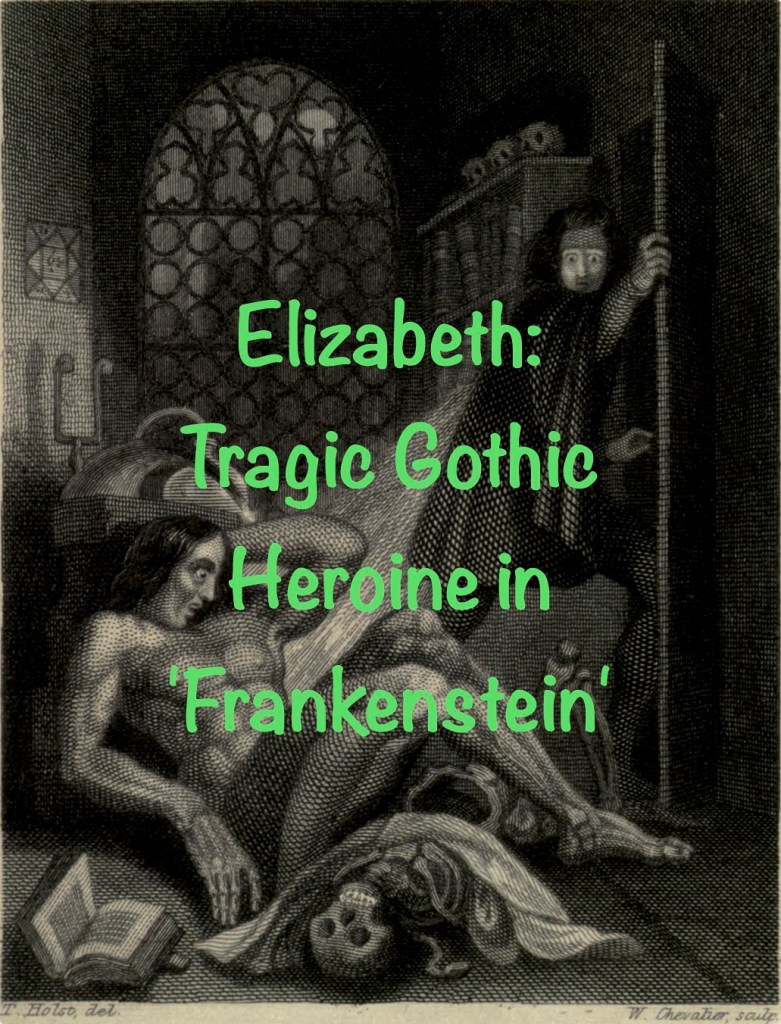
Welcome to day six of Frankenstein Week here at White Rose of Avalon, my Darlings. As this is also this week’s Femme Fatale Friday post, I found it fitting to discuss Elizabeth, the tragic lead female character in Frankenstein, for this post!
Elizabeth Lavenza, who would go on to become Elizabeth Frankenstein, is the cousin of Victor Frankenstein. She is introduced early in the novel, when, as a young girl, she came to live with Victor’s family after the death of her mother. Victor stated that his parents always wanted the two of them to marry from the time they were young. While this seems very strange to a modern audience (the idea of first cousins marrying), it was not really out of the norm at the time of the novel’s writing. As I also mentioned in my post on Victor earlier this week, this idea of first cousins who were raised together marrying is also featured in Jane Austen’s Mansfield Park.
In any case, Elizabeth is described as incredibly loving, caring, and empathetic throughout the novel. It is shown that she had a very special bond with Victor’s mother, and when Victor’s mother passed away, Elizabeth felt her loss as deeply as the woman’s own children did. We can even interpret part of the reason she loved Victor so much, and wanted to marry him as she did, to be because she knew that it was an ardent wish of his mother, whom she had loved so deeply. However, there is no way to know for certain, and we really only see Elizabeth’s story through the recollections of Victor Frankenstein.
What is known, according to the story as Victor told it, is that Elizabeth was beloved by the whole family and was a caretaker to his father and younger brothers after his mother died, loving them all deeply. Elizabeth is shown as very much the heart of the family, who was there when Victor was away studying. One of the points where her intense empathy and compassion are shown is in her belief in Justine’s innocence when the woman was accused of the crime of killing William Frankenstein, Victor’s youngest brother. Justine was a servant who was a great friend of Elizabeth’s, and she could not believe that her friend, who loved William, would do such a thing merely to steal a locket (which was the assumed motive). Of course, Victor believed in Justine’s innocence, for he knew that his Monster had been the culprit, and that the fault lay with him. In fact, Elizabeth’s kind nature is shown even before Justine was accused, as she blamed herself for William’s death because she allowed him to wear the locket in the first place.
Of course, I do have to acknowledge that Elizabeth had a moment of doubt with Justine when the latter confessed to the crime. This caused Elizabeth to feel utterly betrayed, as she had stood by her, but it was all cleared up when Justine explained it was a false confession because she knew she would never be believed. Oh, yes, Elizabeth is a loyal friend, and a kind, empathetic, and intelligent person. In some ways, you could say she is idealized, as we only see her in Victor’s memories. However, I tend to interpret it as the opposite, for Victor would have every reason to paint himself in the best possible light. And within the narrative, he proved time and again that he viewed himself as a victim of the events, even when he presumed to take accountability for creating and abandoning his Monster. Losing Elizabeth was once again his fault, and a reason to be angry with his Monster, as much as with himself. So, no, I cannot see this view of Elizabeth as a truly empathetic and compassionate person, to be simply the case of Victor looking back on her fondly. Firstly, if that were the case, her moment of doubt about Justine would not have been included. Secondly, and most importantly, is the fact that Victor still married Elizabeth.
You see, Elizabeth offered Victor an out of their engagement, worrying that he may not love her the way that she loved him. Instead of taking this out, knowing that the Monster had told him that he would see him on his wedding day, Victor assured Elizabeth of his love, and their wedding went forward. Victor made the assumption that the Monster meant to kill him, as that is what his ego had him believe. Yet, the Monster killed Elizabeth, because this was truly poetic justice for Victor destroying the female Monster he had been working on. Now, neither would know the love of a woman. In many ways, marrying Elizabeth, knowing the danger of his own wedding night, is one of the most selfish things that Victor does in the novel. Even if Elizabeth had not been the one to be killed, she would have had to live with the fact that she was widowed on her own wedding day! The best thing would have been to break her heart in the short term to protect her in the long run, but Victor could not see past his own assumptions, his own hubris, and his own ego to make that choice.
So, yes, this is why I view Elizabeth as so deeply tragic. She was simply caught up in the crossfire between Victor and the Monster. The Monster even expressed true remorse for all of the killings he had done to get revenge on Victor. Yet, with Victor, we see much more anger than remorse. What is possibly sadder is that Elizabeth never knew anything about Victor’s experiments in the original novel. She could not have protected herself because she never knew of any threat. Her worry for Victor was about his health (which was weakened more than once due to the stress of keeping his secret) and his distance. I think this is why many adaptations let Elizabeth in on the knowledge of the Monster. However, this is not always to the character’s benefit. In the Universal films, she knows about the Monster and even survives, but she stood by Henry (as that is what Victor is called in those films), even after he put her in immense danger twice (in the first two films). But in the Guillermo del Toro film, Elizabeth, as played by Mia Goth, meets the Monster and is kind to him, showing a lot of the character as she was originally written. Yes, in the Guillermo del Toro film, all of her intense empathy, compassion, and nurturing are on full display. I would even say that there is added depth in that film of having Elizabeth possessed of so much empathy and kindness that she is even the only one to be kind to a Monster!
Overall, I think that Elizabeth is a wonderful Gothic Heroine, even if she does not survive the tale. She is the heart of her family; she is loyal, she is intelligent, and she is loving. Elizabeth certainly deserved better than Victor, who seemed to only love her because it was expected of him and did not have the emotional integrity to end things to protect her. It truly makes me angry. Yet, that is why she is so tragic!
I hope you have enjoyed my character analysis of Elizabeth from Frankenstein. What do you think of her? Let me know your thoughts in the comments below!
Note on Image: The image at the top of the post is an image from Frankenstein, or the Modern Prometheus (Revised Edition 1831), which I have added text to. I found the art on https://commons.wikimedia.org/wiki/File:Frankenstein,_or_the_Modern_Prometheus_(Revised_Edition,_1831)_006.jpg.

LINK TO AVALONIAN ROSE FAERY MYSTERIES PATREON: patreon.com/AvalonianRoseFaeryMysteries
Further Reading/Watching
- Frankenstein, or the Modern Prometheus by Mary Wollstonecraft Shelley
- Frankenstein (1931)
- Bride of Frankenstein (1935)
- Frankenstein (2025)