
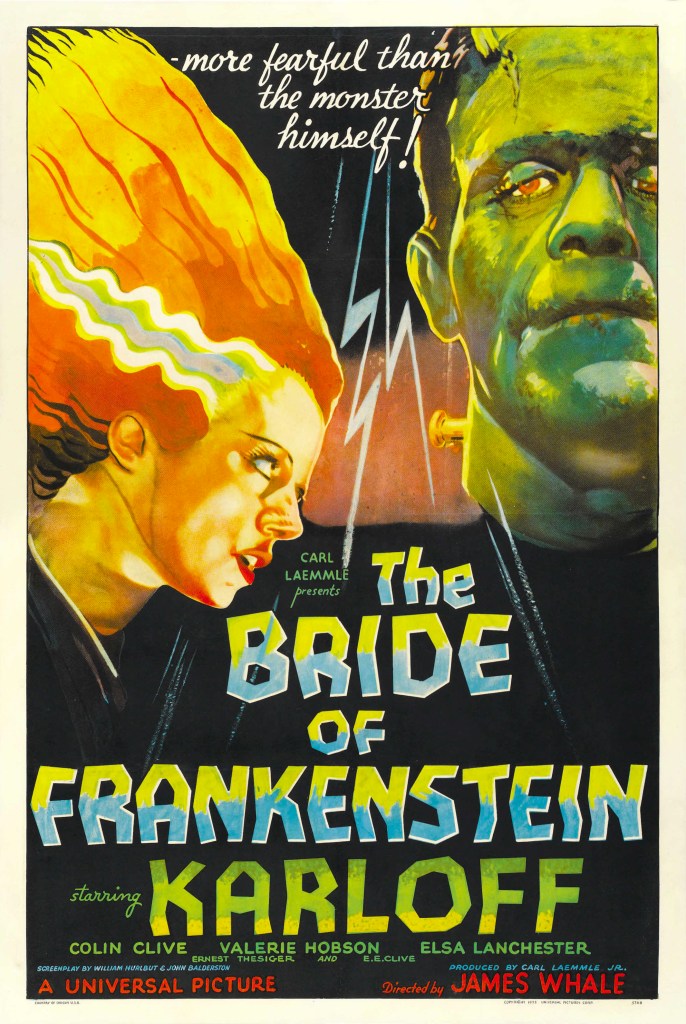
Welcome to day five of Frankenstein Week here on White Rose of Avalon, my Darlings. For today’s post, I will be discussing why I think that Bride of Frankenstein is truly the ultimate Universal Monster film! You see, this has been my favorite of the Universal Monster films since childhood, and none of the others (as much as I adore many of them) could ever change this opinion. So, let’s get into why!
Even beginning with the credits, this film sets the stage. As the opening credits take the time to specify that the novel was written by Mary Shelley in 1816, in a reference to the famed ‘Year without a Summer’ that birthed the tale, as well as John Polidori’s The Vampyre. Of course, those familiar with the novel know that it was not originally published until 1818. Yet this sets the perfect tone going into the opening scene, which features Mary Wollstonecraft Shelley, Percy Shelley, and Lord Byron discussing her novel, but more on that later. There is one other element of the credits that I need to highlight, and that is the choice not to credit the character of the Monster’s Mate (as she is called in the credits) with an actress’s name; instead, there is simply a question mark there. Of course, it is well known that Elsa Lanchester played both Mary Shelley and the Bride, but during the original theatrical run, this choice built mystique for the film. As a side note, I want to state that the same concept of an actress playing both the Bride and Mary Shelley is used in the 2026 Maggie Gyllenhaal film The Bride. Jessie Buckley played both the Bride and Mary Shelley, whom the Bride talks to in her head. I really loved seeing that particular homage in The Bride.
Now, as for the first scene with Mary Shelley, Lord Byron, and Percy Shelley, it is a wonderful way to introduce the sequel by explaining that the end of the first film was not the end of the story. This begins with a wonderful overview by Byron to catch up an audience who may not have recently seen the original, as there were four years between the release of the films. This gives Mary Shelley the place to begin narrating the continuation of the story. So, yes, this is one of the most enchanting things that the film does to seamlessly continue the tale.
Next, I want to discuss Dr. Pretorius, as he is one of the most memorable characters in the film, and one invented for the film. Dr. Pretorius is an iconic character and truly an even madder scientist than Henry Frankenstein, to whom he was once a mentor. I do want to note that many people interpret Dr. Pretorius as a gay man, and some even think it is implied that he and Henry were once lovers. This is amplified by the fact that James Whale, the film’s director, was a gay man himself. In fact, he was an openly gay man, which was not common in the 1930s. Of course, we cannot know the intention for sure. However, the fact that this interpretation is seen by many holds merit, whether or not that was the intent of the filmmakers. This is what is meant when the term ‘queer coding’ is mentioned. In fact, when he is introduced, Dr. Pretorius is even called ‘a queer-looking old gentleman’ by Minnie, who was using the then more common use of queer to simply mean strange. But with this interpretation in mind, one may think that perhaps the use of the word queer is a hint from the filmmakers; yet, as I mentioned, there is no outright proof. Either way, this is a very interesting aspect of this film and its appeal to many people! That is all I have to say about this interpretation, as I find it fascinating, but I am not an expert in the subject of queer coding in classic cinema. Now, with that being said, there is so much more I have to say about Dr. Pretorius as a character, so let’s look at him some more.
In many ways, Pretorius is one of the most interesting characters in all of Universal Monster films. After all, it is Dr. Pretorius who actually empathizes with the Monster and suggests creating him a Mate so he is not alone! Of course, much of this has to do with Pretorius wanting to expand his own research and experiments (where he has created miniature beings, perfect miniature humans, who he keeps in jars). It is quite clear that Pretorius is empathizing to get the Monster on his side, but it is still one of the very few times the Monster is treated kindly.
Now, I want to share some of my thoughts about Dr. Pretorius’s experiments kept in jars. These experiments are really fascinating, and I love that the Queen and King are obviously inspired by Anne Boleyn and Henry VIII. As a side note, interestingly, Elsa Lanchester’s husband, Charles Laughton, played Henry VIII in The Private Life of Henry VIII in 1933, a film in which Elsa herself played Anne of Cleves. So, could this have been a reference to that? I am not sure, but I have always thought so, being such a huge fan of history and classic films. Oh, and I cannot write about Pretorius’s experiments without mentioning that another of his creations is a Mermaid. So, he clearly can create many forms of life; only he does so on a small scale. That is why he reached out to Henry about creating a Mate for the Monster. Pretorius himself had not created a life-size human before.
I have to say that I truly believe that this is a sequel that is better than its original! In my opinion, the choice to shift the focus to the Monster and Dr. Pretorius, who is so engaging and entertaining in his Mad Scientist villainy, was an inspired idea. I also have to note that side characters, like Minnie and her constant fear and screaming, are memorable too. However, one of the things that truly made this film extra special, and more akin to the novel, is that the Monster speaks in the film! This was a bit controversial, given how he was portrayed in the first film, but it works. This shows his growth and some of what he has learned, even if he is never as well-spoken as the novel’s Monster!
Some other things that bring some of the novel’s elements into the sequel include that Elizabeth mentioned that she had been told to beware her wedding night, which is a reference to Victor being told the same in the novel. This line is spoken when Elizabeth has seen that her fiancé, Henry (as he is called in the film), had nearly been killed by his Monster. Another aspect that harkens to the novel is the film’s iconic scene in the blind man’s cottage, which is a direct reference to the Monster in the novel seeking to build a relationship with the blind father of the family he observed and helped. I have to say that I adore seeing how much the Monster grows in this film, even when he is manipulated by Dr. Pretorius, who, as I stated above, empathized with him to get the Monster on his side. After all, we see that his emotional intelligence is still on full display. He truly only ever wanted love and companionship, and he was willing to help Pretorius to get that.
Seeing the Bride’s utter horror and fear of the Monster when she is first brought to life is tragic. I have feelings of sadness for the Monster not being loved by even one like himself, and I feel sadness for the Bride who was created only to be the Mate of one she ended up fearing. As I noted, the Monster is given a lot of emotional intelligence in the end, as he decided to let himself, Pretorius, and the Bride burn, as he believed that they were hopeless. Henry Frankenstein and Elizabeth are allowed to escape, in a call to the empathy the Monster showed to Victor in the novel’s end when he mourned the death of his creator and expressed his remorse at all the evil he had done in seeking vengeance. We also see the Monster’s desire to help, even while he is hated throughout the film. This nicely mirrors the Monster’s plight in the novel, only wanting love but getting hatred instead, and that hatred is truly what caused him to enact the horrific events of the novel. It should also be noted that the Monster does not seek to hurt people for the majority of this film, and is much more likely to show violence when he is defending himself. After all, as I have stated multiple times (but feel I need to say again), he only really wants love and compassion, which is why having a Bride, a Mate, a woman like himself, appeals to him so much.
So, in conclusion, overall, I always feel so much empathy for the Monster in this film, just as I do when I read the novel. Both are abandoned and want love, and both are hated by most people they know. In the Universal films, the Monster is sweet and innocent in the beginning, and finally learns a lot quickly in this sequel film. Dr. Pretorius is a truly Mad Scientist with his own motives, but he was still the only one to show kindness to the Monster (knowing who and what he was, unlike the blind man who did not know the Monster was not human). That fact adds complexity to Pretorius’s character.
I hope you have enjoyed reading my analysis of Bride of Frankenstein. Who is your favorite character in the film? Let me know your thoughts in the comments below!
Note on Image: The image at the top of the post is the original film poster. I found the art on https://commons.wikimedia.org/wiki/File:The_Bride_of_Frankenstein_(1935_poster).jpg.

LINK TO AVALONIAN ROSE FAERY MYSTERIES PATREON: patreon.com/AvalonianRoseFaeryMysteries
Further Reading/Watching
- Frankenstein, or the Modern Prometheus by Mary Wollstonecraft Shelley
- Frankenstein (1931)
- Bride of Frankenstein (1935)