
Welcome to day four of Frankenstein Week here on White Rose of Avalon, my Darlings. For today’s post, I will be exploring how earlier literature, like Milton’s Paradise Lost, influenced Mary Shelley when writing Frankenstein!
So, let’s begin with a little background on the author. Mary Wollstonecraft Shelley was born Mary Wollstonecraft Godwin, daughter of the writers Mary Wollstonecraft and William Godwin. Of course, it is well known that Mary Wollstonecraft died of complications from childbirth just days after her daughter was born. This meant that the author we know best as Mary Shelley only ever knew her mother through the latter’s written works. It also meant that Mary Shelley, as I will refer to her throughout this post to avoid confusion, was raised around great works of literature, philosophy, history, and other intellectual writings. So, it should be of little surprise that so many of those inspirations found their way into references in Frankenstein.
A quote from Paradise Lost by John Milton is featured at the very beginning of the novel. Beyond that, there are many references to Paradise Lost throughout the novel, which I will discuss later in this post. Yet, the very first reference we have is actually in the full title of the novel, and it is a Greek myth reference. The novel’s full title is Frankenstein, or the Modern Prometheus. Prometheus was a Titan who was punished by Zeus for gifting humanity with fire, and this story was a popular topic in literary circles at the time when the novel was written. Percy Bysshe Shelley also had a poem (actually a four-act lyrical drama, to be precise) entitled Prometheus Unbound, which dealt with the myth, and was first published two years after Frankenstein. The reference in the novel’s title can be said to refer to Victor Frankenstein’s experiments that could change humanity, but also caused him great punishment in his life. It can also be interpreted to mean that just as Prometheus was unjustly punished by Zeus, Victor viewed his own punishment by the Monster as unjust.
Early on in the novel, in the letters that Walton is writing to his sister, there are references to Samuel Taylor Coleridge’s The Rime of the Ancient Mariner, which will also be referenced throughout the text. These further references include an excerpt of the poem featured in one chapter. The references to The Rime of the Ancient Mariner are not surprising, as the poem would have been familiar to many with an interest in literature of the day, making it an obvious reference to make.
Then, once the narrative is from Victor’s point of view, recounting his own story, there are early sections discussing his childhood and adolescence. This is where his fascination with the famed Alchemist, Heinrich Cornelius Agrippa, is discussed. Victor described being absolutely enthralled with the writings of Agrippa, as well as another famed Alchemist, Paracelsus, and the medieval German philosopher and theologian, Albertus Magnus. Of course, when Victor went to study at University, he left behind the works he had loved, realizing that their scientific principles were outmoded in the modern day in which he lived. This shows that Mary Shelley knew of the current scientific advancements being made in her own day, as well as the history of Alchemy and philosophy, which obviously makes sense, given that the horror of the novel is rooted in a misuse of science!
Toward the middle of the novel, another poem is also excerpted, and that is Percy Bysshe Shelley’s On Mutability. The use of a poem by the man who would soon be her husband, as he was only her lover at the time of writing the novel, is another obvious reference to Mary’s love of literature and the literary circles in which she lived. Another reference to a poem by a poet that Mary Shelley knew well is to Child Harold’s Pilgrimage by George Gordon, Lord Byron. Of course, it was on a holiday with Byron, Shelley, John Polidori, and her stepsister Claire Clairmont, in Geneva, Switzerland, that Mary Shelley famously first began writing Frankenstein. So, this reference may even be seen as an homage to the famed ‘Year without a Summer’ that birthed both Frankenstein and John Polidori’s The Vampyre. I would also like to note that there is at least one reference to Dante, whose seminal work The Divine Comedy begins with Inferno, and the Nine Circles of Hell certainly relate to some of the emotional threads in the novel, making this another apt reference.
However, the most important literary references come when the Monster relayed his story to Victor. For we learn the Monster learned to read by finding three French translations of books. They are a volume of Plutarch’s Lives, The Sorrows of Young Werther (spelled as Werter in the 1818 edition of the novel, which is the one I reread), and of course, Paradise Lost. The Monster explained what he learned from each book, citing that from Plutarch he learned ‘high thoughts.’ From The Sorrows of Young Werther by Johann Wolfgang von Goethe, he learned about despondency and gloom, which had a large impact on his emotional awareness. Yet, the book that had the most impact on the Monster was definitely Paradise Lost by John Milton. The Monster confessed that early on, he wanted to relate to Adam, but Adam was a son beloved of his creator, and the Monster was an abandoned son. So, as he read, he found that he related more and more to Lucifer, to Satan, and the plight of the fallen angel who would become a demon, the very ruler of Hell. It is clear that there are parallels between the story of Lucifer in Paradise Lost and the Monster, so it is of little surprise that Mary Shelley stated this outright. She gave a voice to her Monster by allowing him to use what he had learned from literature, from the true magic of the written word, to express how he viewed the world. I think that is what makes Frankenstein so much more than a Gothic Romance and horror novel, so much more than what is considered the first science fiction book, to be truly a love letter to literature and books! This aspect of the novel has always spoken to me, as a lifelong lover of reading, for yes, we can learn and express so much through our relationships with literature.
I hope you have enjoyed this breakdown of some of the best literary references in Frankenstein. Of course, I am not sure if I even got them all, given how densely packed the narrative is with references. I was helped greatly in writing this post by some footnotes in the Intervisual Books Classics edition, to aid me in making sure I had mentioned the references I saw in my most recent reread of the novel. Then I fleshed out the list of references with my own thoughts and analysis. Please do let me know of any literary references in Frankenstein that I may have missed. What are your favorite references in this novel? Let me know your thoughts in the comments below!
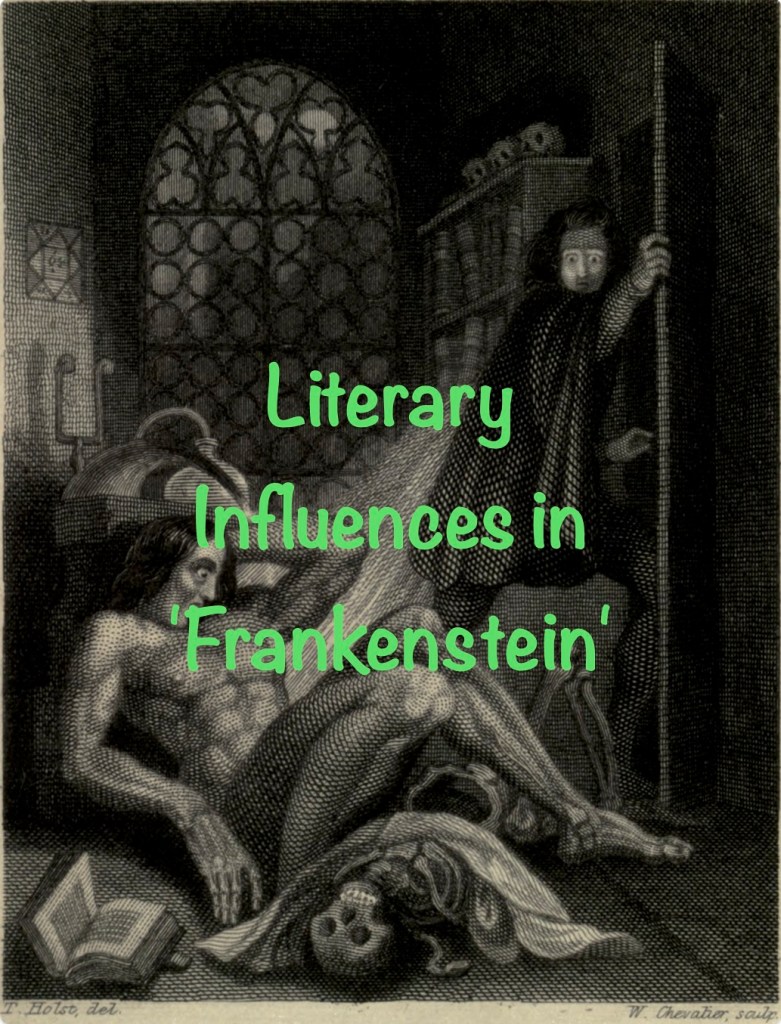
Note on Image: The image at the top of the post is an image from Frankenstein, or the Modern Prometheus (Revised Edition 1831), which I have added text to. I found the art on https://commons.wikimedia.org/wiki/File:Frankenstein,_or_the_Modern_Prometheus_(Revised_Edition,_1831)_006.jpg.

LINK TO AVALONIAN ROSE FAERY MYSTERIES PATREON: patreon.com/AvalonianRoseFaeryMysteries
Further Reading
- Frankenstein, or the Modern Prometheus by Mary Wollstonecraft Shelley