
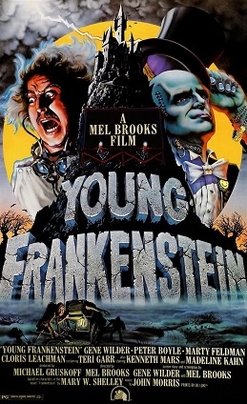
Welcome to day two of Frankenstein Week here on White Rose of Avalon, my Darlings. For today’s post, I will be discussing the iconic Mel Brooks parody film, Young Frankenstein.
I have loved this film forever, to be honest. It is my favorite Mel Brooks film and my favorite Gene Wilder performance. It is goofy and over-the-top, and it is exactly how to do parody right. You see, in my opinion, in order for parody to be done properly, there has to be a love for that which you are sending up. It is clear that there was so much love for the old Universal Monsters films, and for the source novel, put into this film. It is this love, and an understanding of the source materials, that makes this parody film shine. This is shown in so many ways, but one of the most obvious was the choice to make the film in black and white to keep with the aesthetic of the Universal Monster films, and having the setting be in Transylvania also conveys this (as most Universal Monster films are set there, even though the Frankenstein novel takes place largely in Geneva and Ingolstadt).
In many ways, this film reads as a ‘What if Dr. Frankenstein actually loved his Monster instead of abandoning him?’ meets a ‘What if we combine sex comedy energy and lots of innuendo with classic literature?’ And it works. You have full scenes that are obviously calling back to the first two Universal Frankenstein films, with the scene with the little girl (who is totally safe in this version) and the scene in the blind man’s cottage being played for laughs. The serious is made satirical, which is what parody does, as it relies on the assumption that you, as a viewer, are also in on the joke. Which is why this film is much funnier if you know your Universal Monsters films, and also if you know your Mary Wollstonecraft Shelley!
However, I have to also note that there is so much heart here. You get to see Gene Wilder’s Frederick Frankenstein come to terms with his ancestral legacy as the grandson of Baron Victor von Frankenstein (as he is called in this film), and truly give in to the Mad Scientist archetype. Yet, in doing so, he does not make the same mistakes that his predecessor did, for he is not the Victor of the novels or the Henry of the films (as Victor is called in the Universal films). You see, this is part of the beauty of the running joke of him wanting to be called ‘Frokensteen’ to distance himself from his legacy, until he bonds with his Monster and fully embraces his name. Yes, Frederick goes mad with the power of creation, but he is also there to teach his Monster, and even goes so far as to give some of his own intellect to the Monster to balance out his abnormal brain! That is why I tend to view this film as a light-hearted look at what could have been if Victor Frankenstein of the novel had possessed a bit more empathy and compassion.
Other things that make this film stand out include the way references to the source materials are made. For instance, Frederick’s fiancée is named Elizabeth, just like Victor’s eventual wife in the novel. However, she does not possess the empathetic and loving nature of the novel’s (and the Universal film’s) Elizabeth, as she is shown as a spoiled rich girl. The more nurturing and empathetic qualities of Elizabeth in the novel are given to the character of Inga (played to perfection by Teri Garr). So, we can almost say that they have sort of split the character in two. At least that is until Elizabeth gets together with the Monster, has a sexual awakening, and becomes the Bride of Frankenstein figure in this film! That leaves room for Inga to be the one to happily marry Frederick in the end. Then there are the characters of Igor and Frau Blücher, who are based on the Universal film characters of Fritz from Frankenstein (1931) and Minnie from Bride of Frankenstein (1935), respectively. Marty Feldman’s portrayal of Igor is wonderful, and interestingly, as I noted, he was based more on Fritz, as he also works for the Frankenstein who is building a Monster, but is given the name of a character in later Universal films (who was played by Bela Lugosi). Cloris Leachman truly gives Frau Blücher a manic energy of chaos that amplified the Minnie characterization, but she did not have to add much chaotic energy, as the character already had so much of it in the Universal film.
As for how the film honored Mary Shelley’s original novel, the most obvious thing was restoring the name of Victor to the Frankenstein character who had created a Monster in the past. It would have been easy to use the name of Henry, as had been established in the Universal films, which served as a huge inspiration to the comedy here, but that small thing really makes me happy as a Mary Shelley fan. Beyond that, the fact that Frederick’s character reads to me as a more empathetic and less hubris-filled version of Victor from the novel, which allowed the Monster to be shown love, truly seems to be honoring the message of Shelley’s novel. After all, from the Monster’s perspective, the novel is about the pain and trauma that is caused by desiring love and being denied it from everyone, and how that could make you do horrible things. Beyond that, there is the scene where Frederick bonds with his Monster, after fearing him. He told his Monster, ‘You are not evil. You are good.’ And then he continued by stating, ‘Together, you and I are going to make the greatest single contribution to science since the creation of fire’, which I have always seen as a reference to the novel’s subtitle, “the Modern Prometheus”. As in Greek myth, Prometheus was punished after he gave fire to humans.
At the end of the day, I love this film because all of the characters are lovably weird, and it is such a fun and very hilarious take on the source material. I hope you have enjoyed reading my thoughts on Young Frankenstein and how it worked with its source materials, both the original novel and the classic Universal films, to create a wonderful parody. What do you think of this film? Let me know your thoughts in the comments below!
Note on Image: The image at the top of the post is the original film poster. I found the art on https://en.wikipedia.org/wiki/Young_Frankenstein.
LINK TO AVALONIAN ROSE FAERY MYSTERIES PATREON: patreon.com/AvalonianRoseFaeryMysteries
Further Reading/Watching
- Frankenstein, or the Modern Prometheus by Mary Wollstonecraft Shelley
- Young Frankenstein (1974)
- Frankenstein (1931)
- Bride of Frankenstein (1935)