
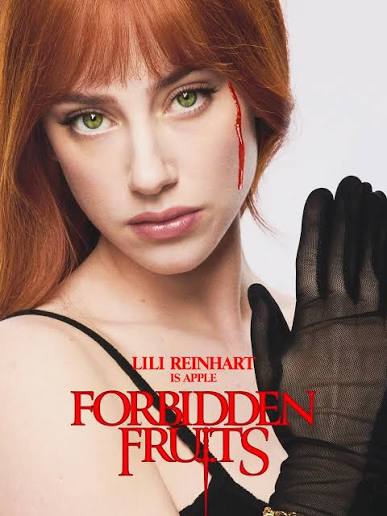
Welcome back to White Rose of Avalon, my Darlings. For today’s Femme Fatale Friday blog post, I will be discussing the character of Apple from the film Forbidden Fruits! So, given this is a character analysis post, there will be plenty of spoilers for the film.
I truly love this new horror film, which was released earlier this year. I first got the chance to watch it over the Summer when it was released on Shudder, as none of my local theaters had the film during its limited release theatrical run. Of course, I also rewatched the film to get into the Season of the Witch energy back in September, and to take notes for a future blog post. You see, I did not know how I would approach writing about this film at first. I was uncertain if I wanted to approach this as just a Magical Media Analysis of all of the Biblical and Occult references that make this film so witchy, or if I should focus on a specific character. Clearly, I chose the latter, because Apple is a character I personally think will eventually become a Witchy Horror Icon, à la Nancy Downs from The Craft. In fact, this film often gets compared to both The Craft and Mean Girls in how it approaches its horror comedy plotline. I can definitely see where those comparisons come from, after having seen the film.
Now, let’s finally get onto looking at Apple as a character! Apple is the first character we meet as the film opens, seeing her in her car, which has a custom license plate referencing Lilith (the first Biblical reference of literally dozens). She seems to be flirting with a man in the car next to hers, whom she deemed to be a pervert (he was masturbating), so she poured her hot latte on his lap! Already we can see that she is someone who does not suffer fools. It really does set the tone right out of the gate that this film is all about feminine power. Before long, the audience is introduced to ‘The Fruits,’ Apple and her other friends who work at the store named Free Eden, obviously another Biblical reference. Besides Apple, there is Cherry (known to be the sexually aggressive one) and Fig (who is much more logical, with a degree in astrophysics and is saving to go to grad school). Their introduction is done very much in the light of ‘The Plastics’ from Mean Girls, with the mall food court being used instead of the school cafeteria. It is here that Pumpkin is introduced, the new girl to enter the group (currently working at the pretzel stand, soon to work at Free Eden). She is clearly the audience insert character, who comes into this world, a la Sarah Bailey or Cady Heron, to reference the two films this one is often compared with.
Yes, the vibe really does feel as if The Craft and Mean Girls were intertwined, but with a lot of thought put into theming this with witchcraft and Biblical references, marking the film as truly its own. Oh, and there is also a vibe that reminds me of Jawbreaker, in some ways. However, it should be remembered that these characters are older than the ones in any of those films, as they are not in high school, which adds a different energy to the film as well.
Back to the plot of the film, Apple is quickly convinced to hire Pumpkin; after all, it is perfect that she has a fruit name, as they all do. Plus, they can complete their retail season cycle because she is a fruit that peaks in Autumn, just like Apple peaks in Winter, Cherry peaks in Spring, and Fig peaks in Summer. This is explained the first time Pumpkin joins a Paradise (what they call a coven meeting, and yet another Biblical reference). I love this whole idea, as it is a breakdown of the four seasons instead of the four directions as used in The Craft, but still retains the same energy of them finding their complete circle. It is also at this first meeting that Pumpkin sees how they do magick, with Apple asking Pumpkin, ‘What is your definition of a witch?’ In her reply, we get an answer that included a Nicole Kidman reference, which makes me happy. Then Apple clarified that their magick is not what you see on everyday WitchTok: she has studied the Occult, Alchemy, and Astrology. This certainly explains all of the Biblical references thrown in even more, given that Apple would have found that a lot of old Alchemical and Occult texts include plenty of Christian elements, as that is how those working in these fields often avoided persecution back in the day, by integrating their practices with the dominant religion.
This first Paradise meeting is rife with plot threads that will carry throughout. It is also during the meeting that they introduce Pumpkin to Shine Theory, women building one another up and not dulling their shine. Plus, we get to know how they practice a form of Ancestor work, or Saint Veneration, as they do confessions in the store changing room into the mirror. They confess to Marilyn Monroe, who here is seen as a type of Pop Culture or Folk Saint, or a Pop Culture Ancestress. This is a real thing that is done in some witchcraft circles, and as a huge Marilyn Monroe fan, I adore this inclusion! Apple calls her ‘The Ultimate Femme Martyr’ and instructs Pumpkin to call her by her stage name. Later, at the climax of the film, we hear the idea of a snake amongst them (another Biblical reference that has been used throughout) is used interchangeably with JFK, as Apple states that the government and JFK had Marilyn killed. The utter consistency with the writing and references in the film is really incredible.
Over the course of the film, we see that although Apple wanted to portray herself as a woman who uplifts other women, and even calling herself an empath, what she seems to want most is power. She seeks to control Cherry’s life and sexuality (she cannot have sex on Wednesdays when she is supposed to go to therapy, but sneaks out to have sex with strangers in the mall anyway). The Wednesday choice is clearly another Mean Girls reference. Apple also helped Cherry get sober, as she viewed Cherry’s promiscuity and drinking as something that was derailing her life, and maybe it was, but the audience mostly sees Apple’s manipulation. It is interesting to see how, in this instance, you can see both sides, as Cherry definitely seems to need help, but Apple is definitely not just looking to help her. Apple also insisted that they only communicate with men through emoji texts, which impeded Fig’s relationship with a man named Norman. So, that is how Fig rebelled, being with Norman. Both of these secrets, Cherry’s sexual escapades and Fig’s relationship, get discovered by a spying Pumpkin.
It had already been made clear that Pumpkin was up to something, given many phone calls with her mother and her buying a doll with a camera to spy on the store. The discovery of Fig’s relationship also gave Pumpkin the information on the previous store employee, Pickle, who was put in a mental hospital after her boyfriend’s death. She had been Apple’s mini-me (her mentee), and she had abandoned them largely for this boyfriend. So, Apple had told them they were performing a hex on a snake that needed to be punished, but not who, and he ended up in a coma! This leads into history repeating itself, when Pumpkin had reached out to the store manager, Sharon, who Apple hated (as Sharon was installed after this issue with Pickle). The rest of the group thought that Sharon was picking on Pumpkin and that she might get fired, so Apple suggested another hex. That is how, yet again, they had a Paradise meeting after hours in the store, as that is where they meet. Another hex was placed, and this time, Pickle killed herself.
Of course, Apple made the excuse that Mercury was in retrograde, so the hex misfired. All of this is the lead-in to the climax of the film, which sees Pumpkin seeing a recording of Cherry (who believed herself Apple’s best friend) confessing to her own issues involving the loss of her family and that she knew Apple had killed her own father. Paranoia mounted from there, with Pumpkin faking being poisoned by Apple (by drinking coffee, which had been established to make her sick), Apple trying to force them into more dark magick, and Cherry taking an axe to Norman (who oddly survived but broke up with Fig). It is also revealed that Fig lied about her name; her real name is Emily, and after all of the chaos, she sought to leave for grad school.
It only ramps up from there, with both Cherry and Fig meeting dramatic ends. That is not even Apple’s doing, as it is more an issue of being stuck in a mall during a tornado, which caused the escalator to malfunction (and Cherry’s own nails to work against her); she got chewed up by it in grotesque fashion. Fig got killed by falling glass due to the storm, also very brutal. That is when Apple calmly suggested to Pumpkin that they wash off in the fountain. All the rest is revealed, piecing it all together, the reason why Apple seemed to have a fondness for Pumpkin. They are half-sisters; it is implied that their father was a bigamist, as both state he was married to their mother, and Apple said that he abandoned one family to starve while helping the other. There is also implied abuse, as Apple seemed to think poisoning him would save her mother, but then her mother kicked her out, so she lived out of her car during the duration of the film! However, Pumpkin stated that her father was her best friend and she was shocked he had been unfaithful to her mother. Apple always knew she had a sister, but Pumpkin only found out shortly before he was killed. This was the reason Pumpkin sought to strike out against Apple; it all boiled down to revenge. Of course, when Pumpkin confronted Apple. The confrontation ended with Apple killing her by strangling and drowning her in the fountain! It is dramatic, and it is violent (the whole climax is). However, there is a real sense that if Pumpkin had not sided with their dead (and, in Apple’s view, abusive) father, Apple would have welcomed her back into the fold.
After all of this, Apple drove out to another state, left Texas, and went to Arizona, finding another mall. One where a new Free Eden is about to open, one where it will be run by women with flower names, who hold the same sway the Fruits once did. After all, Apple is a fruit, but the tree holds blossoms, so she is a flower too. So, the cycle can repeat: more carnage, more chaos, more Poisoned Apple antics.
So, yes, Apple is wicked and does evil things, but she is also arresting and interesting. There seems to be a very skewed and twisted sense of justice in how she behaves. This makes her an utterly fascinating character, played to perfection by Lily Reinhart! I hope you have enjoyed this film and character analysis. Who is your favorite Fruit? Let me know your thoughts in the comments below!
Note on Image: The image at the top of the post is one of the film posters of Apple. I found the poster on https://www.instagram.com/p/DTvXaxTAAEY/.
LINK TO AVALONIAN ROSE FAERY MYSTERIES PATREON: patreon.com/AvalonianRoseFaeryMysteries
Further Watching
- Forbidden Fruits (2026)
5 responses to “‘Forbidden Fruits’: A Truly Poisoned Apple”
What a fantastic analysis, Maranda! I absolutely loved reading your deep dive into Apple and Forbidden Fruits. You captured so perfectly why she’s such a compelling character—that twisted sense of justice and the way she sees herself as the hero of her own story, even as she’s manipulating and destroying the people around her.
Your comparison to Nancy Downs from The Craft is spot-on. There’s that same magnetic, dangerous energy—a woman who has been hurt by the world and has decided to take her power back by any means necessary, regardless of who gets caught in the crossfire. The Mean Girls parallels are brilliant too, especially with the “Plastics” dynamic and the Wednesday therapy sessions. It’s that perfect blend of camp and genuine horror.
I also really appreciated you highlighting the Marilyn Monroe ancestor work and the Shine Theory. It shows that Apple genuinely understands these powerful concepts of feminine empowerment and mutual support, which makes her eventual betrayal of those very principles all the more tragic and chilling. She built a coven on the foundation of lifting women up, but her need for control corrupted it into a system of domination.
As for my favorite Fruit, it’s a tough call! Cherry’s chaotic, self-destructive energy is so tragic, and Fig’s logical, grounding presence was much needed in the group. But I think I have to give it to Pumpkin. She’s the audience surrogate, the innocent who gets pulled into this glamorous, witchy world, only to discover the rot at its core. Her journey from wide-eyed newcomer to vengeful half-sister is the dark heart of the film.
Thank you for this wonderful post! It’s made me want to rewatch the film immediately and pick up on all the details you mentioned. I’m already looking forward to your next Femme Fatale Friday!
I am delighted that you enjoyed my analysis! I agree that she genuinely understands mutual support and, yes, it makes her betrayal of this truly tragic. I can totally understand loving Pumpkin the best, as they are all compelling, but we kind of live in the shoes of the audience surrogate in these types of films, allowing us to empathize with her. I am also glad I inspired you to rewatch the film! It’s truly wonderful, and there’s so much there to dig into. As always, thanks for reading and commenting! 🍎 ✨
🌹🤝
This film seems promissing, thanks for the tip!
It seems that Apples embodies a kind of Nemesis vibe, preying on weaknesses and fears. In this sense, she is the real snake, tempting and consuming others. It’s more like the archetype of the Angel of Death itself. So she is not free at all, she is bound and confined by the very same energy she embodies. IMO that is, I may be wrong.
I am always glad to make a good film recommendation! And, I can definitely see that interpretation of her character. There’s so much depth to the way the film is structured (and honestly very well written). So, over multiple rewatches, I think it would be easy to unpack multiple interpretations of the characters, especially Apple as primary antagonist! As always, thanks for reading and commenting. 🍎 ✨