
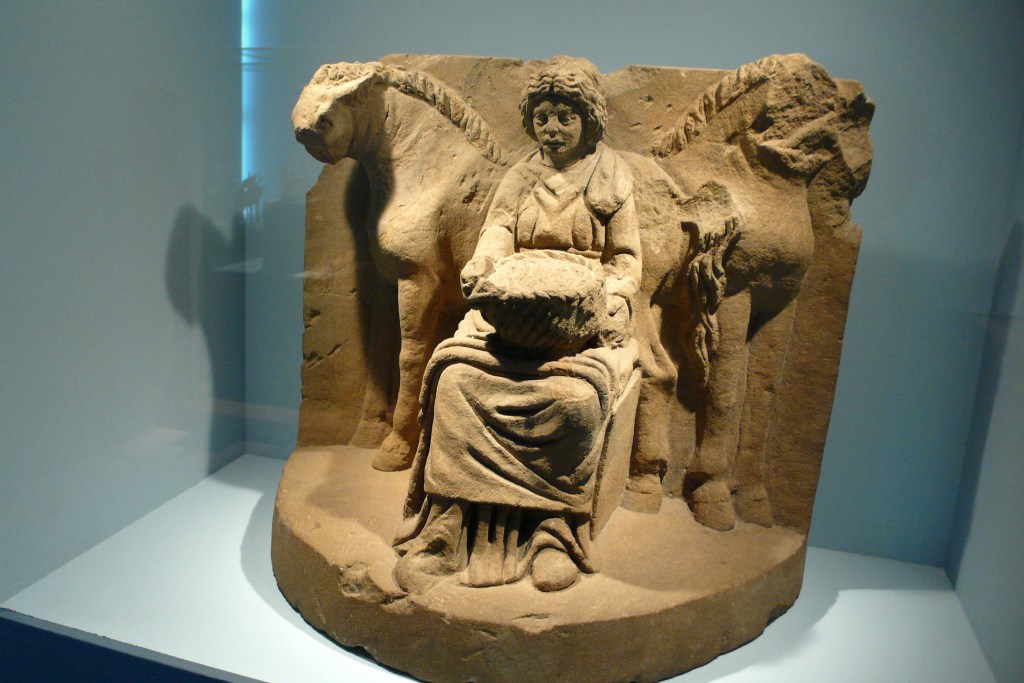
Welcome back to White Rose of Avalon, my Darlings. For today’s Femme Fatale Friday blog post, I will be discussing Horse Goddesses as Sovereignty figures. In particular, I will focus on Rhiannon, Epona, and Aine.
Each of these Celtic Horse Goddesses holds ties to a specific Celtic land. Rhiannon is a Welsh Celtic Goddess, Epona is a Gaulish Celtic Goddess, and Aine is an Irish Celtic Goddess. So, we see that Horse Goddesses were worshipped throughout the Celtic world. There is something just so visceral about the image of a beautiful woman riding on a horse, or of a beautiful woman transforming into a horse. Beyond the beauty of the image, we also have the fact that there was a link between the Horse Goddess and granting the King his right to rule. You see, horses were seen as intimately linked to Sovereignty, largely due to the fact that these animals could be ridden out into war.
It really is of little surprise that we see stories like Rhiannon’s, where she is first encountered by Pwyll while riding her shining white mare and clothed entirely in gold. The image of Pwyll riding after Rhiannon, desperate to catch her, and finally asking that she stop, is iconic. It is so easy to imagine in the mind’s eye Rhiannon pulling aside her Golden Veil and introducing herself to Pwyll. The story of their marriage is a mythic version of practices that Celtic Kings would likely have participated in. The Sacred Marriage of the King and the Sovereignty Goddess, the King and the Divine Mare. There is even a rather unsettling account of how the King marrying the mare may have happened by Gerald of Wales. In this account, it is stated that in Cenél Conaill (which is modern-day Donegal, Ireland), the King would perform a ritual that would cement his rulership of the land. He would begin by publicly having intercourse with a white mare; then the horse would be sacrificed; after that, the horse meat would be boiled, and the King would bathe in the broth; and finally the King and his Court would eat the horse meat and drink the broth. As you can see, rituals like this are clearly inspired by stories of Kings marrying Horse Goddesses to cement their right to rule. Of course, the ritual above takes the idea of Horse Goddesses providing Sovereignty to a really basic level, using the sacrifice of the mare to grant the Sovereignty. I know that the Gerald of Wales account is rather unsavory, but it is an important historical account of the link between Horses and Sovereignty motifs.
The fact that this particular tradition is of Irish origin, according to the Gerald of Wales account, could very well be a link to Aine as a Horse Goddess, or even Macha (one aspect of the Morrigan) who is also an Irish Horse Goddess. Aine certainly has deep ties to Sovereignty, with her name being found in the land, like Cnoc Aine, or the Sacred Hill of Aine, which is in the modern day spelled as Knockainey. Aine is said to be capable of transforming into a Red Mare, named Lair Derg. This ability shows her as a Goddess of Transformation, as well as of Sovereignty. It is no surprise that Aine is one of the most celebrated Goddesses in Ireland, with the height of her celebrations taking place at Midsummer, as she is a Sun Goddess as well as a Sovereignty Goddess. As for Macha, her story is very sad, with her being forced to race against horses while heavily pregnant, which leads to a curse being placed on all of the men of Ulster.
Finally, I want to touch a bit more upon Epona. She is known as a Goddess of the Land, associated with prosperity. She is often depicted with a cornucopia for this reason. It is no surprise that she would be so linked with Rhiannon by many, given that Rhiannon also has deep ties to the Sacred Landscape, prosperity, and fertility! In fact, all of the Goddesses discussed in this post have this in common. This shows even more common motifs amongst Horse Goddesses. It is believed that Epona, specifically, was likely one of the most popular Goddesses for the ancient Celts. Even the Romans did not change her name, or syncretize her with one of their Goddesses, showing the massive amount of respect they had for her!
So, yes, the Horse Goddesses of the Celts are almost invariably Sovereignty Goddesses. I hope you have enjoyed learning a bit about these powerful Goddesses. Who is your favorite Horse Goddess? Let me know your thoughts in the comments below!
Note on Image: The image at the top of the post is a famous German statue of Epona, circa 200 AD, held at the Historic Museum of Bern. I found the photo on https://commons.wikimedia.org/wiki/File:Celts_-_the_horse_goddess_epona_(4121249698).jpg.
.jpg)
LINK TO AVALONIAN ROSE FAERY MYSTERIES PATREON: patreon.com/AvalonianRoseFaeryMysteries
Further Reading
- The Mabinogion translated by Sioned Davies
- Rhiannon: Divine Queen of the Celtic Britons by Jhenah Telyndru
- Celtic Myths & Tales: Anthology of Classic Tales forward by Jake Jackson
- Encyclopedia of Spirits by Judika Illes
- https://www.persee.fr/doc/ecelt_0373-1928_1987_num_24_1_1847
- https://feminismandreligion.com/2016/06/29/epona-goddess-of-the-land-by-deanne-quarrie/
2 responses to “Horse Goddesses & Sovereignty”
I would invite you though to explore the meaning of the horse. When there are items or animals associated with Gods, usually they encode a deeper message, which prove to be crucial in understanding the God’s Function and Nature.
Yes, that is true. Horses as animals were deeply tied with Sovereignty in Celtic culture and mythology, as I explored in the post. Thanks for reading and commenting!