
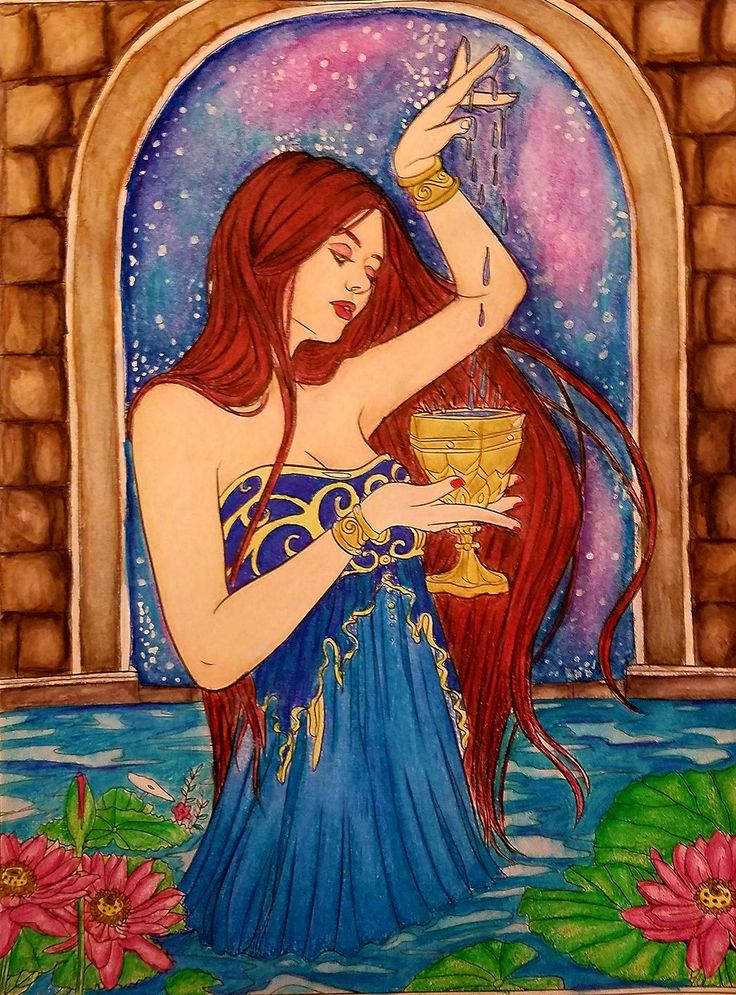
Welcome back to White Rose of Avalon, my Darlings. For today’s Femme Fatale Friday blog post, I am discussing Coventina! I have long been fascinated by this Goddess worshipped by the Celts, and I am excited to write about her today.
Coventina’s Sacred Site was a Shrine at Carrawburgh River on Hadrian’s Wall. This is where her Spring and Well were located, making it a popular site in the late second and early third centuries. There is even evidence to suggest that Devotees of Coventina attempted to hide her Shrine by placing building stones over the Well in order to protect it.
Coventina is classified as a Mermaid by Judika Illes in her book Encyclopedia of Spirits. This classification truly gets at the heart of the magick of Coventina as a Water Spirit and Goddess, and it serves as a reminder that not all Mermaids are associated with the Sea, with several being tied to Sacred Wells. In fact, this is an aspect that Coventina shares with my beloved Melusine!
Coventina was called upon to heal illnesses and restore fertility. She was venerated by the ancient Romans as well as the Celts during the Roman occupation of Britain. The Romans syncretized her with Minerva, which is an aspect that Coventina shares with another important Celtic Water Goddess, as Sulis was also syncretized with Minerva! It is interesting to note that although Coventina was heavily worshipped at her Shrine on Hadrian’s Wall, she was not just a local Goddess. You see, Coventina was also worshipped in northwestern Spain (in Narbonne) and in Southern Gaul. The very fact that Coventina has ties to Gaul, which was ancient France, hints at a possible further connection with Melusine, given that it seems they were venerated in similar areas! The Romans considered Coventina a very important Deity, ranking her as a State Deity, showing that she was not a minor Goddess by any means.
Water Lilies and Water Lily Leaves are associated with Coventina. Coins, Jewelry, pins, terra-cotta ex-votos of body parts (likely given in offering when asking to be healed), and a bronze incense burner inscribed with her name were all common offerings to Coventina. She also holds an association with Dolphins, according to Annwyn Avalon, in her book Celtic Goddess Grimoire.
Now, in these few paragraphs, I have covered basically all that is known about Coventina! That may seem to be shocking, but although we know her name and have a good deal of archeological evidence of her worship, we do not have stories about Coventina preserved. This is a very common thing with Celtic Gods and Goddesses. There is either a good deal of archeology to show us where and how they were worshipped, or there are a good deal of stories surrounding the Deity, but often there is not both. We can attribute this to the fact that the Celts did not write down their own stories, as memorizing and performing them was a Sacred part of their religious practices. So, the stories we have come from medieval sources recording the previously orally passed tales. This means that we often do not have stories linked directly to the Gods and Goddesses who are found in archaeology. I think that this is part of the enchantment of practicing Celtic Paganism, the hunt for the treasure of how story and archeology thread together!
I hope that you have enjoyed this post looking at Coventina. What do you find most fascinating about her? Let me know your thoughts in the comments below!
Note on Image: The image at the top of the post is a lovely Coventina artwork. I found the art on https://jp.pinterest.com/pin/526287906448200786/.
Note on Mer-May Sale: As a reminder, today is the final day of the Mer-May Sale here at White Rose of Avalon. If you would like to purchase a Mystical Mermaid Channeled Reading from me, today is the final day to do so at a 13% discount!
LINK TO AVALONIAN ROSE FAERY MYSTERIES PATREON: patreon.com/AvalonianRoseFaeryMysteries
Further Reading
- Encyclopedia of Spirits by Judika Illes
- Celtic Goddess Grimoire by Annwyn Avalon