
Welcome back to White Rose of Avalon, my Darlings. For today’s blog post, I am discussing Walpurgisnacht! Walpurgisnacht is considered the Teutonic, or Germanic, version of the Celtic Beltane. However, they can certainly be celebrated back-to-back, as this night is celebrated on the night of April 30 and into May 1. Walpurgisnacht is considered a Night of the Witches!
This gives us a very interesting twist on Beltane, as Celtic, Germanic, and Norse traditions often overlap, so we see so many similarities in celebrations and traditions. Walpurgisnacht has a deep connection with all of the things we associate with Beltane, including fertility, joy, and Springtime Goddess energy. This means that things like dancing around the fire are very much part of this celebration. There are a lot of associations with White Goddesses (Fertility Goddesses), Divination Rites, Blessing of the Land to Encourage Fertility, and Sexual Congress to further blessings. Finally, there is the ultimate casting off of Winter, to encourage the joy of Summer to come forth! So, yes, we have Beltane traditions with the addition of a bit of a more complex Witch energy that gives us this ideal balance point between Samhain and Walpurgisnacht, celebrated exactly six months apart! We can think of Walpurgisnacht and Beltane as the celebration of the Enchantress of Spring and Samhain as the celebration of the Sorceress of Autumn.
I have truly enjoyed looking a bit more into Walpurgisnacht traditions recently, as I love to see overlaps and connections between different cultural celebrations. I was inspired to look a bit deeper into this because I have been researching Melusine’s Germanic legends a bit more lately, and that gave me a desire to look into Germanic Beltane celebrations. After all, I begin my classes for The Melusine Mysteries in the Spring because I feel that Melusine’s energy is very potent beginning in the Spring, meaning that I associate her with Beltane in a lot of my personal practices. Of course, as a Priestess of Melusine, I do work with her all year long, and have associations with her different aspects for each holiday, but I know that others feel her energy increase at this time, too.
As far as Walpurgisnacht goes, it is tied to St. Walburga, who is thought by scholars to be another example of a Goddess who was sainted to encourage her worshippers to convert to Christianity. Oh, yes, a story as old as time, a Goddess who is still worshipped, either needing to be demonized or integrated in order not to deter the growth of Christianity. Walpurga was an Abbess, often associated with being a White Lady, showing her magickal nature, even in her Christian guise. Of course, there are many conflicting stories and confusion when it comes to the story of how Walpurgisnacht came into being, but I did want to at least touch upon some of it.
I hope you have enjoyed this brief look at Walpurgisnacht. Do you celebrate this Night of the Witches in addition to Beltane? Let me know your thoughts in the comments below!
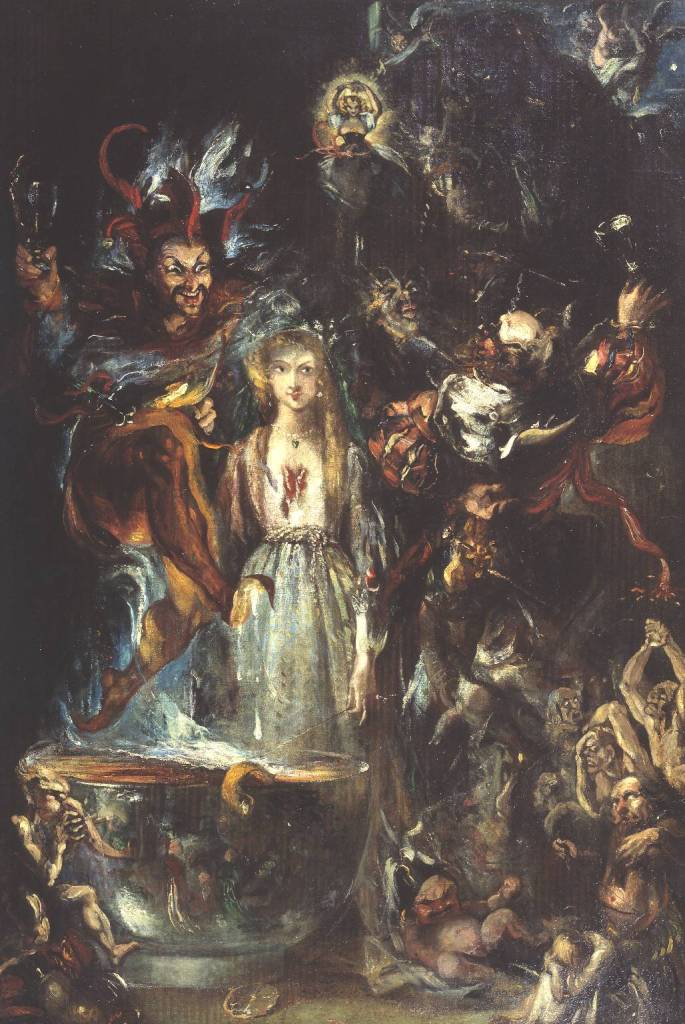
Note on Image: The image at the top of the post is a painting titled Fantasy Based on Goethe’s ‘Faust’ by Theodor von Holst. I found the art on https://eclecticlight.co/2019/02/12/painting-goethes-faust-6-walpurgis-night/.
LINK TO AVALONIAN ROSE FAERY MYSTERIES PATREON: patreon.com/AvalonianRoseFaeryMysteries
Further Reading
- Llewellyn’s Sabbat Essentials Beltane
- https://sabbatsandsabbaths.com/2024/04/18/walpurgisnacht/
- http://www.friggasweb.org/walburga.html