
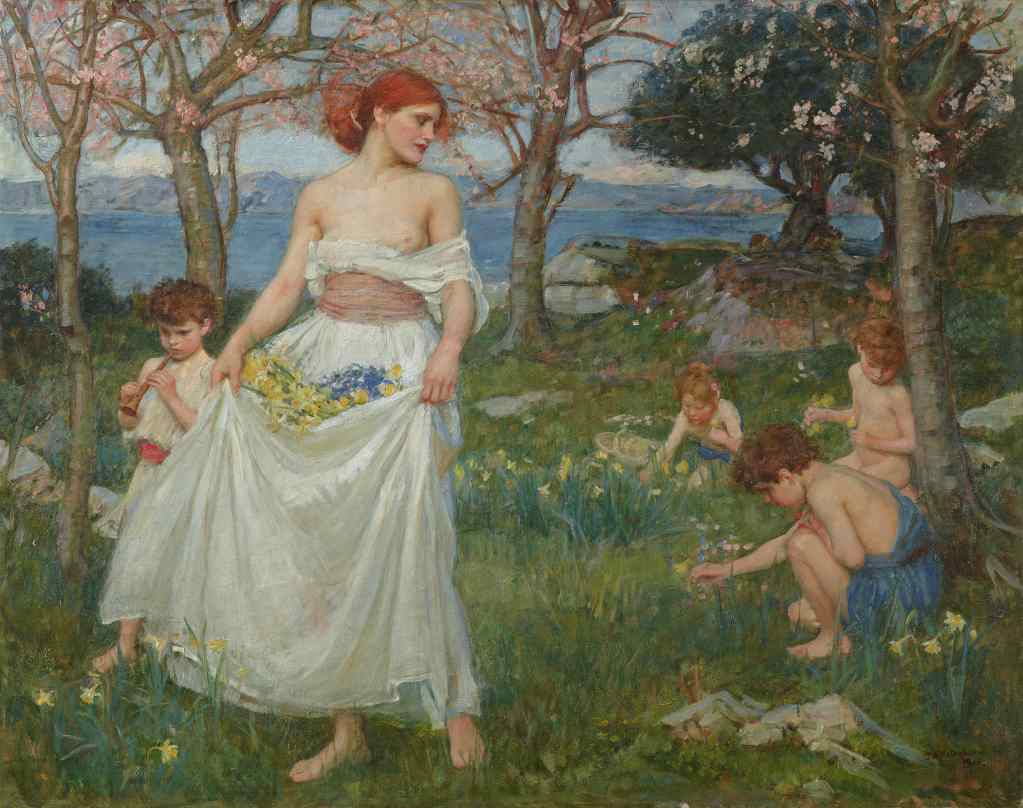
Welcome back to White Rose of Avalon, my Darlings. For today’s Femme Fatale Friday blog post, I will be discussing embracing the Maiden Archetype! I will be discussing three primary examples of the Maiden Archetype from Welsh Celtic and Arthurian myth and legends to illustrate how we can learn so much about Maiden energy by studying stories of Maiden Goddesses. With the Maiden energy being so prominent beginning with Imbolc and all the way through Spring Equinox season, I thought it was the ideal time to discuss this energy! Without further ado, let’s look at three examples of Celtic Faery Queens who hold Maiden energy.
Olwen
~Olwen is one of the titular figures in the tale of How Culwch Won Olwen, found in The Mabinogion. She is a Faery Maiden with a Giant for a father, whom the hero Culwch, a relative of King Arthur, seeks to marry. Due to the fact that when Olwen marries her father, Ysbadden, he will die, he is not too quick to allow his daughter to marry. This leads to a list of seemingly impossible tasks needing to be completed to win her hand in marriage. Of course, Culwch is successful, and the two happily marry at the end. Now, Olwen herself is a very intriguing figure. Firstly, she is very clearly a Flower Bride, given that white flowers spring from the ground with every step that she takes! In fact, her name means ‘White Track’ or ‘White Footprint’. The fact that specifically white flowers are conjured by her very steps on the earth certainly speaks to her pure and innocent nature. Olwen is truly the embodiment of the soft and loving Maiden energy, who gets to have true love once her Culwch proves himself worthy to be her husband!
Blodeuwedd
~Blodeuwedd is another perfect example of the Flower Bride, as she is a Goddess whom was called forth from the Otherworld as a Maiden literally made from flowers! Her story also appears in The Mabinogion, in the Fourth Branch. Similarly to Olwen, the early part of her story is very much the ideal of Maiden energy, for she is pure and innocent. Blodeuwedd is a loving and dutiful wife to Lleu Llaw Gyffes, until her eyes are opened by meeting her true love, Gronw Pebyr. Blodeuwedd had been created by the magicians Math and Gwydion to be the wife of Lleu, but she was never given a choice. Which was a right held by Welsh women, as they always held the right to dissent if the marriage was not what they wanted, just as Rhiannon did in the First Branch of The Mabinogion, choosing Pwyll for her husband instead of an arranged marriage! So, Blodeuwedd’s falling in love with Gronw Pebyr and choosing him was a regaining of the autonomy she had been stripped of. This also allowed her to fully embrace her Sovereignty, which is why she is viewed as a Goddess of Seasonal Sovereignty. This is also what led Blodeuwedd to become the Owl, for she is a Goddess who is both a Flower Bride and a hunting bird. The Maiden made of Flowers is also the fierce Bird of Prey, gaining the ability to protect herself, and I think we can even look at this as Blodeuwedd protecting her own innocence and the innocence of other Maidens who may be taken advantage of!
Guinevere
~Finally, I want to discuss Guinevere, the Queen of King Arthur, who is very much a Flower Bride, fitting the Maiden Archetype early on. In many versions of the legends, Guinevere is the daughter of King Leodengrance of Scotland, a Princess in her own right, who is married to Arthur, the High King. In the early days of the marriage, Guinevere is often described as loving and dutiful, an innocent young Queen wishing to do right by her King and her people. At this time, Guinevere is much like Blodeuwedd, as the Maiden aspect of the Sovereignty Goddess, for she has married Arthur and fully cemented his right to rule. Of course, her energy as a Maiden is most often overshadowed by the famed love triangle of Guinevere, Arthur, and Lancelot. However, even that love triangle, I view as being much in line with how I described Blodeuwedd’s love triangle. Guinevere did not choose her marriage to Arthur, but her love for Lancelot, when Arthur was ignoring her (more interested in the exploits of his Knights), was something that grew naturally in most tellings! So, yes, Guinevere is very much so a Goddess who begins her story full of the youthful and hopeful energy of the Maiden Archetype.
~I hope that you have enjoyed this look at the Maiden Archetype through the stories of three Welsh Celtic Faery Queens whose stories reflect it. Who is your favorite example of a Maiden Goddess? Let me know your thoughts in the comments below!
Note on Image: The image at the top of the post is the painting A Song of Springtime by John William Waterhouse. I found the art on https://commons.wikimedia.org/wiki/File:John_William_Waterhouse_-_A_Song_of_Springtime.jpg.

LINK TO AVALONIAN ROSE FAERY MYSTERIES PATREON: patreon.com/AvalonianRoseFaeryMysteries
Further Reading
- The Mabinogion translated by Sioned Davies
- Le Morte d’Arthur by Sir Thomas Malory
2 responses to “Embracing the Maiden Archetype Through Studying Stories: A Look at 3 Maiden Faery Queen Goddesses”
Hi Maranda! This was a wonderful read, and such a perfect choice for this time of year as we move toward Spring! I love how you’ve highlighted the depth and complexity within the Maiden Archetype. It’s so easy to think of the Maiden as just “pure and innocent,” but you’ve shown through Olwen, Blodeuwedd, and Guinevere that she is also powerful, autonomous, and the holder of Sovereignty.
Olwen, with her white flowers, is such a beautiful and gentle representation of that pure, hopeful energy. But I was especially drawn to your analysis of Blodeuwedd. The way you framed her transformation—from a flower bride created without consent to an owl who reclaims her autonomy—is so powerful. I’d never thought of her transformation as a way of “protecting her own innocence and the innocence of other Maidens,” but that is such a insightful and beautiful way to look at it. It truly re-frames her entire story from one of tragedy to one of empowerment.
And thank you for including Guinevere in this context! It’s so true that her early, hopeful energy as the young Queen is often lost in the later parts of her story. Viewing her as a Flower Bride who, like Blodeuwedd, had her eyes opened and found her own truth really connects these three figures in a meaningful way. This has definitely given me a new perspective on all of them. Thank you for sharing your wisdom 🌷🤝
Thank you so much for your kind words! I am delighted that my discussion of these three Faery Queens has given you a new perspective with which to look at them, and at the Maiden Archetype. I really love analyzing stories, especially ones of Goddesses and the Fae, with nuance. There is just so much there beneath the surface which is often overlooked! As always, thanks for reading and commenting.