
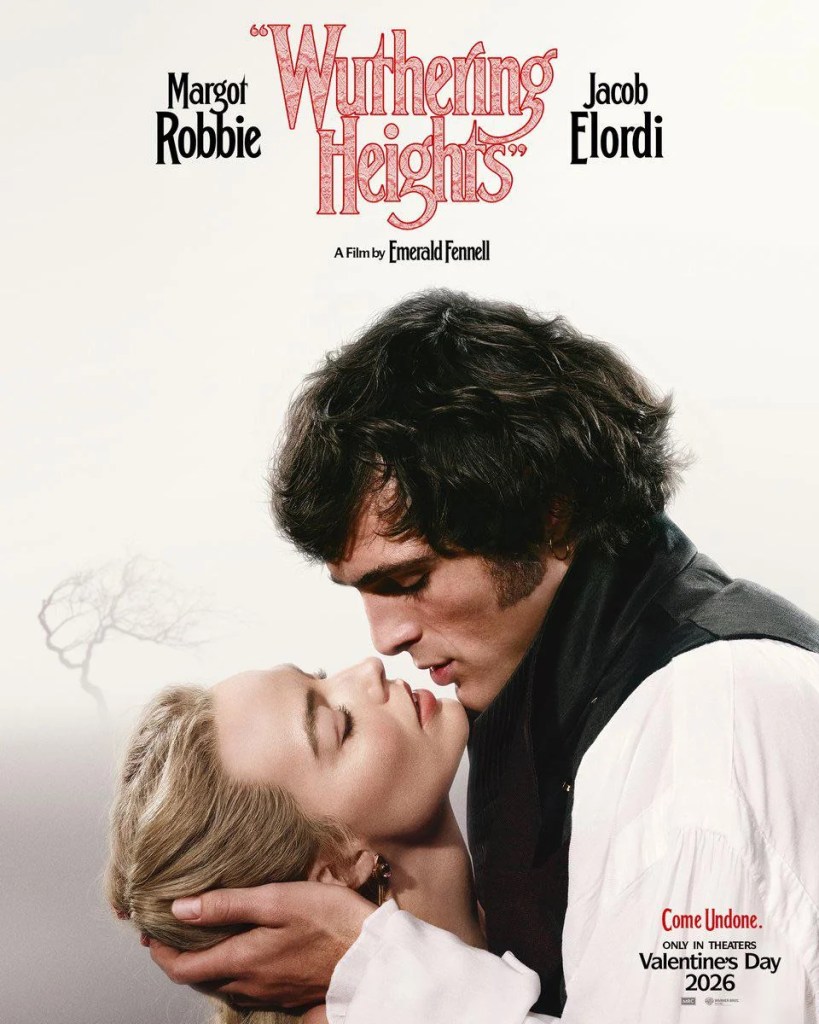
Welcome back to White Rose of Avalon, my Darlings. Today’s post is a bit of a bonus post in Wuthering Heights Week, as I just had to review the new film for you all! To be honest, I do have one more Wuthering Heights-related post coming tomorrow, as well, which will be the true conclusion of this week themed around this beloved novel. Without further ado, let’s get into the review, and just know that it is going to be a long one!
I was lucky enough to see this film on opening night, Friday the 13th of February, as my wonderful husband, Andrew, took me to see it as an early Valentine’s Day celebration. So, I want to say thank you to Andrew, because I am so delighted to have seen this film with you! Now, I want to begin by stating that I did not know what to expect from this film. The novel is incredibly close to my heart, being an all-time favorite book since childhood that I re-read constantly, and it is my most re-read book of all time! That means that I tend to keep my expectations in check when it comes to adaptations, always hopeful I will love them, but also realizing that many fall flat. All of that being said, I LOVED this film! I was utterly blown away by it, and honestly enjoyed it far more than I thought possible. Even my husband enjoyed it, and he is not a fan of the novel, given that he is not one for the purple prose of florid Victorian language in novels! I also want to say that this is a radical interpretation that is totally different from any other adaptation of the novel, but it succeeds in making me feel all the torrent of emotions that I feel reading the book, which is a triumph. Here is your warning: from here on out, I will be going into spoilers!
The film changes a lot of key components in order to simplify the story into something that can be told more easily in the visual medium of cinema. That is likely why the film has been so divisive, with many Emily Brontë fans who saw early screenings feeling that it was disrespectful to the novel, and others being completely enamoured with the film. I am someone who is a huge fan of Emily Brontë and all of her work, which is evident from all of the writing I have done on this blog about it, and I am also someone who believes that adaptation is an art form of its own. That is why I was very hopeful that the film would be good, but in the end I was utterly blown away! Emerald Fennell herself explained in an interview that she put quotation marks around the title because a novel as dense as Wuthering Heights cannot be adapted book to screen. She stated that all you can do is make a version of the story, and this was hers, and I loved hearing that before seeing the film, because it is exactly how I feel about this novel and its adaptations! Honestly, it is a pretty impossible novel to adapt faithfully, as it was always meant to be read. That means changes always occur, but this time the filmmaker was very specific in making her changes and in crafting a version of the story.
From the jump, the film sets a tone that this will be something emotionally resonant and surreal. While there is no haunting, as the film focuses only on the story up until Cathy’s death, the surreal tone and fever dream style give the fantastical energy that I come to expect with Wuthering Heights, even without a full-on haunting. Characters are removed, and not just the second generation. For the sake of making the film easier to follow, at least I believe this to be the case, Fennell chose to remove Hindley and Mrs. Earnshaw (having her already dead at the beginning). This left Mr. Earnshaw as both the one to save Heathcliff and ultimately the one to abuse him! That was a surprise, as was the film literally opening with a young Cathy and Nelly watching a public hanging. Now, I have a lot of thoughts on Nelly, who is disagreeable and really unlikable throughout, but I will get to that later.
After the introductions of Cathy, Nelly, and Mr. Earnshaw, Heathcliff is introduced by Mr. Earnshaw, bringing him home after a night of drinking. Cathy is the one to name him Heathcliff after her dead brother, not Mr. Earnshaw, as he could not speak at that time, which I interpret as a trauma response from what happened in his life before being found by Earnshaw. There are many sweet scenes of Cathy and Heathcliff playing together, which leads into showing Mr. Earnshaw’s wrath, punishing Heathcliff for the two being late to his birthday dinner. Heathcliff took the blame even though Cathy had told him they should wait out a storm that had started. Heathcliff is whipped off-screen by Mr. Earnshaw as a punishment! This is where they transition from the child actors to Margot Robbie and Jacob Elordi, with the blood on the young Heathcliff’s shirt transitioning to the scarred back of the adult man. Before I move on, I have to say that I adore the performances of the child actors; they truly did a wonderful job with the young love and protectiveness the characters felt for eachother. This is also the ideal time to point out that there are numerous easter eggs throughout the film, calling back to the novel, even where it deviates. One is the scene showing Cathy attempting to teach Heathcliff to read, which harkens to Catherine Linton teaching Hareton Earnshaw to read in the novel!
Once we are with the adult characters, their charm and charisma are on full display as they flirt, tease, and taunt. These early scenes with the adult actors show that Cathy and Heathcliff lean on one another to keep themselves from going mad living with her father. It is truly very cute and adds some levity to the film before the more intense and dark themes take over once again. Edgar Linton is introduced quickly after we transition to the adult actors, but this time, he is not from Thrushcross Grange originally. He is instead a wealthy man who made a fortune in textiles and bought the property. We also learn that Isabella is his ward, not his sister. The love between Cathy and Heathcliff is obvious by the time they are adults, with Cathy discussing the possibility of Edgar falling in love with her to try to coax Heathcliff to declare his own love. This does not work, but it is clear that the love is there from the way they look at eachother during this exchange.
Even after it is discussed that Edgar Linton has moved into the Grange, he does not arrive at Wuthering Heights to pay a visit to Cathy, as she had expected, which annoyed her. This became even more pertinent when she found out that her father had gambled and drunk away all their money (much like Hindley did in the novel after his wife’s death), leaving her with just the good name of Earnshaw to secure a marriage. At that point, her possible marriage to Edgar is no longer a teasing matter, and she tells Heathcliff as such, to which he breaks a chair in anger and tells her that it will not come to that! This scene had been teased on the press tour, as they mentioned that in one scene, Jacob Elordi broke a chair while in character, and it was unscripted. This means that Margot Robbie’s reaction was very genuine, and I am glad they kept that take in the film, because it is definitely a reaction I would expect from Heathcliff when he believed that he would lose Cathy!
Of course, this would not be a version of Wuthering Heights if it were as simple as Cathy and Heathcliff finding a way for her not to have to marry Edgar. One morning, Cathy takes it upon herself to go to Thrushcross Grange and meet Edgar, even if it is not ‘proper.’ Nelly had repeatedly told her that she could not go to meet him, that he had to come to her due to propriety. When she arrived at the Grange, Cathy attempted to climb a wall and fell when Isabella screamed that she had seen a ghost trying to get into the garden. This is another clever easter egg to Cathy’s Ghost in the novel, as well as a twist on Cathy being bitten by the Lintons’ dog, as both the bite and the fall from the wall result in a twisted ankle and prolonged stay at the Grange! Of course, when she comes back, Heathcliff is cold to her, and they argue. This response is very different from Mr. Earnshaw’s, as all the time she was at the Grange, he was delighted at the prospect of his daughter marrying Linton, and Heathcliff was distraught.
From there, the famed sex scenes of the film begin. However, I do not find the sex scenes to be in poor taste or to be graphic, as many have criticized. In fact, the sex scenes with Cathy and Heathcliff are steamy, erotic, and truly romantic! Yes, there are many sex scenes, and yes, there are a couple of BDSM references, but nothing too graphic is really shown, even then. Overall, the sex scenes are meant to be sensual and not overly shocking. The first sex scene we get is surprisingly one with Joseph and a maid. I find it interesting that the choice was to make Joseph younger and trade his religious zealotry for a bit of a BDSM kink, because even in the book, he certainly could have been a pervert for all of his repression! This is also a way to show that while the film is telling the story in its own way, it is still showing characters who are complex. The complexity is still a mirror to the Shadow within the characters, just done in a more cinematic way, which I appreciate. In any case, we do not see much of the interaction between Joseph and his lover, making it more implied than explicit. Rather, the audience sees Cathy, and later Heathcliff, spying on them. This is the first moment of full-blown sexual tension, given the close proximity of the characters and what they are seeing!
This will lead to a bit of a sexual awakening for Cathy and an almost consummation of her relationship with Heathcliff, before she stops it. Her reason for stopping the tryst with Heathcliff at that point is likely a combination of being overwhelmed and worried about having sex outside of marriage, a true concern at the time. It is when Cathy returned home after this encounter that Edgar visited her at Wuthering Heights and proposed. Of course, just like in the novel, she accepted and then felt conflicted, seeking Nelly’s advice. Also, just like in the novel, Nelly sees Heathcliff and knows he can overhear what is being said, allowing him to hear Cathy state that she could not marry him or they would be beggars!
However, what I adored in this interpretation is that Nelly is fully painted to be in the wrong, which is how I always saw this. In fact, Nelly kept Cathy talking in this scene when Heathcliff came into earshot, asking further questions to encourage her to continue speaking! The miscommunication between the two was purposeful on Nelly’s part, making her a villain in the situation. Heathcliff still ran off, but, in the film, Cathy did not know he left immediately. Instead, she spent the night awake in dread and had decided to seek out Edgar to end the engagement, only then learning that Heathcliff had left. That is why Nelly is the villain, even though Cathy and Heathcliff had not had clear communication with each other; they were prevented from rectifying that by Nelly’s actions!
Cathy then waited, putting off the wedding for a year, until finally marrying Edgar, with Nelly pushing her that it could not be put off any longer. This is very different from the novel, where the wedding had to be postponed for a time because Cathy was so ill after being outside in the rain all night searching for Heathcliff, but the result is the same. The early years of her marriage to Edgar are shown in a montage of surrealistic and fever-dream visuals, showing her attempts to be happy even as she is bored and unsettled. This whole portion of the film is quite psychedelic in tone, making for a very interesting way of viewing the time spent without Heathcliff. It is almost like it is easier for Cathy to be in a haze, as if in a psychedelic trip, than to be parted from Heathcliff, uncertain if he will ever return!
Eventually, Heathcliff does return, but instead of being gone three years, it has been five. At the first dinner he attended at the Grange, it is revealed that he had already bought Wuthering Heights outright. Isabella’s affection for Heathcliff is likewise revealed quickly, with Cathy warning her against him, just as in the novel. However, this also leads to Cathy and Heathcliff confronting one another and fully confessing their love. In a moving scene, we get to hear Cathy tell Heathcliff that he had not heard everything the night he left and that she planned to break the engagement the next morning, but he was already gone! It is after this that all of the sex scenes between Cathy and Heathcliff begin, as they have a passionate affair.
I know that a lot of Emily Brontë fans really hate this, as there are no sex scenes in the novel. It is very unlikely that there would have been sex scenes in a novel in the era in which the book was published, especially a novel written by a woman (even if it was originally published under a male pseudonym). To be honest, the novel was scandalous enough without having sex scenes and a confirmation of an extramarital affair. However, I think it is easy to read between the lines and say that Cathy and Heathcliff could have slept together off-page, and certainly, I personally hold that interpretation to be true in my interpretation of the novel.
I do really love this portion of the film, as it is at this point that we get to see some happiness for the couple. Instead of focusing on the hatred between Linton and Heathcliff and the fighting that is present in the novel, we get a reprieve (as Linton never knew he had a rival in Heathcliff this time around). Yet, this cannot last, as Heathcliff learned of Cathy’s pregnancy. He asked the question many of us pondered, reading the novel as teenagers: Is the baby his? Of course, in the film, Cathy already knew for sure that she was pregnant before Heathcliff came back. It is at that point that Heathcliff stated that he would kill Edgar Linton if Cathy wanted that. He truly seemed willing to accept that her child was not his, and was happy to kill for them to be together! That is when Cathy ended things, as this offer shocked and unsettled her.
After that, it is not long before Heathcliff seduces Isabella and marries her. The relationship between Isabella and Heathcliff is possibly more toxic than in the novel, with the BDSM energy coming back. Heathcliff is clear that he will never love her and uses her to send letters to Cathy, none of which are ever read, as they are burned by Nelly! Once again, the communication is prevented by Nelly, as she actively seeks to keep them apart. I will say that the burning of the letters seems to be a nod to the love letters from Linton Heathcliff to the younger Catherine that Nelly finds in the novel. It is very clear that Nelly is determined to keep Cathy and Heathcliff apart.
All of this is not to mention that just like in the novel, she also does not believe Cathy to actually be sick when she begins to go mad. Nelly just thinks that Cathy is being dramatic and manic and trying to get everyone’s sympathy. There is a poignant small easter egg during Cathy’s illness, that Nelly insisted she was faking, where we can see that Cathy had carved the window in her bedroom with the names ‘Catherine Earnshaw’, ‘Catherine Linton’, and ‘Catherine Heathcliff’. This is an obvious reference to Mr. Lockwood finding those names carved into furniture in Cathy’s old bedroom at Wuthering Heights in the novel, before seeing her ghost outside the window!
At this point, the film does not let up as it spirals into tragedy. Edgar finally comes to see his wife when Nelly realizes that she was not faking, and in fact had not lied when she said the baby was dead. Nelly had been certain that since Cathy had not bled, she was still pregnant with a healthy baby. However, since Cathy had not bled, she had not fully miscarried, but the baby was still inside her body, dead, and that is what ended up killing her, all thanks to Nelly’s negligence! This is a very dark and unsettling change, but one that truly exemplifies the fact that Nelly, even as the novel’s narrator, never cared much for Cathy’s well-being. I applaud the film for going to this brutal extreme, as it is likely as shocking to a modern audience as the original novel had been to a Victorian one! The very end of the film shows Heathcliff giving a slightly altered version of his famous ‘Drive me Mad’ monologue to Cathy’s dead body. I have to say, I was crying, completely overwhelmed by the anguish of the scene. I always cry reading Wuthering Heights, and I cried multiple times in the theatre. This film’s end is an interpretation of the story that did not hold back in showing the darkness of Heathcliff’s pain at losing her, allowing us to see him literally speak to her corpse instead of speaking to the air, to her spirit!
So, yes, this is NOT a version of the story for everyone. It is radical, it is racy, it is twisted, it is deeply romantic, and it is sexy. There is stunning cinematography and even grotesque visuals on display that truly show why this is an R-rated take on the source novel. However, it is also a film that truly captured the essence of what makes the Dark Romance and doomed, toxic love affair so special. It showed how very true the love was, even as Cathy and Heathcliff made poor choices and were kept apart by circumstance. It also showed just how much the outside forces in their lives conspired to keep them apart in life, thus leading to and reinforcing their toxic behaviors. The film made me feel what I want out of a version of my favorite novel, and I loved it for that! This film is not for the faint of heart or the prudes who want a sexless version of the story. It speaks to the underlying sexual tension and sexual desires that you can see if you read between the lines, and also fearlessly shows some of the violence in the novel, but in its own way. Would I recommend this film? Yes! But, I would only recommend it to the open-minded people who are okay with getting an adaptation that is vastly unique, creating a film that feels like the novel without being it. To me, that is the true magic of this film; it is at once an interpretation of the novel without trying to be the novel. In all honesty, no film that has attempted to adapt the novel more accurately has really hit the mark, because the source material is so dense. These types of more radical adaptations of source material, if done well, can end up speaking to a deeper truth held within the cherished pages without having to be a carbon copy of the novel! While the novel will always be my favorite way to consume this story, this film is definitely one I know I will return to time and again!
I hope you have enjoyed this very honest review of the new film adaptation of Wuthering Heights. Have you seen the film? Do you want to? Or, do you know it is just not your cup of tea? All is okay, for the original novel was panned by critics and loved by readers upon publication, so in my opinion, this story is meant to be divisive. Let me know your thoughts in the comments below!
Note on Image: The image at the top of the post is the official poster for the film. I found the image on https://www.reddit.com/r/movies/comments/1n7isk0/official_poster_for_emerald_fennells_wuthering/.
LINK TO AVALONIAN ROSE FAERY MYSTERIES PATREON: patreon.com/AvalonianRoseFaeryMysteries
3 responses to “We Need to Talk About Emerald Fennell’s “Wuthering Heights” 2026: A Full Spoilers Film Review”
This is such a wonderfully detailed and passionate review! I love how you’ve approached the film with both your deep love for the source material AND an openness to adaptation as its own art form. That balance is so hard to strike, but you’ve articulated it perfectly.
The points you make about Nelly being fully painted as the villain are fascinating – her burning the letters, keeping Cathy talking when Heathcliff could overhear, and especially the devastating change about the miscarriage where her negligence becomes fatal. That’s brutal but you’re right that it speaks to something true about her character in the novel.
I also appreciate your take on the sex scenes. The novel is absolutely simmering with repressed desire and reading between the lines, it’s not hard to imagine the physical passion that would exist between them. Making that explicit in film seems like a natural interpretation rather than a betrayal.
The surreal, fever-dream quality you describe sounds perfect for capturing the novel’s Gothic intensity without trying to replicate its structure exactly. And that Easter egg with the carved names in the window frame gave me chills just reading about it!
Your husband’s enjoyment despite not being a fan of the novel’s prose is also telling – maybe this version captures the emotional truth in a way that translates across mediums.
I am so glad that you found my review enlightening! I definitely think that the structure of the film does translate the novel into the visual medium in a way that still holds onto the emotional intensity of the novel, hitting on key themes. I found it brilliantly done, and truly enjoyed that it was not the novel, but made me feel the way the novel does! I know this is a divisive film and one that many fans of the novel hate, but I have always believed that the novel as is needs to be altered to be properly translated to film, as it is so dense. This film did that, and took risks, and I think those risks paid off!
So, the film is not for everyone, but it is definitely for me. I am so glad that we are getting truly artistic and innovative adaptations. After all, that is part of the magic of storytelling, having it evolve for generations and making people think and feel! As always, thank you for reading and commenting.
Thank you Maranda for your wonderful reply 🌷🤝