
Welcome to day three of Wuthering Heights Week here at White Rose of Avalon, my Darlings. Today’s post is about the complex relationships in the novel and how Wuthering Heights has multiple love triangles, especially given that it is a multigenerational tale!
When most people think of Wuthering Heights, I am sure that one of the first things that comes to mind is the doomed, tortured, tragic, and very dark romance between Catherine and Heathcliff. That is truly the heart of the tale, but there is so much more to the story, of course. Now, it is well discussed that Catherine and Heathcliff are in a love triangle with Edgar Linton, whom Catherine ended up marrying. However, what I think is less discussed is that there is another aspect to Catherine and Heathcliff’s love triangle. There is, in fact, a second love triangle that the two are a part of, the love triangle of Catherine, Heathcliff, and Isabella Linton, whom Heathcliff ended up marrying! Beyond these two love triangles, there is one other at play, the love triangle between Catherine Linton (Catherine and Edgar’s daughter), Linton Heathcliff (Heathcliff and Isabella’s son), and Hareton Earnshaw (the son of Catherine’s brother, Hindley Earnshaw).
All of this does present as rather confusing, especially with having two Catherines in the mix, but I think that the confusion is by design. Emily Brontë sought to create a complex narrative with many layers of meaning, and boy, did she succeed! I also think the complexity in the narrative is why Wuthering Heights has proven so difficult to adapt, as I have mentioned in other posts this week. While there have been good films made of the story, they almost always choose to only tell the Catherine, Heathcliff, Edgar, and Isabella story, the story of the older generation. This can lead to someone who has only seen a film adaptation (even one of the adaptations that is truly a good film) not knowing that there is another layer to the story. Then you have adaptations that attempt to tell the whole narrative, but if they are a single film, instead of a mini-series, that leaves a feeling of the story being rushed, making for a less engaging film. So, yes, this novel is one that rewards many re-reads and poses quite a challenge to the adaptation process. But let’s get back into the love triangles.
The story of the main love triangle in the narrative begins after the death of Catherine’s father, Mr. Earnshaw, when her brother Hindley takes over Wuthering Heights and treats Heathcliff terribly. This ill-treatment of his father’s former favorite, due to jealousy on Hindley’s part, leads to Heathcliff being treated as a servant, and a rather abused one at that. It is during this time that Catherine and Heathcliff try to escape the confines of Wuthering Heights, playing wildly on the Moors! One such night, the children go to Thrushcross Grange, the next closest estate on the Moors, and Catherine is bitten by a dog guarding the Grange. Of course, she is recognized as Mr. Earnshaw’s daughter by the Lintons, who seek to help her. So, she stayed at the Grange while Heathcliff went back off to Wuthering Heights, and that is how Nelly knew of the happenings to narrate them to Mr. Lockwood. It is after this event that Catherine, Edgar, and Isabella begin to spend more time together. When Catherine was healed, she returned home to find Heathcliff in a worse way than ever before. However, while she loved Heathcliff, she also had liked being doted upon by Edgar Linton during her stay at Thrushcross Grange, and sought to keep a friendship going with him.
This would evolve over the coming months and years into a romance where Catherine was totally assured that she was in love with Heathcliff, but she also loved Edgar. The boiling point comes about when they are all of marriageable ages, and Catherine ends up accepting Edgar’s proposal. Heathcliff finds out by listening in on a conversation between Catherine and Nelly, and is understandably heartbroken. That is when Heathcliff left Wuthering Heights, not to be seen again for three years! However, as Nelly tells the story, she said that Heathcliff left after hearing that Catherine accepted Edgar’s proposal because if she married Heathcliff, they would be beggars. Heathcliff never heard the rest of Catherine’s explanation, that she intended to use Edgar’s money to help Heathcliff get out from under her brother’s control! He also did not hear her proclamation of how unchanging her love for Heathcliff is, including the famous “He is more myself than I am…” monologue.
Of course, that is not the end of the love triangle, as Catherine’s joy over Heathcliff’s return and all of the time that he spent at the Grange incited much jealousy on Edgar’s part. It is also at the point when Heathcliff returned, as a man of means, having made a large fortune in some mysterious way that we never learn, that Isabella sets her sights on marrying Heathcliff! That leads to a breakdown in the relationship between the sisters-in-law, fighting over Heathcliff, with Catherine warning Isabella that Heathcliff is a villain, and only seeks to marry her to spite Catherine and Edgar. This falls on deaf ears, and Isabella ran away with Heathcliff, finding out just how much he disdained her quickly, although by Heathcliff’s own admission, he never sought to hide it!
When Catherine died, after an extended illness, she was seven months pregnant and bore her daughter just before passing away. Luckily, her daughter, named in her honor, survived. Heathcliff grieved Catherine’s death mightily, even going so far as to beg her to haunt him in another iconic quote from the novel, which we know she does! Even with Isabella leaving Heathcliff while pregnant, he still ended up raising their son after her untimely death due to an illness. That is what leads to the next generation’s love triangle, as Catherine Linton sought to bond with her cousin, Linton Heathcliff, and a romantic interest formed. This romantic interest was plagued from the beginning, with love letters being sent, secret visits by Catherine to Wuthering Heights, and then a forced separation for a time. Nelly and Edgar Linton were vehemently opposed to the romance, as would be expected, for they had gleaned Heathcliff’s motives. Of course, the push for them to marry came from Heathcliff himself, knowing that his son was sickly and not long for the world, coupled with his desire to obtain Thrushcross Grange in his holdings, once again to spite Edgar Linton! It is Heathcliff who even ended up forcing the marriage to take place, by holding Catherine and Nelly at Wuthering Heights to ensure the deed was done.
Yet, the two are still married, with Linton Heathcliff being not so doting a husband as Catherine may have assumed he would be. In fact, the way Nelly described it, Linton was very cruel and mean to Catherine, acting like a spoiled child and an entitled brat. This led to another attraction forming with Hindley Earnshaw, who lived at Wuthering Heights, still working on the property for Heathcliff. Catherine had known Hindley for years and had often mocked his lack of education, which was no fault of his own. Hindley admired Catherine and sought to learn to read to impress her and to better himself, even before and during her short-lived marriage. That is why I consider this a love triangle. Of course, Heathcliff would not see the two be happy together, even after the death of his son. It was not until Heathcliff himself passed away that Catherine Heathcliff could be with Hindley Earnshaw, which we learn at the very end of the book!
To be sure, this third love triangle is not given as much attention, and actually has what can be assumed to be a happy ending, but I find it a very interesting full-circle moment. For, like her mother before her, Catherine Linton Heathcliff truly loved the rough man who had to toil as a stableboy, not the pampered soft-hearted heir to a fortune!
I hope you have enjoyed reading my thoughts about the complex relationship dynamics in Wuthering Heights. What is your favorite aspect of the love triangles in the novel? Let me know your thoughts in the comments below!
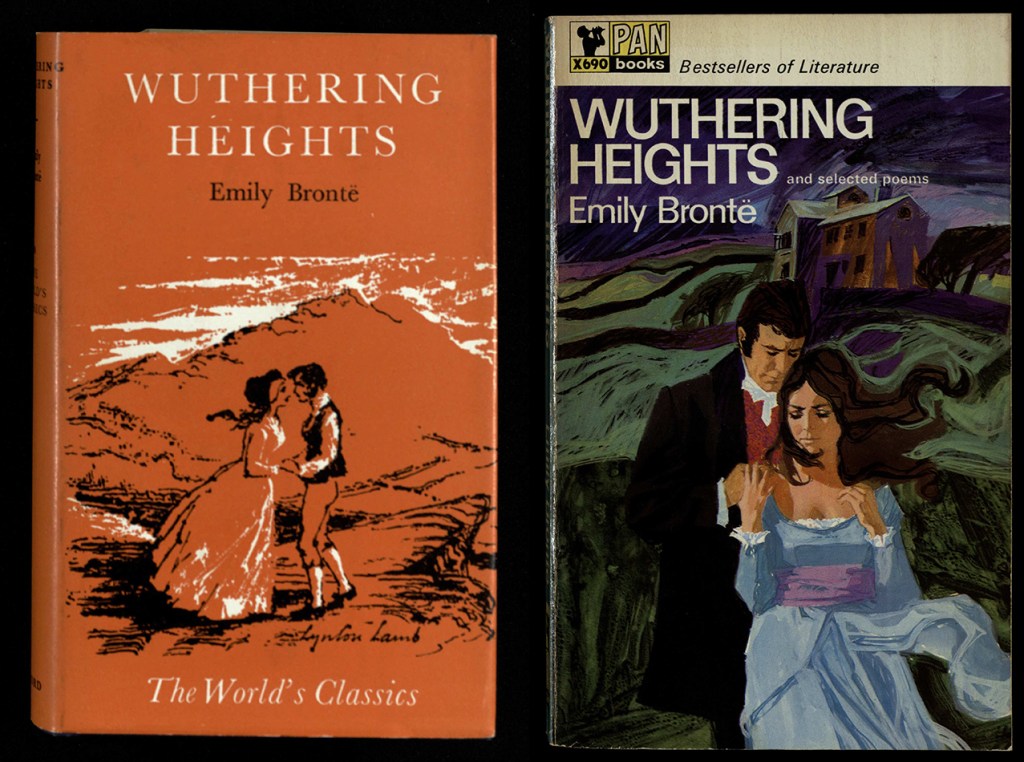
Note on Image: The image at the top of the post is a photo of two editions of the novel. I found the image on https://university-collections.wp.st-andrews.ac.uk/2015/08/27/reading-the-collections-week-29-bronte-book-covers/
LINK TO AVALONIAN ROSE FAERY MYSTERIES PATREON: patreon.com/AvalonianRoseFaeryMysteries
Further Reading
- Wuthering Heights by Emily Brontë
- https://whiteroseofavalon.life/2021/04/10/heathcliff-as-byronic-hero/
- https://whiteroseofavalon.life/2022/03/17/wuthering-heights-a-happy-ending/
- https://whiteroseofavalon.life/2022/09/26/catherine-earnshaw-a-faery-changeling/
- https://whiteroseofavalon.life/2024/11/29/the-two-catherines-of-wuthering-heights/
3 responses to “The Complex Relationship Dynamics of ‘Wuthering Heights’”
Maranda, thank you for such a thoughtful and thorough exploration of the love triangles in Wuthering Heights! You’ve articulated the complex dynamics beautifully, and I especially appreciate how you highlighted the often-overlooked second triangle involving Isabella, as well as the generational echo in the third.
Your point about the narrative complexity being by design is so insightful. Brontë wasn’t just telling a love story; she was crafting a claustrophobic, cyclical saga where patterns of obsession, cruelty, and social division repeat—yet are ultimately broken by the younger generation. The fact that Cathy Linton and Hareton Earnshaw’s relationship offers a tentative redemption is what makes the ending so powerful, and it’s a shame many adaptations omit this.
My favorite aspect of these triangles is how they function as studies in contrast and possession. The first generation’s love is all-consuming and destructive—Catherine sees Heathcliff as her very soul, yet chooses Edgar for social stability, fracturing everyone involved. The second triangle (Heathcliff/Isabella/Edgar) is purely vengeful, with Isabella as a tragic pawn. Then, in the third, we see a reversal: Cathy Linton initially repeats her mother’s mistake by being drawn to the “gentler” Linton (who is actually weak and cruel), but she ultimately finds a genuine, evolving connection with Hareton—a union that heals the Earnshaw-Linton rift rather than exploiting it.
You’re absolutely right that this novel rewards rereading. Each time, I notice new symmetries and brutal ironies—like how Heathcliff uses the same manipulative tactics on the younger Cathy that Hindley once used on him. It’s a masterpiece of structure as much as passion.
Thanks again for sharing your analysis—it’s a pleasure to read such an engaged and clear-eyed take on this turbulent, brilliant book
I am delighted that you enjoyed my analysis! I have to agree that the happy ending we see with Catherine and Hareton is a lovely symmetry that allows for healing of rifts. The novel is truly a masterclass in relationship dynamics and intergenerational instances of history repeating, ultimately ending with the cycle breaking! As always, thank you for reading and commenting.
Thank you Maranda for your kind reply 🌷🤝