
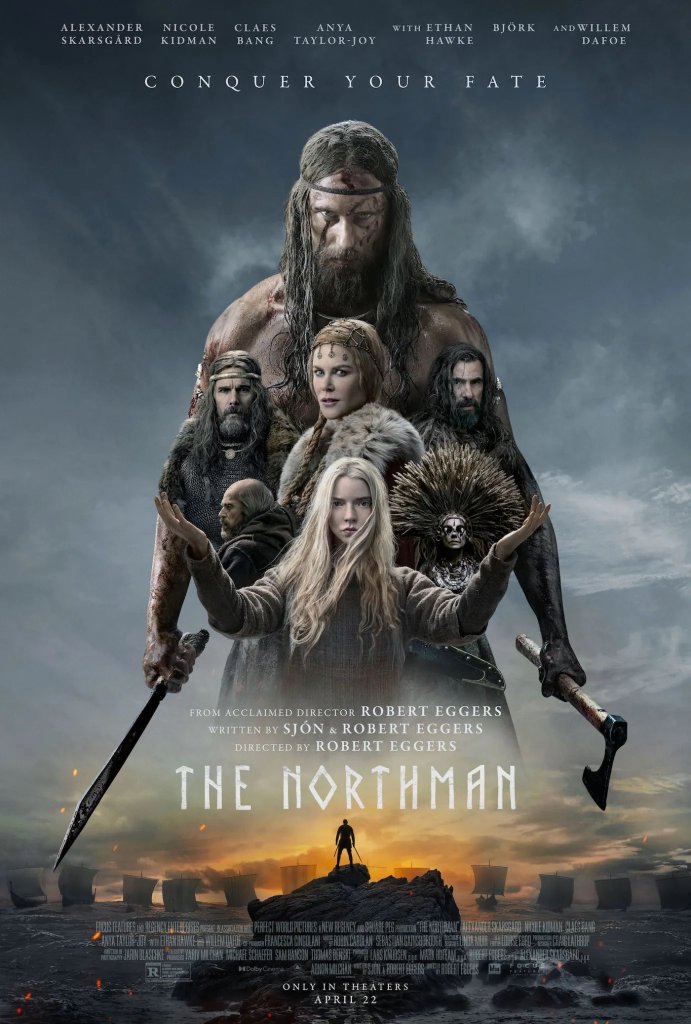
Welcome back to White Rose of Avalon, my Darlings. For today’s Magical Media Analysis blog post, I will be discussing Robert Eggers’ film The Northman and unpacking some of the Norse mythology, spirituality, and inspiration from Shakespeare’s Hamlet found within the film! It was actually the final Robert Eggers film that I had not seen, up until this past Yule, when my wonderful husband, Andrew, gifted me a Blu-ray of the film.
It is quite crazy that I had not gotten around to watching the film until the end of December 2025, as I adore all of Eggers’ films, and I also love Norse myth and Hamlet. That being said, I am very glad to have finally seen the film, and I actually have watched it twice, as I loved it so much and wanted to take thorough notes before writing about my thoughts here. Before I get to sharing my thoughts on the film, I want to note that I will only briefly discuss Olga and her role in the plot here, as I will be doing an entire post about her tomorrow. Now, there will obviously be spoilers from here on out. Without further ado, let’s talk about The Northman!
The very beginning of the film is evocative and sets the tone for this Viking Saga. Ravens flying across the screen, which I interpret as obviously meant to be Hugin and Munnin (Odin’s Ravens), along with a dramatic monologue. From there, the film begins at the Court of a Norse Chieftan, King Aurvandil War-Raven. Aurvandil’s return home sets the stage for the beginning of the film’s plot, with his son, Amleth, informing his mother of the King’s return. The Queen Gudrun is first seen on screen scolding her son for entering her chambers without asking, and then, as soon as she greets her husband, she asks after his brother. These moments serve as a beautiful foreshadowing of her character, which is all the clearer upon a rewatch. However, even on the first viewing, I could see the implication, due to my knowing the film was inspired by Hamlet, and it was very clear that Gudrun would be married to Fjolnir, her husband’s brother, before long!
Fjolnir entered the scene with his infant son not long after this exchange. It is at that point that a Jester began to mock Gudrun. As the Jester mocked Gudrun, Fjolnir was outraged and called in the name of Freyr, obviously a reference to Freya’s brother, while threatening the Jester for his mockery. At this exchange, the King does his best to calm the situation. Now, I see this reference to Freyr early on as aligning Gudrun with Freya, and also as a reference to a story where Loki accused Freya of sleeping with her own brother, mocking her sexual encounters. This is another hint at the plot between the two, which Gudrun confessed to later in the film, even stating that she was laughing, not screaming, when she was carried over Fjolnir’s shoulder after Aurvandil’s murder. But I will touch more on that later.
Later, in a scene between the husband and wife, King Aurvandil War-Raven states his desire to die in battle, to go to Valhalla. The fact that this is said to his wife, the very person who was then plotting his murder with his own brother, is very poignant, for he is murdered, and not given a Warrior’s death! Now, after that exchange between Aurvandil and Gudrun, Aurvandil took Amleth to a ritual, obviously meant to be a way to initiate the boy into manhood.
The Vision Quest to initiate Amleth is a powerful sequence of worship of Odin, of the initiation of a young boy, and of a shapeshifting ritual. The visualization of the family tree, called the Tree of Kings, is a powerful icon to show the literal bonds of familial union that are so important to the film’s narrative! It is also an important alignment with Ygdrassil, the World Tree of Norse myth. Willem Dafoe gives a memorable performance in this scene as a character named Heimir the Fool, who obviously acts as a Priest of Odin conducting the ritual. The whole ritual is a great show of the importance of a father teaching a son, of a King teaching a Prince. The phrase ‘Never seek the secrets of women’ while they discuss the Norns and Valkyries (and once again hints at Freya’s place of importance to Norse myth) shows both a respect for women and a realization of the distinct power of the masculine and feminine. In fact, this balance of the masculine and feminine is a key driving force in the film. Fjolnir killed his brother at the behest of the woman he loved, who was unwillingly wed to his brother, and Amleth will later respect and prioritize Olga’s safety! But, I have one last thing to say about the ritual, the last tear shed in weakness becomes a diamond to be given back when needed, and becomes a powerful totem of Amleth’s journey.
It is directly after the ritual had concluded that the murder of Aurvandil happened. Brother killing brother and the attempt to kill Amleth himself aligns perfectly with Hamlet’s father being murdered by his brother, but here we get to see the rather brutal murder. It is obvious that Fjolnir wants to be a King, but he is a bastard son, so cannot claim the title, only doing so with the murder of his brother, but as predicted by said brother, he doesn’t remain King long, he is not destined to be a King, instead he ends up as essentially a farmer, but still a powerful landowner. Of course, he owns those lands and slaves only after being run out of his Kingdom by another King.
While Fjolnir is about to kill Aurvandil, Amleth runs at his father’s behest, but still cannot leave, witnessing the murder of brother against brother. When he is chased, he cuts off the nose of his attacker, who later lied about killing the boy, as Amleth actually got away! As he rowed away from the land where he was a Prince, he chanted to himself that he would avenge his father, save his mother, and kill Fjolnir, and that is how he lived his life for years to come, not knowing his mother never wanted saving! Nicole Kidman’s performance as Gudrun is amazing, as she truly made me loathe the character, a woman who would willingly sacrifice her own son because she wanted out of her marriage! While I can empathize with a woman in a forced union hating the man who took her as a prize when he conquered her land, as she implied was the real history of the marriage, hating him enough to want her own son dead is despicable.
Throughout the narrative of the film, there is less emphasis on the haunting of the father, like in Hamlet, although there is a reference to Amleth being led to his mother and uncle by the Raven spirit of his father, making for a very Norse take on this haunting. The haunting of Hamlet by his father’s ghost is largely reworked with acts of magick and surreal vision journeys to learn the truth!
Years later, after the murder of his father, in the land of the Rus (or modern-day Russia), Amleth is in a horde of Berserkers, where he yet again embodies the Wolf, as he did as a child in the ritual. The Berserkers were fearsome Norse Warriors known to either embody wolves or bears to embrace the animal’s energy in the battle fury that the Berserkers were known for! The brutality is on full display with Eggers’ signature historical accuracy, with another ritual before the sacking of a village. After the village is overtaken by the Berserkers, Amleth is said by one of the others to have had a heart of cold iron when he was found by them as a child. This is likely a reference to what makes him the ideal warrior to take into the ranks.
After that, there is the iconic scene of Amleth meeting the Witch, which I interpret to be based on the Volva, who were Norse Witches, said to have been trained in the art of Seidr by Freya. This is an iconic moment of prophecy that leads Amleth on his journey to his destiny! The character is simply called the Seeress and is played memorably by Björk. She is a fascinating character; even if she only appeared in this one scene, as she reminds him of his father and of the final tear, and Amleth followed her orders, ready to seek his sword! It is obvious that although he’s a great warrior, he feels deep compassion for the people they conquer, and that it weighs on him, which also plays into his fighting to find a way to beat his uncle.
This is what leads Amleth to willingly pretend to be a slave to find his uncle, who he found out has land in Iceland, and hopefully rescue his mother, which is a brilliant sacrifice. The meeting of Amleth and Olga on the ship is a memorable moment. Olga of the Birch Forest, as she will introduce herself as in a later scene, is a Rus slave, and she is portrayed impeccably by Anya Taylor-Joy. Olga can tell immediately that Amleth is no slave by birth, and this is where we first see her magickal abilities. She clearly is very psychic, and also clearly has a soft spot for Amleth, aiding him from the time they first meet.
When Amleth arrived on his uncle’s lands, it is stated that he is powerful enough to be of use to Fjolnir. However, even in the beginning, Fjolnir said that if he proved to be as untrustworthy as a wolf, he would put him down. This is part of a continued comparison between Amleth and Wolves! Of course, this makes great sense in the film, as he truly is like an Alpha Wolf, powerful and protective of his family, both past and future. Amleth and Olga had to plot carefully, as she is kept working in the house, so that her hair is kept long and her arms are kept white, which is something that Fjolnir requested, and Amleth must work in the fields.
It is not long after the plotting begins that Amleth goes about the act of receiving a magickal Sword named Draugr that can only be used at night. The fact that the sword can only be used at night aligns with special ways that magickal swords often must be used in folklore. Amleth’s sword’s name means ‘undead’ or ‘revenant’ in Old Norse. This is why it has been associated with some viewers of the film as being a Vampire sword, as it craves blood and can only be unsheathed at night! I will actually link an interesting article about the sword interpreted in this way below. It is a challenge for Amleth to gain the sword, as he had to receive Draugr by battling the undead. This battle with the undead is a test to prove his worth to wield such a blade. Through a small reference, it seems that the sword may also be associated with Jormangandr (the World Serpent of Norse myth), as there is a brief mention of the sword in association with a serpent’s belly.
Because of the restrictions placed upon how to wield the blade, work with the sword must be done strategically, with Amleth killing slowly and smartly, while even endearing himself to the uncle and mother who do not recognize him. Early on, right after getting the blade, Amleth saves Fjolnir and Gurdun’s son, Gunnar, during the games, earning their respect. He is even given privileges as a reward, including being allowed to sleep with whom he wants, even Olga. Fjolnir’s elder son, Thorir, said his father found Olga too unyielding, so Amleth is allowed to bed her, which is obviously highly upsetting language to use, but shows the massive disrespect the slaves face. At this point, Amleth is also reminded that he will never be free, but he will get these privileges. This leads to his first sexual encounter with Olga at the festival, which takes place after the games. After they consummate their relationship, she speaks about the threads of fate binding them together and speaks to the Earth. It is also in this scene that Olga states that she will use her Earth Magick to help him. They will incite the chaos together, showing the bond they share. Olga with her magick and Amleth with his blade and warrior heart!
Olga aids Amleth with potions during a night when he needed to slay Fjolnir’s men. Her potion caused the men to go insane, making them easier targets for Amleth to pick off! In fact, during that same night, the potion driving the men insane also gave Amleth time to meet with his mother. This is the scene that truly made me loathe the character of Gudrun. Gudrun states that his father only endured her because she bore him a son, that she never mourned him, and, as I stated earlier, even laughed when she knew he was dead. She implied that she was a prostitute, or at the very least, she was taken as a trophy, as I mentioned above. Amleth is horrified that his mother begged for his father’s death, and was happy to have him die, as she told him she had given her blessing that he should die! There are even the gross Oedipal inferences that she would marry her son Amleth if he conquered Fjolnir. She stated that a son loves his mother and a mother loves her son, even if he was born of savagery and forced upon her. Gudrun even goes as far as to state that if he killed Fjolnir and Gunnar, he would be her new King! This only serves to anger Amleth more, as he stated that her words are poisonous, which is certainly true. However, after this, he states that he would not kill a woman, even his mother, even after what he had learned.
It is on this night that Amleth killed Fjolnir’s older son, Thorir. He even took Thorir’s heart, an act of making sure his body is not intact, which it should be before he was given a funeral. Amleth gave a heart to Fjolnir before the funeral, but implied that it may be an animal’s heart. Although they are uncertain if his body is intact, a Norse funeral rite is held for Thorir, complete with his wife going to the funeral pyre with him, is performed!
After he gave Fjolnir a heart, as he was being beaten, Amleth insisted he would die in battle. His devotion to Odin, just like his father’s before him, is made clear in this scene. Which differed greatly from his uncle’s devotion to Freyr, showing just how different the two brothers were. The deep devotion Amleth had for Odin is why the Ravens bless him, blessings of Odin and his father’s spirit. I love the use of Ravens to free Amleth, as they pecked at the ropes that bound him in this scene. Amleth would even see Olga as a Valkyrie after this, as she rode away with him, as he assumed he was dying and being taken to Valhalla.
After Olga and Amleth got away, they could have been safe. Olga’s love and loyalty to Amleth run deep. She is happy with the idea of going to Orkney with Amleth, when he stated that he had kin there. Of course, this loyalty is reciprocated by Amleth, who said he had never felt close to anyone but her. Even so, he could not give up the vengeance he sought, especially knowing they were to have children. It was after a vision that Amleth discovered she was pregnant that he decided he needed to return to face his destiny. As Amleth leaves her on the ship to go to the final battle, Olga is pained and crying, knowing he will die. However, she stated that she will plant a Birch Grove for the Goddess and raise her children (for Amleth’s vision showed she would have a boy and a girl).
After Amleth returned, he accidentally killed his mother and her other son, Gunnar, in self-defense, which clearly pained him greatly. For, as he had stated before, he never wanted to kill a woman, and the same was likely true for a child, yet he had to defend himself. That is the lead-up to the final battle, which includes Amleth and Fjolnir slaying each other, much like Arthur and Mordred at Camlann! Amleth is struck through with a blade as he cuts Fjlonir’s head off. It is a bloody battle, literally in the realm of Hel, or Helheim, the Norse Underworld. Before he died, he had a last vision of Olga and their children. Finally, as he lay dying, the Valkyrie comes back in a vision for Amleth, this time likely a real Valkyrie, as he had truly died!
The end is true tragedy, as they came so close to having a life of true love. At the end of the day, Amleth could not let the vengeance go, as he knew the children could not be safe if Fjolnir lived. So even as Olga begged him not to go, he did, fulfilling the prophecy and destiny he knew must be fulfilled! It is truly heartbreaking watching Olga cry and lose the man she loved, but she called on the spirits whom she served to carry her and her children safely with the promise of planting them a Birch Grove. Olga will build a life with her children, as the mother of a King, just like Amleth wanted for her!
At the end of the day, Olga and Amleth’s relationship is a truly loving one that does not end with her going mad, as Ophelia did in Hamlet. So, that makes for a more hopeful ending in my opinion, even if it is rooted so deeply in tragedy! I truly adored this film, and I am so glad I got to share this long post discussing it with you. I hope you have enjoyed reading my discussion of The Northman. What are some of your favorite elements in the film? Let me know your thoughts in the comments below!
Note on Image: The image at the top of the post is the poster for the film. I found the poster on https://www.imdb.com/title/tt11138512/.
LINK TO AVALONIAN ROSE FAERY MYSTERIES PATREON: patreon.com/AvalonianRoseFaeryMysteries
Further Watching/Reading
- The Northman (2022)
- Hamlet by William Shakespeare
- Bulfinch’s Mythology by Thomas Bulfinch
- Mythology by Edith Hamilton
- https://www.vampires.com/the-northmans-vampire-sword/