
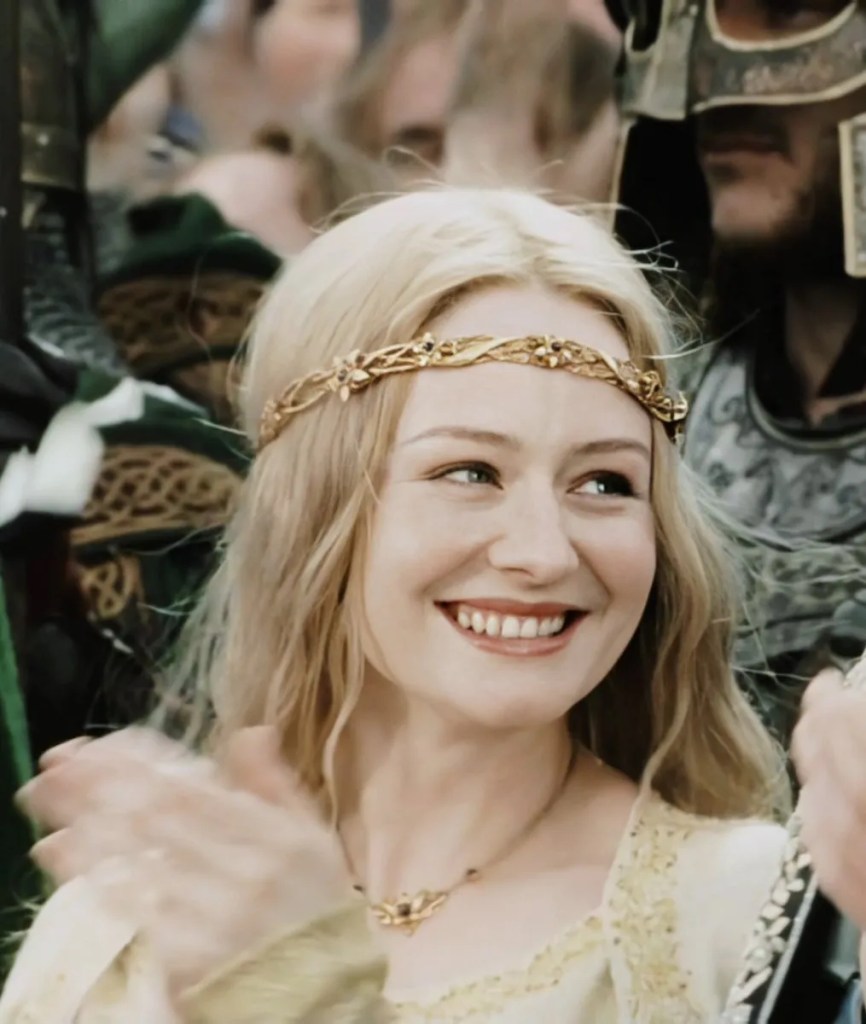
Welcome back to White Rose of Avalon, my Darlings. For this week’s Femme Fatale Friday blog post, I will be discussing Éowyn from The Lord of the Rings. I have surprisingly never discussed her before, which I realized during my recent rewatch of the films, so I will be rectifying that today! Éowyn is known as the Shieldmaiden of Rohan and the White Lady of Rohan, which shows her importance in the narrative of The Lord of the Rings, as titles like this tend to denote characters who make an impact on the plot.
When Éowyn is introduced, we learn that she is the niece of King Théoden. It is obvious that Éowyn is quite distraught over the state of her uncle, the King, as he had fallen under the thrall of Saruman and Wormtongue. In fact, Éowyn had been taking care of her uncle for several years by the time she was introduced into the narrative. It is alluded to that Éowyn had been enduring uncomfortable advances from Wormtongue for some time. In fact, the way that Wormtongue looks at Éowyn and speaks to her in The Two Towers film is definitely one of the most unsettling things to watch, even if it is not part of the primary plot. This always makes my skin crawl when I watch it, and it makes me very happy that they cast Brad Dourif as Wormtongue, given that he is so great at playing a villain and making the audience feel discomfort!
Although this relationship between Éowyn and Wormtongue is not elaborated on, it is one of the first indicators of just how strong she is. After all, she had clearly had to put up with this for some time, and it had also led to the departure of her brother when he tried to defend her and their uncle, as Wormtongue had him removed from Court! Of course, Gandalf was thankfully able to restore King Théoden, ridding him of the influence of Saruman. So, that is how Wormtongue is removed from the Court of Rohan.
That is when Éowyn’s place in the narrative really takes form. She quickly formed a bond with Aragorn, idealizing him as a hero and as a man that she clearly had a romantic interest in. In the films, I find that I feel even more sad for her romantic feelings towards Aragorn than in the novels, as the whole of The Two Towers film is interspersed with flashbacks to Arwen and Aragorn’s love story. So, it is quite clear that Éowyn and Aragorn are not meant to be from the beginning, but in the novel, it is left a bit more ambiguous, leaving room for a first-time reader to wonder who Aragorn would end up with. That being said, the novel also elaborated on Éowyn’s love story with Faramir much more, as they meet and develop feelings for one another as each is healing after the Battle of the Pelennor Fields.
That leads perfectly into the discussion of the most iconic part of Éowyn’s story. During the Battle of the Pelennor Fields, it is Éowyn who challenged the Witch-king of Angmar, Lord of the Nazgûl, and was able to kill him. This is one of the most enjoyable moments in any Battle featured in The Lord of the Rings, as the Witch-king of Angmar had found it amusing that he was being challenged initially, stating that “no living man may hinder me”. However, as Éowyn removed her helmet, she showed that she was not a man, and therefore could defeat him! I love this bit of lore, this loophole, for a man could not slay him, but a woman who was brave enough to ride into battle could!
So, yes, Éowyn’s place in this story is beyond important, as she is the one who defied orders to ride into battle and, because of this, defeated a fierce opponent. I also have to state that I love Éowyn’s dynamic with Merry, as the two form a sweet friendship, which is again elaborated on more in the novel, but we still get to see their bond in The Return of the King film, when they ride into battle together!
At the end of the day, Éowyn is a multi-layered character. She is at once a fierce warrior-woman, seeking to protect herself and her people from harm, fearlessly riding into battle, and she is also a loving caregiver who selflessly cared for her uncle when he was ailing. She more than earned her titles of both Shieldmaiden and White Lady, with her nature as a protective figure to the people of Rohan well-established. Finally, while she did not get to have a romance with Aragorn or become Queen of Gondor, she did get a happy ending of her own, with Faramir! I do wish that we got to see more of it in the films, but at least the novels elaborated on this aspect of her story. I truly do love Éowyn, and as one of only three prominent female characters in The Lord of the Rings trilogy, she definitely stands out. One thing is for certain, while Tolkien did not write many female characters in Middle-Earth, the ones he did include are all amazing in their own right!
I hope you have enjoyed reading some of my thoughts on Éowyn. What is your favorite thing about the Shieldmaiden of Rohan? Let me know your thoughts in the comments below!
Note on Image: The image at the top of the post is a lovely photo of Miranda Otto as Éowyn from the films. I found the image on https://frockflicks.com/wcw-miranda-otto/.
LINK TO AVALONIAN ROSE FAERY MYSTERIES PATREON: patreon.com/AvalonianRoseFaeryMysteries
Further Reading/Watching
- The Lord of the Rings: The Two Towers by J.R.R. Tolkien
- The Lord of the Rings: The Return of the King by J.R.R. Tolkien
- The Lord of the Rings: The Two Towers (2002)
- The Lord of the Rings: The Return of the King (2003)
- https://lotr.fandom.com/wiki/Éowyn
5 responses to “Éowyn, Shieldmaiden of Rohan”
I absolutely love Eowyn! I love that she was brave, smart, beautiful and ambitious. I also love that it showed a woman can go for her dreams, kick some butt and still fall for someone. It made me so happy that they gave her and Faramir more scene time in the extended versions. I loved them in the book.
Yes, I definitely agree! Eowyn is such a multi-layered character. Thank you for reading and commenting!
What a fantastic and deeply appreciated analysis for Femme Fatale Friday, Maranda! You’ve captured the essence of Éowyn’s character with such clarity and passion. I especially loved how you structured it—starting with the subtle, everyday heroism of enduring Wormtongue’s creepiness (and yes, Brad Dourif is perfectly unsettling) and building to her legendary, lore-defying moment on the Pelennor Fields.
You touched on so many key points that make her resonate:
· The Duality of Strength: The “White Lady” who is both a tender caregiver and a fierce shieldmaiden. Her strength isn’t just in swordplay; it’s in years of patient, lonely endurance.
· The Nuanced Heartbreak: Your observation about the filmmaking choice to intercut her Aragorn scenes with the Arwen flashbacks is so sharp. It heightens the tragedy of her unrequited feelings, making her arc one of finding a love that sees her, not just an ideal.
· The Iconic Victory: You articulated perfectly why her defeat of the Witch-king is so satisfying. It’s not just a “girl power” moment (though it is); it’s a narrative loophole born from prophecy, fulfilled by someone brave enough to step into a space where “no living man” could go. The helmet-removal reveal is cinema history.
· The Underrated Bonds: Highlighting her dynamic with Merry is a lovely touch. It’s a friendship of mutual respect and shared desperation that adds such warmth to her character.
Your final point is so true: while Tolkien’s female characters are few, they are formidable, and Éowyn stands as a pinnacle of that. She transcends the “warrior woman” archetype by being fully human—vulnerable, yearning, healing, and ultimately choosing a life of peace and love after achieving glory.
Thank you for rectifying the omission and giving Éowyn the thoughtful spotlight she deserves. This blog post is a wonderful tribute to a character who continues to inspire. I’m already looking forward to next Friday’s entry!
To answer your question: My favorite thing about the Shieldmaiden of Rohan is that moment of defiance. It’s not just her famous line, but the weary, desperate, and utterly fearless “I will hinder you, if I may” that comes before it. It encapsulates her entire journey—a willingness to stand against despair itself, even when all seems lost.
What a great read, Maranda! 🌷🤝
I am delighted that you enjoyed reading my thoughts on Éowyn! She is truly an unforgettable character. As always, thank you for reading and commenting!
Thank you for your reply and you are most welcome Maranda 🌷🤝