
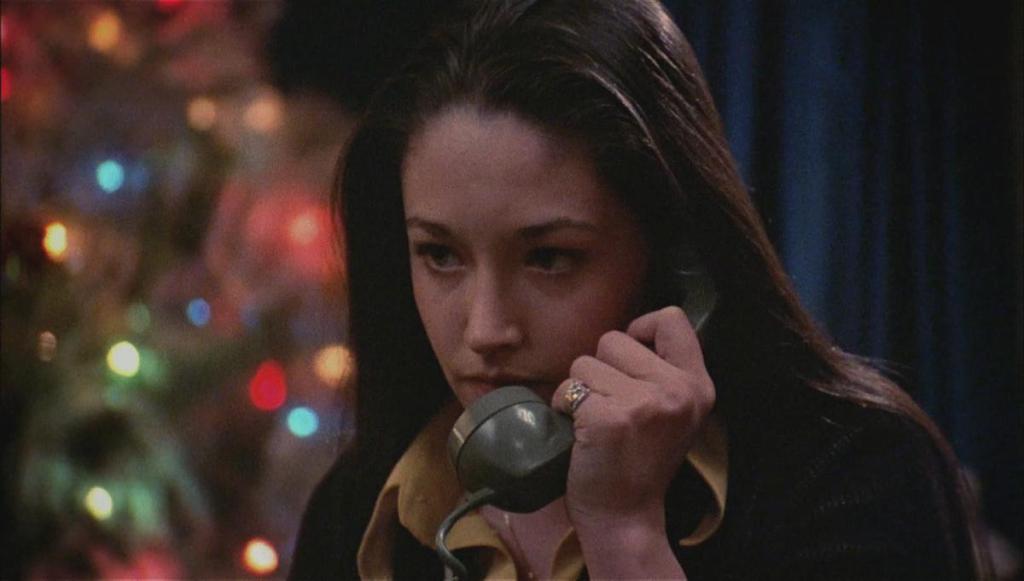
Welcome back to White Rose of Avalon, my Darlings. For today’s Femme Fatale Friday blog post, I am discussing the character of Jess from Black Christmas, played by the amazing Olivia Hussey! I thought this was the ideal topic for this final Femme Fatale Friday of December.
I have been a huge fan of the horror genre since I was only eleven years old, but honestly, it goes back even further, as I have always adored stories of things that go bump in the night. It was just that I had been too scared to watch horror films until I was eleven, but after that, I never went back. I state this to show that I have a long history with the horror genre, and that is part of why I just could not resist talking about the character of Jess Bradford from Black Christmas.
Black Christmas is a film from 1974, often cited as the original slasher film, alongside that other iconic 1974 film, The Texas Chain Saw Massacre. Of course, the slasher subgenre had been building up for quite some time, with several films called proto-slashers, but it was not until the 70s that the famed sub-genre would become close to what it is today. However, these early slashers often did not include what we may consider staples of the sub-genre, and Jess Bradford as a character is a great example of this, as she does not fit with what people often think of when they hear the term Final Girl.
Before I get into why Jess is a unique early Final Girl, I want to acknowledge that this is not the only film with the title of Black Christmas. There was a 2006 remake, often referred to as Black X-Mas to differentiate it from this original, and while it is not nearly as good, it is a watchable film, if you like really, really dark backstories for characters. There was also another remake made in 2019, which I have never seen, especially since I have only heard terrible things, and it is well-known that it is a remake in name only, essentially using the name of a popular IP to get people to watch a movie that has nothing in common with the other films, besides a having a college and Christmas setting.
Okay, with that out of the way, I will get into my thoughts on Jess Bradford as a character, and why I adore her as a Final Girl! For those unfamiliar with the original film, I will be going into full spoilers here, as should be expected when examining a character in depth. Black Christmas begins with Jess at home in her Sorority House with her friends, throwing a holiday party. So, the audience is thrown right into the Christmas energy, with college students cutting loose after exams and preparing to return home for Winter Break. The film also does not waste time in establishing that the Sorority House has been dealing with an issue of a prank caller who is saying vile things when the girls answer the phone. This serves to build the tension, along with the obvious anxiety that Jess herself is under in the opening scenes.
It is not long before the audience is clued in that the source of Jess’s anxiety has to do with her boyfriend, Peter. Peter is a music student, and clearly completely and obsessively focused on his upcoming audition, making him oblivious to why Jess may need to speak with him in person. The scene where Jess meets up with Peter before his audition to tell him her news is amazingly done. Of course, Jess is pregnant, and she is unhappy about it, even having already decided to get an abortion. Peter’s reaction is partially what one may expect: shock and upset that Jess has made the decisions without him. However, as the film progresses, it is quite clear that Peter only wants Jess to have the baby and marry him because his music career is going nowhere!
Through a nuanced lens, we can see how each of them is being selfish. Jess should not have told him right before an audition (which he messed up), but Peter was also unlikely to have done well, given how perfectionistic he was, as that would have gotten in his way. Peter should not try to control what Jess does with her own body, or try to press for them to make their relationship something it is not, when neither of them is ready or emotionally equipped to be parents! One thing I always note when I discuss this situation in the film with friends is that Jess chose to tell Peter when she could have easily said nothing, had the abortion, and he would never have been the wiser. So, to me, that makes Jess the slightly more mature one in the situation, for her willingness to be open and honest about what was going on!
Now, all of this is going on while one of Jess’s Sorority Sisters has disappeared, with her father spending the whole film searching for her (and sadly, the audience knows that she was the first to be killed and her body has been in the attic the whole film), and the continued prank phone calls from Billy. Billy is the killer of the film, and we learn next to nothing about him, save for what he says during the calls, which amounts to a jumbled mess of sexually aggressive and wrathful threats, as these are very obscene phone calls. I find the fact that we know so little to be a benefit, as he is much more unsettling when he is a voice on the phone and a threat within the house! It is this very complex climate that really makes the film work, and really keeps the audience on the edge of their seats.
Jess makes a point to try and help in the search for her friend, working with the police to try and figure out who Billy is by having the calls traced, and deals with her personal stuff, all at the same time. That is the true strength of Jess as a character, not being the overly idealized virgin we normally see as a Final Girl (as she is obviously not a virgin, and she is not shown as perfect). Her strength is her willingness to help those she cares for and to confront problems head-on, rather than hide from them! Of course, like much of the film and much of Billy’s character, there are no solid answers at the end. At the close of the film, Jess has killed Peter in self-defense, thinking he had been Billy all along, especially with his increasingly controlling, irrational, and volatile behavior over the course of the film. However, the audience knows that Billy is not dead, but rather hiding in the attic while the police are leaving Jess in the home to rest. This means that although Jess is the Final Girl and has survived the film, her continued survival is not assured!
I have to admit, I like that the film has a bleak ending, as there is something real about it. Life is beyond difficult, and sometimes tragedies and crises do pile up, and we, like Jess, do our best to endure, but there are no guarantees. However, the fact that Jess does not give up, even as things get worse and worse and seem hopeless, is an inspirational reminder that we are stronger than we think and that we can endure more than we give ourselves credit for!
I hope you have enjoyed this exploration of Jess Bradford from Black Christmas. Who are some of your favorite Final Girls? Let me know your thoughts in the comments below!
Note on Image: The image at the top of the post is a production still of Olivia Hussey as Jess from the film. I found the picture on https://bloody-disgusting.com/editorials/3597308/original-final-girl-legacy-jess-bradford-black-christmas/.
LINK TO AVALONIAN ROSE FAERY MYSTERIES PATREON: patreon.com/AvalonianRoseFaeryMysteries
Further Watching
- Black Christmas (1974)
3 responses to “Jess Bradford from ‘Black Christmas’: An Iconic Final Girl”
This was such a fantastic and thoughtful analysis of Jess Bradford, and a perfect choice to close out the year for Femme Fatale Friday! You perfectly captured why she stands apart in the Final Girl pantheon. Your point about her not being the idealized virgin is so crucial—her strength is rooted in her complex, messy humanity. She’s proactive, morally conflicted, and trying to navigate a personal crisis while a literal monster is in the house. The fact that her “victory” is so ambiguous and bleak feels incredibly modern and powerful.
Your deep history with the genre really shines through, especially in how you contextualize Black Christmas within the evolution of the slasher. It’s so true that Jess represents a blueprint that was, sadly, often simplified later on. And thank you for the disclaimer about the remakes—it sent me laughing, especially the “remake in name only” note for the 2019 version. Spot on.
To answer your closing question, Jess is absolutely high on my list of favorites for the reasons you outlined. Others who come to mind for their unique strength and complexity are:
· Laurie Strode (Halloween, 1978): The archetype, but her resilience and resourcefulness under relentless, unknowable pressure still resonate.
· Nancy Thompson (A Nightmare on Elm Street, 1984): The shift from victim to active hunter, using her intelligence to set traps in a battle fought on a psychological battlefield.
· Sidney Prescott (Scream franchise): The evolution across multiple films, wrestling with trauma and becoming a master of the “rules,” is phenomenal.
· Ginny Field (Friday the 13th Part 2): For her brilliant, if short-lived, use of psychology and empathy to try and disarm Jason.
· Mia (Evil Dead, 2013): A phenomenal arc of sheer, brutal will to survive, fighting both literal and internal demons.
Thanks for such an engaging and insightful post, Maranda! It was a pleasure to read. Here’s to more fascinating femme fatales and final girls in the new year!🌷🤝
I am so delighted that you resonated with my thoughts on Jess as a character! I love the final girls you listed, as I usually place Nancy in the top spot on my personal list, with Jess being high up there of course. And who can forget Laurie and Sidney as icons of the subgenre. I really like that you included Mia, as she’s another example of a Final Girl who does not fit the standard trope, given her addiction issues and that she was the first one to become possessed. It was a very good call to make her the Final Girl and subvert the assumption of a Final Boy fans of ‘The Evil Dead’ series had up to that point! As always, thanks for reading and commenting.
You are welcome Maranda 🌷🤝