
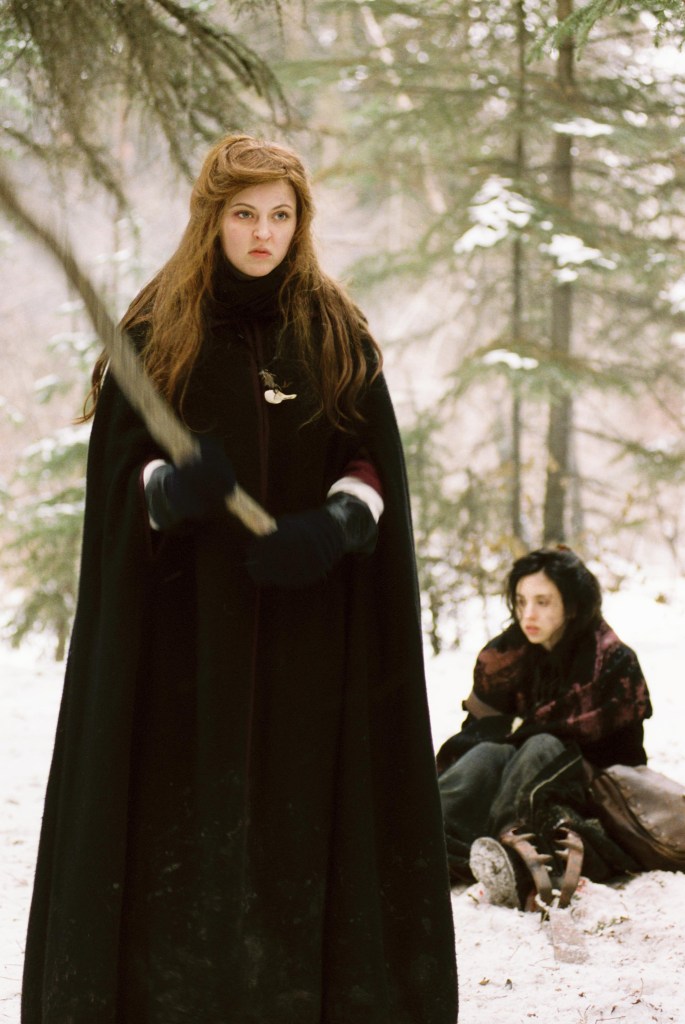
Welcome back to White Rose of Avalon, my Darlings. For today’s blog post, I will be exploring some of my thoughts about why Werewolf stories so often take place in Winter! The idea for this post came to mind as I thought of some of my favorite Winter Horror films. So, let’s begin by looking at these Wintery Horror films that inspired this post!
First, I thought of Ginger Snaps Back: The Beginning and The Company of Wolves, which are both excellent horror films set in snowy landscapes, and both are Werewolf films. Then I thought of Red Riding Hood from 2011, which, although it is not a great film, I do still enjoy the campy nature and over-the-top energy, and it is another Wintery Werewolf film. Another example that came to mind, not from a film, but from a television series, was Once Upon a Time, which had a lot of the Werewolf Ruby’s backstory set in the Winter too! Even the television series Teen Wolf chose to set important flashbacks of its La Bête du Gévaudan storyline during the Winter. This one I find truly fascinating, and very important, not just because I loved that particular storyline, but because La Bête du Gévaudan is a real historical creature whose origins have never been fully discovered. However, many believe the Beast to have been a Werewolf that terrorized the village of Gévaudan, France, between 1764 and 1767.
Clearly, there is a lot of film and television content out there featuring Werewolves in a snowy landscape, and some of it is inspired by real history and the folklore of Werewolves. When I thought on this information, I found that it made perfect sense to me for this to be the case. Werewolves are half-human and half-wolf, meaning that they are often depicted as having warm coats of fur, so they could easily survive outdoors in the cold of Winter. Not to mention that it also makes sense that Werewolf fear would be more pronounced historically during the Winter months, when animal attacks in the Forest, combined with fear of freezing to death via exposure, and the fear of starvation, would all be on the minds of many people. Werewolves can easily be seen to represent the fears of people in times gone by, and especially for the context of this post, the fears of the wilderness during the harsh Winter season!
Time and time again, we can see that Werewolves could be blamed for a lot of the issues going on for people in the Winter. If your chicken was not producing enough eggs, or an animal had killed your livestock, that could be blamed on a Werewolf taking the eggs or killing the animals. If a person were attacked by an unknown animal, that could certainly be a Werewolf. Or even, if a person began behaving oddly due to mental illness or physical illness, this too could be blamed on the person possibly turning into a Werewolf! That is why men were often accused of, and even put on trial for, being Werewolves, as Werewolves were seen almost as the male equivalent of Witches in the medieval period.
So, yes, I truly do think that the Winter season and Werewolf stories are intrinsically linked, both in modern media and in the old folklore! I hope that you have enjoyed this post exploring the link between Werewolves and Winter. What is your favorite Wintery Werewolf tale? Let me know your thoughts in the comments below!
Note on Image: The image at the top of the post is a production still from Ginger Snaps Back: The Beginning. I found the picture on https://www.imdb.com/title/tt0365265/mediaviewer/rm2117515264/.
LINK TO AVALONIAN ROSE FAERY MYSTERIES PATREON: patreon.com/AvalonianRoseFaeryMysteries
Further Reading/Watching
- The Werewolf in Lore and Legend by Montague Summers
- The Book of Were-Wolves by Sabine Baring-Gould
- The Company of Wolves (1984)
- Ginger Snaps Back: The Beginning (2004)
- Teen Wolf (2011)
- Once Upon a Time (2011)
- Red Riding Hood (2011)
- https://youtu.be/8_VfGiuvask?si=1jz4sdLabFS3orwm (This is a great YouTube video that discusses the history of the Werewolf!)
- https://www.margeride-en-gevaudan.com/en/explore/history-and-heritage/the-beast-of-gevaudan/
3 responses to “Exploring the Werewolf in Winter”
What a beautifully chilling and insightful exploration you’ve offered us today. The connection you’ve drawn between the stark, unforgiving landscape of winter and the primal fear embodied by the werewolf is utterly compelling.
You are so right to highlight that it’s more than just an aesthetic choice—a snowy backdrop for a creature with a warm fur coat. It goes to the very heart of the folklore. Winter was, historically, a time of profound vulnerability. The nights were long and dark, the cold was a silent killer, and the line between a sustaining harvest and starvation was razor-thin. The forest, which in summer might offer bounty, became a gauntlet of hidden threats. In that heightened state of fear, the mind seeks a shape for its dread. The werewolf becomes the perfect vessel: a manifestation of the wilderness itself breaking into the village, a predator that blurs the line between the beast outside and the neighbor within.
Your point about the werewolf as a historical scapegoat—for missing livestock, for unexplained illnesses, for “odd” behavior—is brilliantly astute. It reframes the monster from a simple beast to a societal pressure valve, a way to explain and contain the chaos of a harsh season and a harsh world. The comparison to witches is particularly powerful, revealing how our folklore creates gendered vessels for our collective anxieties.
As for my favorite wintery werewolf tale? While I adore the Gothic richness of The Company of Wolves, I must tip my hat to your mention of Ginger Snaps Back: The Beginning. There is something so uniquely potent about its setting—the isolated, snowbound fort, the way the cold seeps into every frame, mirroring the chilling transformation taking hold. It perfectly encapsulates your thesis: the winter isn’t just a setting; it’s an active participant in the horror, amplifying the isolation, the desperation, and the raw, animalistic survival instinct that the werewolf myth represents.
Thank you, Maranda, for another thought-provoking and wonderfully researched post. You always have a gift for weaving together pop culture, history, and folklore into a tapestry that is as enlightening as it is enchanting. I look forward to reading the comments and seeing what other winter wolf tales our fellow devotees hold dear.
With warmth against the cold,
Srikanth
I am delighted that my post resonated so much with you! I am always glad to know that my analysis of the intersection between folklore and pop culture is helpful to others as they study and discuss folklore and history. As always, thanks for reading and commenting!
You are welcome Maranda 🌷🤝