
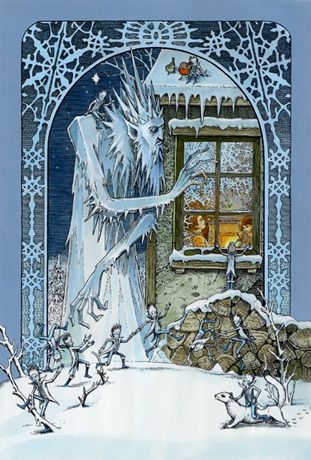
Welcome back to White Rose of Avalon, my Darlings. For today’s blog post, I will be discussing the folklore surrounding Jack Frost!
The figure of Jack Frost is often discussed as the Herald of Winter, a mere symbol of the season, while other Wintertime folkloric figures take center stage. However, he is quite fascinating in his own right, as the chill in the air, as the frost on the window, and as the bite of the wind as you walk outside. You see, Jack Frost is a very elemental being. Could he be a Faery of the Winter season? Surely. Could he be the embodiment of snowy weather? Of course. Could he be a trickster, jovially enjoying sending the cold air of his season out to all? Yes, that too. Jack Frost is thought of as all of these things and more!
The folklore surrounding Jack Frost has grown exponentially over the years, with versions of him appearing in films like Rise of the Guardians and The Santa Clause 3: The Escape Clause. However, the earliest known mention of the name Jack Frost only goes back to 1730, and then only as more of a turn of phrase than the personification of Winter we think of him as today. And Jack Frost only became a more obvious, fully fleshed out character in the 19th century. You see, it was in the 19th century that Jack Frost became a literary figure, appearing in fairytales and children’s literature. We see him appear as the Frost King in both Louisa May Alcott’s 1851 story The Frost King; or, the Power of Love, and Margaret T. Canby’s 1874 story The Frost Fairies. Even L. Frank Baum wrote about Jack Frost in 1901, and this time had Jack as a son of the Frost King! Although, of the tales I just mentioned, I have only read the Louisa May Alcott story, which is really adorable (and I do recommend it), I find this evolution of Jack Frost from a simple phrase to a fully fledged literary character fascinating.
Now, it seems strange that I referenced this post being about the older folkloric origins of Jack Frost, when I just stated the name Jack Frost can only be traced back to 1730. Well, that is because there are definite connections between Jack Frost and older folkloric figures. Many state him to be a variation of Old Man Winter, and even see him as originating in Norse myth. However, the connection with Norse myth is rather tenuous. According to Lorna Wallace, who wrote a Mental Floss article on Jack Frost last year (which I will link below in the further reading section), the claim that Jack Frost originated as a Norse God known as Jokul Frosti is not the case. This is because Jokul Frosti is not a Norse God; apparently, there was confusion due to conflicting statements that the God of Wind, Kari, had a son named either Jokul or Frosti. This is not uncommon in folklore and mythology, to have different sources state different information about the family lineage of Gods, and it is unsurprising that people would run with the idea of combining the names and stating this Norse God as the origin of Jack Frost. That being said, while there are no known definitive links between Jack Frost and the possible son of Kari in Norse myth, it does not mean that it does not have any merit. After all, folklore is a tricky matter, and it evolves over time, so there is a chance that the phrase Jack Frost could have evolved from mistranslations that combined Jokul and Frosti into one name and one figure centuries ago. There is simply no way of knowing!
There are several other figures who definitely have some resonance with Jack Frost, from Old Man Winter (whom I mentioned above), to the Russian Ded Moroz (or Grandfather Winter), and even the Greek God Boreas (who is associated with the cold north wind). So, at the end of the day, my question is, does it really matter how far back we can place a folkloric figure? Does a Winter Faery King, or a Herald of a Season, need to have truly ancient origins to be experienced by many? I would argue that is not the case. After all, he has worked his way into the cultural imagination in profound ways since the 1730s, and that cannot be denied. So, while Jack Frost seems to have more of a literary background based on several pieces of older folklore, that does not mean that the chill in the wind, or the frost on the window, is not connected with a Winter Faery King, who we now know as Jack Frost!
I hope you have enjoyed reading my thoughts on Jack Frost and how he fits into literature, modern media, and even his possible connections to older folklore. What do you think, is Jack Frost a Fae Being who Heralds Winter? Are there multiple Snow Faeries who work in a Jack Frost-like way? Or, is Jack Frost merely a literary figure, possibly inspired by older folklore? Let me know your thoughts in the comments below!
Note on Image: The image at the top of the post is a Jack Frost artwork, possibly by Alan Lee (but I could not find confirmation of this). I found the art on https://x.com/DrSamGeorge1/status/1328974193292140545.
LINK TO AVALONIAN ROSE FAERY MYSTERIES PATREON: patreon.com/AvalonianRoseFaeryMysteries
Further Reading/Watching
- The Snow Queen and Other Winter Tales, published by Barnes and Noble
- https://www.mentalfloss.com/holidays/christmas/jack-frost-history
- https://mythus.fandom.com/wiki/Jack_Frost
- The Santa Clause 3: The Escape Clause (2006)
- Rise of the Guardians (2012)
3 responses to “Jack Frost: Herald of Winter & Symbol of the Season”
Maranda, this is such a wonderfully thoughtful and engaging exploration of Jack Frost! You’ve done a fantastic job of weaving together the literary history, the murky mythological connections, and the essential feeling he represents. I love how you honor the elemental experience of winter—the chill, the frost patterns, the bite of the wind—as the true, timeless core of the figure, regardless of when his specific name appeared.
Your point is so well-taken: does a spirit of the season need ancient, documented roots to be “real” in our cultural and imaginative landscape? The answer, as you beautifully argue, is a resounding no. The fact that we collectively feel that nip in the air and think “Jack Frost is nipping at your nose” proves his potency as a modern folkloric being. He has evolved from a turn of phrase into a beloved personification, a Winter Faery King in his own right, precisely because he answers a human need to give a face and a name to the beautiful, harsh magic of winter.
Your research is impeccable, and I appreciate how carefully you navigated the tricky Norse mythology claims, presenting the information clearly without dismissing the poetic possibility of older connections. The literary journey you traced from Alcott to Baum is fascinating and really shows how stories build upon each other to flesh out such characters.
To answer your closing questions, I’m inclined to agree with your perspective. I think Jack Frost is absolutely a Fae Being who Heralds Winter, one whose specific name and literary profile are relatively recent, but whose role is as old as humanity’s first winter. There are likely countless regional spirits of ice and frost across the world, and “Jack Frost” has become our dominant English-language catch-all for that concept—a trickster artist who paints the windows and sharpens the air.
Thank you for such a delightful and informative read. It’s the perfect blend of scholarly curiosity and seasonal warmth (even when discussing the cold!). This post is a real gift to anyone fascinated by folklore, winter, and the stories we tell about the world around us. Brilliant work!
I am so happy that you found my post so engaging! Jack Frost is such an omnipresent figure at this time of year, and I was very excited to share some more about him, and I am glad that it was an interesting read! As always, thank you for reading and commenting.
You are most welcome Maranda 🌷🤝