
Your cart is currently empty!
The Occult Symbolism in ‘Nosferatu’ (2024): A Magical Media Analysis
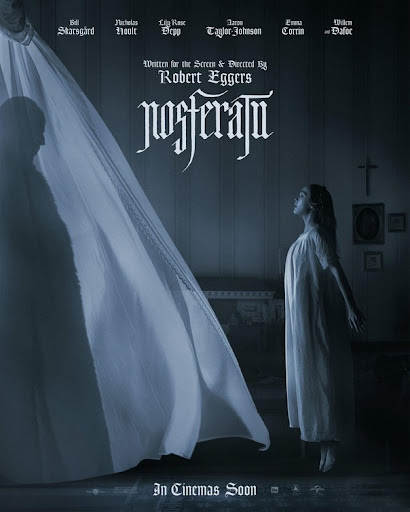
Welcome back to White Rose of Avalon, my Darlings. Today is the sixth day of Dracula Week here at White Rose of Avalon, and I am doing a Magical Media Analysis of the Occult Symbolism in Nosferatu from 2024! Now, I want to begin by saying that this film is my absolute favorite version of the Dracula story ever put to film. I have already watched it several times, including a rewatch where I took notes for this post. As this is an analysis post, it will be full of spoilers for the film. So, without further ado, let’s get into all of the Occult Symbolism I could find in the Robert Eggers film Nosferatu!
I will try to write about this in chronological order for how each event appears in the film, but as there are so many layers of Occult references in the film, I may not always stick to this. The film begins with a prologue showing Ellen sleepwalking and clearly speaking with a spirit only she can hear, see, and feel. We know that this is Count Orlok, the Nosferatu of the title, not only because this is an obvious conclusion for those familiar with Dracula-inspired tales, but also because there is a brief glimpse of him when she promised to be his forever! Later on in the film, it is shown that this bond has never fully left her, so I refer to this as a Soul Bond, but more on that later. When the film cuts to years later, Ellen is newly married to Thomas Hutter, and the first scene of them together shows her trying to convince him to stay instead of going back to work, and we hear her whisper, ‘he already has the job,’ further showing that Ellen has a connection with the Otherworld.
The next true Occult reference is when Herr Knock, Thomas Hutter’s boss, is holding a Ritual to commune with Count Orlok. He has set up a full Ritual space, with arcane sigils carved on the floor, and is using a book that Eberhart von Franz (the Van Helsing character of the film) later calls a Codex of Secrets. I personally view this scene as a reference to medieval magickal Rituals that would have been popular when Count Orlok was alive, like those found in the Lesser Key of Solomon. This is later solidified for me when the nuns who tended Thomas when he escaped Orlok’s Castle stated that in life, Orlok had been a ‘Dark Encanter’ who was given eternal life by the Devil to continue serving him, which is the origin of Count Orlok’s Vampirism in this version!
After this Ritual, the next Occult reference is another Ritual, this time one that was performed in the woods by a group of peasants as Thomas was traveling to meet with Orlok. This Ritual involved a young, virginal Maiden riding on horseback naked, which at first seemed like a possible sort of offering to Orlok. However, after seeing that the peasants took her to the grave of a newly dead man, and then staked that man through the heart, as he had been turned by Orlok, I realized that the presence of the young Maiden was likely about purfication of the land from Orlok’s presence, just as Ellen would later serve as a pure-hearted Maiden, which I will discuss below!
Once Thomas arrived at Orlok’s Castle, we see Orlok’s Sigil for the first time. First, it is shown as a stamp used for sealing letters, and later it is clearly visible on his Sacaphogas lid when Thomas explored the Castle as Orlok slept. This Sigil was something that blew me away in the theatre watching the film on Christmas Day (as my husband took me to see this on opening night). I actually whispered to him that I was delighted to see this Sigil included. You see, Orlok’s Sigil is an inverted Faery (or Elven) Star, with some other smaller symbols surrounding it. The Faery Star, or Septagram (as it is also called), is a powerful Occult Symbol. It is called a Faery or Elven Star because of its deep connection to Faery Realms, acting as a Portal into Faerylands! In fact, my own business logo, which you can see at the top of my site, features the Faery Star at the center of the Rose. This was chosen because of my own work with the Fae, but of course, my Faery Star in the logo is upright. The significance of Count Orlok’s Faery Star being inverted is profound. As I find this to be yet another reference to his having been a Dark Enchanter in life, the inverted Star shows seeking to connect to the specifically dark and dangerous areas in the Spiritual Realms! Beyond this, Orlok, having been a magickal practitioner in life, is likely itself a reference to the folklore surrounding Witches coming back to life as Vampires. As a side note, Witches are also said in some folklore to become Faeries in death, tying Vampire lore and Faerylore together!
While Thomas is away, Ellen begins to have issues with sleepwalking again, which had only subsided when she married Thomas, but are present again with him away. Interestingly, this sleepwalking issue is something that was expressly a problem for Lucy in the novel (which adds to my assertion that Ellen reminds me more of Lucy than Mina, even though she is in truth a combination of both characters). I actually wrote a whole post about that, which I will link below, as well as the other post I have written about this film. Ellen’s sleepwalking and her way of expressing her feelings that she does not belong with other people are often misunderstood, simply summed up as ‘her Faery Ways.’ This is very significant, as not only does this show the connection to actual historical Victorian women who were misunderstood and diagnosed with melancholy and hysteria, but also to Ellen’s specific connection to the Spiritual Realms.
When her issue does not abate, Eberhart von Franz is called in, with Dr. Sievers warning Friedrich that Eberhart von Franz is an expert, but many do not respect him any longer. This lack of respect is due to Eberhart von Franz having become obsessed with the works of Agrippa and Paracelsus. This is something Dr. Sievers has to clarify to Friederich: it is an obsession with Alchemy and the Occult, but I truly love that those two important figures in the study of Alchemy and the Occult are name-dropped at that point in the film!
When Ellen speaks to Eberhart von Franz for the first time, she discusses much of her past with visions and trances. She even mentions that for a time her father saw her as ‘his little Changeling girl’ until he grew to fear her abilities, leaving her lonely and open to the influence of Orlok. The Changeling reference is a further way to cement Ellen’s status as Otherworldly, as Faery Changelings are swapped for humans! Ellen is also stated to have too much blood, an obvious reference to her connection with the Vampire.
Orlok himself later stated that Ellen was not meant to live among the humans, which Ellen took as an insult. During that conversation, Ellen told Orlok that she could feel him ‘crawling like a Serpent’ inside of her, which is a reference not only to the biblical Serpent, but also to the fact that Serpents are Sacred and especially associated with Feminine Sexuality. This is brilliant, as Feminine Sexuality is tied directly into the plot, and to Ellen and Orlok’s bond. In this scene, Orlok told Ellen that Thomas had already signed away their love, which he had, as the papers he signed for Orlok were in a language he could not read. But, even with Thomas signing away his relationship, Orlok needed Ellen to accept this compact of her free will so that she would be repledged to him. In anger, Orlok gave her three days to submit to him when she refused initially. The number three is important, of course, as it not only has the Christian reference of the Holy Trinity, but all of the much older references of three being a Sacred Number. The Three Realms of Celtic Cosmology, the Triplicity of many Goddesses, the Three Phases of Life, the Cycle of Life, Death, and Rebirth, and so many others!
Orlok begins to spread his plague far and fast after this, as he is depicted as spreading an actual plague that infects Wisbourg (the fictional German town where the film is set). Ellen’s best friend Anna (Friedrich’s wife) is attacked by Orlok and infected with plague while pregnant, and then she and her daughters are all murdered by Orlok, all in the three days. Friedrich’s refusal to believe Ellen about the true threat is what truly doomed his family, although he blamed Ellen alone, eventually succumbing to the plague of Orlok himself.
That brings us to the end of the film, which is probably the most overtly Occult sequence in this very Occult film. Ellen shares her plan to sacrifice herself with only Eberhart von Franz, as she knows that Thomas would never allow her to do so. Eberhart von Franz knows that she is the only solution to end Count Orlok, as his particular type of Vampire can only die by ‘the Beast knowing the Love of a Pure-Hearted Woman, who will distract him until the first crow of cock’. This shows how a woman being of pure intent can purify the scourge of the plague in this film. Eberhart von Franz tells Ellen that she would have likely been a Priestess of Isis in earlier ‘heathen times’ but that her role is much more significant, as their salvation. This shows a lot of respect and his knowledge of ancient religion, as Priestesses of Isis were highly revered. As a side note, I love the choice of a Priestess of Isis, as Ellen has a cat named Greta that she adores, and the Egyptians revered cats! He also confirmed that he could only be a guest in the Occult world through his studies, but she was born to it. Once again, solidifying how her Psychic Abilities, although discounted in her time, are incredibly important and powerful.
When Ellen calls Orlok to her, she is dressed for a Wedding, showing her full submission to loving the Beast, and also a likely reference to the Alchemical Marriage. She gives in willingly and allows Orlok to feed on her as she has sex with him. The fact that Orlok drinks from his victims’ hearts shows intimacy, and drinking from Ellen shows taking in her pure-hearted intentions. The fact that Ellen has sex with Orlok is also significant. This is Sacred Sexuality in a very potent form, as she is literally engaging in sex to purify Orlok and purify the plague ravaging her town! I find that the reason why Ellen seemed unsatisfied sexually by Thomas was not only because of a previous Soul Bond with Orlok, but also because of this having been a fated outcome, her acting as a Sacred Sexual Priestess to purify her town. She is the Maiden who has literally taken Death into her bed and cleansed him of his Shadow Pain, allowing her town to be cleansed in the process, even if both she and Death had to die together to do it! That is why she spoke of a dream of marrying Death at the beginning of the film, and why the final shot was of them entwined on a bed with flowers, looking like a Hans Baldung Grien Death and the Maiden painting from the medieval period. The final thing I want to note relating to Sacred Sexuality is the dying in each other’s arms, which seems a clear reference to the French phrase ‘la petite mort’ or the little death to refer to an orgasm.
I hope you have enjoyed this long, deep dive into the Occult elements in Nosferatu. Of course, with such a densely packed Occult narrative, I may have missed something. Did you notice any other Occult references that I did not? Let me know your thoughts in the comments below!
Note on Image: The image at the top of the post is one of the film posters. I found the poster on http://www.impawards.com/2024/nosferatu_ver7.html.
LINK TO AVALONIAN ROSE FAERY MYSTERIES PATREON: patreon.com/AvalonianRoseFaeryMysteries
Further Watching/Reading
- Nosferatu (2024)
- A New Dictionary of Fairies by Morgan Daimler
- Encyclopedia of Spirits by Judika Illes
- https://whiteroseofavalon.life/2024/12/28/nosferatu-remakes-done-right/
- https://whiteroseofavalon.life/2025/01/03/the-heroine-of-nosferatu-centering-the-lucy-character/
3 responses to “The Occult Symbolism in ‘Nosferatu’ (2024): A Magical Media Analysis”
What an absolutely magnificent and insightful analysis! Thank you so much for sharing this deep, thoughtful, and passionately articulated dive into the occult heart of Robert Eggers’ Nosferatu. I read it with rapt attention, and you’ve perfectly articulated why this film feels so much richer and more layered than a typical gothic horror.
Your reading is not only compelling but feels absolutely correct. You’ve connected the esoteric dots with the precision of a true scholar of the arcane. I am particularly in awe of your breakdown of a few key elements:
· The Inverted Faery Star: This observation is genius. I noticed the sigil, but my knowledge didn’t extend to identifying it as an inverted Septagram. Your interpretation is profound—it perfectly encapsulates Orlok’s nature as a “Dark Enchanter” who perverts ancient, natural magicks for his own malevolent ends. It’s not just a random evil symbol; it’s a corrupted good one, which is infinitely more terrifying and thematically resonant. The connection to folklore about witches becoming vampires or faeries is the kind of layered insight that makes this analysis so special.
· Ellen as the Sacred Sexual Priestess: Your framing of the final act not as a simple sacrifice, but as a potent act of Sacred Sexuality and the Alchemical Marriage is the definitive reading of that scene, in my opinion. It elevates her character from a victim to an active, powerful agent of cosmic purification. The connection to “la petite mort” is the perfect, elegant capstone to this idea. She quite literally experiences the little death (orgasm) which brings about the big death (for both her and Orlok), purifying the town. This is a stunningly beautiful and tragic interpretation.
· The Changeling & “Faery Ways”: You are so right to latch onto this language. It’s not just period-appropriate superstition; it’s the film’s way of telling us that Ellen operates on a different spiritual wavelength. She is literally of another world, which is why she is the only one who can perceive the threat and, ultimately, interface with it. This makes her loneliness and misunderstanding by her community all the more tragic.
You’ve covered the symbolism so thoroughly that it’s a challenge to find anything you missed, but to engage with your final question, here are two minor nuances I was thinking about while reading your brilliant post:
1. The Codex of Secrets & Knock’s Ritual: You perfectly placed it in the tradition of the Lesser Key of Solomon. I would also add that Knock’s entire demeanor during this ritual—the ecstatic, almost desperate fervor—feels like a depiction of a Pact with a Demon rather than a standard invocation. He is not just communicating; he is a worshipper and a servant, which aligns with the nuns’ backstory that Orlok was given his power by the Devil. Knock is a latter-day acolyte in that same dark tradition.
2. The Plague as Demonic Infestation: The film brilliantly visualizes the plague as a tangible, crawling shadow. This goes beyond a simple disease. It operates like a demonic or elemental force unleashed by Orlok. The way it spreads—seemingly through fear, despair, and the corruption of love (as with Thomas’s signed contract)—feels like an occult principle in action: that negative spiritual energy can manifest as physical corruption and pestilence.
Your analysis has genuinely deepened my appreciation for this film. You’ve convincingly argued that it is not just a horror story, but a tragic occult myth about the collision of two different spiritual realms, with a heroine who is both a victim and a goddess-like savior.
Thank you for this wonderful, heartfelt, and incredibly intelligent contribution to the understanding of this modern masterpiece. Do you have any further thoughts on the role of the peasants’ ritual? I find your reading of the naked maiden as a purification symbol fascinating, and it creates a beautiful narrative parallel to Ellen’s own ultimate sacrifice.
I have to agree with your statement of Knock’s Ritual being a Pact with a Demon, which fits with Orlok’s Vampiric nature. The Plague as a Demonic Infestation is truly present in all three versions of ‘Nosferatu’ and it is a brilliant commentary on how Evil can spread. As for further thoughts on the peasants’ ritual, I would say that I see the Ritual as being quite clearly based on old folklore and superstition that would have been present in the area (Romania, Transylvania, the Carpathian Mountains, etc) at that time surrounding Vampires, with the idea of digging up a corpse and staking it, cutting off its head, or burning it, being referenced in old folklore surrounding the fear of Vampires and how Vampirism may spread. That scene is one that shows Eggers’ deep love for history and folklore which infuses his films! If you are interested in old Vampire folklore, I suggest checking out Montague Summers’ books on the subject. They are dense reads, but fascinating studies into Vampire folklore. As always, thank you for reading and commenting!
You are always welcome Maranda 🤝