
Welcome back to White Rose of Avalon, my Darlings. Today’s post is a discussion of the original Nosferatu and both of its remakes. In fact, the new film has been my most anticipated film of the year, what with my adoration of Vampires in general and my lifelong love of both of the earlier versions of the film! My husband also really adores the original 1922 film, as it is one of his favorite silent films of all time, making for an ideal end Christmas Night for both of us, but more on that later.
Now, the original Nosferatu: A Symphony of Horror was released in 1922 and is a German Expressionist film by the great F.W. Murnau and starring Max Schreck as Count Orlok. For those unfamiliar with the making of this film and the controversy surrounding its release, I do want to state that we are lucky to even still have this film in existence at all. The film was made without permission as an unofficial adaptation of Bram Stoker’s 1897 novel Dracula. And that unofficial part is what got the film into trouble, as even though Murnau was careful to change things from the source material, like the names, location, and how the Vampire is killed, Bram Stoker’s widow was still angry enough at the copyright infringement that she took him to court. Furthermore, she won the case, and all copies of Nosferatu were supposed to be destroyed, and all of the copies in Europe and the UK were destroyed. However, as luck would have it, there was a copy in America that survived, and it is from that copy that all the versions of this film circulating today come from! I know that this backstory has little to do with the actual film plot, but I just had to include it, as I find it to be a truly fascinating story.
As for the actual plot of the film, it is much more simplified than Dracula. It tells the story of a man named Hutter (which is our Jonathan Harker character) who has a wife named Ellen (who, although being his wife, is actually more akin to Lucy Westernra in the novel). He is tasked with going to Transylvania from his home in Wisborg, Germany, to sell Count Orlok a home. Hutter’s boss is named Knock, and he is our Renfield character in the film. Before leaving, Hutter takes Ellen to a friend’s home where she can stay so she is not alone while he travels. So, Ellen stays with Hutter’s friend Harding while he is visiting Count Orlok. Hutter experiences trauma in Orlok’s home. Of course, there had been signs that he was going into danger, as no locals dared go near the Count’s castle!
It is made obvious that Count Orlok is feeding on Hutter, and it is not long before Orlok leaves Hutter to die (but he luckily gets saved). Orlok takes a ship from Transylvania to Wisborg, bringing with him much soil from his homeland and countless rats. This is because, in this film, Count Orlok is the carrier of the Black Death, he literally brings the Plague upon the town of Wisborg! Equating Vampirism to a Plague is a very interesting interpretation of Vampires rooted in old folklore. Eventually, Hutter is healed enough to make his way home to Ellen, who had been having episodes of distress and delirium in his absence. This is the thrall of the Vampire, as Orlok had seen Ellen’s image when he first met Hutter, and it was then that he decided he must have Ellen! Of course, I have always liked an alternate interpretation of this being rooted in the bond between the lovers, with Ellen knowing of the danger her husband was in with the Vampiric thrall, exacerbating the power of the connection between all three. But either way, Ellen is certainly linked to Count Orlok from the time he meets her husband.
Ellen goes on to read a book Hutter had not wanted her to read, as it contained much information about Vampires. This book allows Ellen to figure out what is going on in the town and come up with a plan to save everyone by offering herself, as a maiden of pure heart and pure intent, to Orlock to distract him until sunrise. Of course, this is how Orlok died, by staying too long with Ellen and being burned by the Sun (which is also the first time that ever happened in Vampire media)!
The 1979 Warner Herzog remake is an eerie and beautifully shot love letter to the original, as Herzog considered the original to be a masterpiece. It has an interesting history, as it was filmed simultaneously in German and English, with certain scenes filmed in each language and the actors in the film dubbing their own voices in each language, meaning you can watch the film in either dialect! Herzog chose to use the names of the characters from Dracula, as they were at that time public domain, and he could (likely a nod to the trial that almost destroyed the first film). The film starred Klaus Kinski as Dracula and the amazing Isabelle Adjani as Lucy. So the story follows Jonathan Harker leaving Wisborg to go to meet Count Dracula at the behest of his employer, Renfield. His wife is Lucy, and she stays with their friend, this time named Warden. The film follows much of the same plot as the original, with more fleshed-out scenes and giving the narrative room to breathe (it need not be so fast-paced as it was as a silent masterpiece).
In this version, Harker is almost catatonic when he returns home to his wife, and Lucy is determined to discover the cause of his illness and the Plague that has permeated her town. It is she who does the research by reading a book that Harker brought back from Transylvania and figures out what is actually happening. Van Helsing (as a side note, there is a Van Helsing character in the original called Professor Bulwer) is very dismissive of Lucy, which he later regrets, seeing that Lucy died making sure Dracula would meet the Sun! Van Helsing goes go on to also stake Dracula, who appears dead on Lucy’s bedroom floor, just to make sure he is truly gone. The film ends a bit differently than the first, but I will not spoil that for those who have not seen it!
Finally, I have to end this post with my thoughts on the new remake by Robert Eggers, which was just released on Christmas Day. My wonderful husband Andrew took me to see the film opening night as one of my Yuletide gifts, well, a gift to both of us, given our mutual love for the original (as I hinted at in the first paragraph of this post)! I will not be going into spoilers, as I truly want anyone who is interested to go and see this film, even though I did go over the basic plot of the original, the interpretation this film takes does add so many new layers.
Seeing the 2024 Nosferatu was a visual treat, as it is truly stunning and atmospheric, as anyone familiar with Robert Eggers’ work would expect. I was very impressed by the performances of the cast, Lily-Rose Depp especially really blew me away (as I had never seen her take on a dramatic role like this one)! Willem Dafoe was phenomenal as Professor Albin Eberhart von Franz, the Van Helsing of this film. Nicolas Hoult was pitch-perfect casting as Thomas Hutter (as this film goes back to the original 1922 names for most characters). Of course, Bill Skarsgard did a fantastic job as a truly creepy and unsettling Orlok. I do have to admit I had two small reservations when Orlok appeared, one having to do with makeup (but I will not spoil it) and the other having to do with the cadence at which he spoke when speaking in English. Orlok’s voice has a thick accent and very slow speech when in English, which is not as odd in the ancient dialect he speaks, but I quickly became accustomed to the strange cadence and truly thought it added to the overall atmosphere of the film. The same goes for the makeup choice I was uncertain of, as I quickly adapted to this new look, enjoying its historical and folkloric take on the Vampire and how it differed from other interpretations of Dracula and Orlok! While I absolutely adored this film, I want to note that it is much more explicit than either of its predecessors. I appreciated the way the explicit content was used, as it was tasteful, artistic, and truly fit the worldbuilding of the film (plus, explicit content does not bother me). That being said, I wanted to mention it in case you are sensitive to gory imagery or do not like erotic overtones.
I do want to state that I really appreciated all of the Faery references within the film, with a Faery or Elven Star (also called a septagram, the same symbol in the center of my White Rose of Avalon logo) appearing many times and several references to the Fae and Changelings peppered throughout the film! The attention to detail was amazing when it came to the costuming, the sets (with some signs actually in German), and references to actual medical beliefs of the time period. The last thing I will say is what I said to my husband in the theater: This film is what you get when you mix Nosferatu with Bram Stoker’s Dracula (1994). There was obvious inspiration taken from the Francis Ford Coppola film in the best ways while still being very much a Nosferatu adaptation, with the credits acknowledging being based on both Nosferatu and Dracula by Bram Stoker.
The film really does build upon what was developed in the first two in rather unique ways. So, to answer the question in this post title, yes, these are remakes done right, building upon the source material and giving nuance! For me, all three films are 10/10 movies, but in their own special and unique ways. I also have to say that this has got to be my favorite film I saw this year, having lived up to and even exceeded my expectations. I hope you have enjoyed this long and loving rumination on the three Nosferatu films. Do you want to see the new remake? Let me know your thoughts in the comments below!
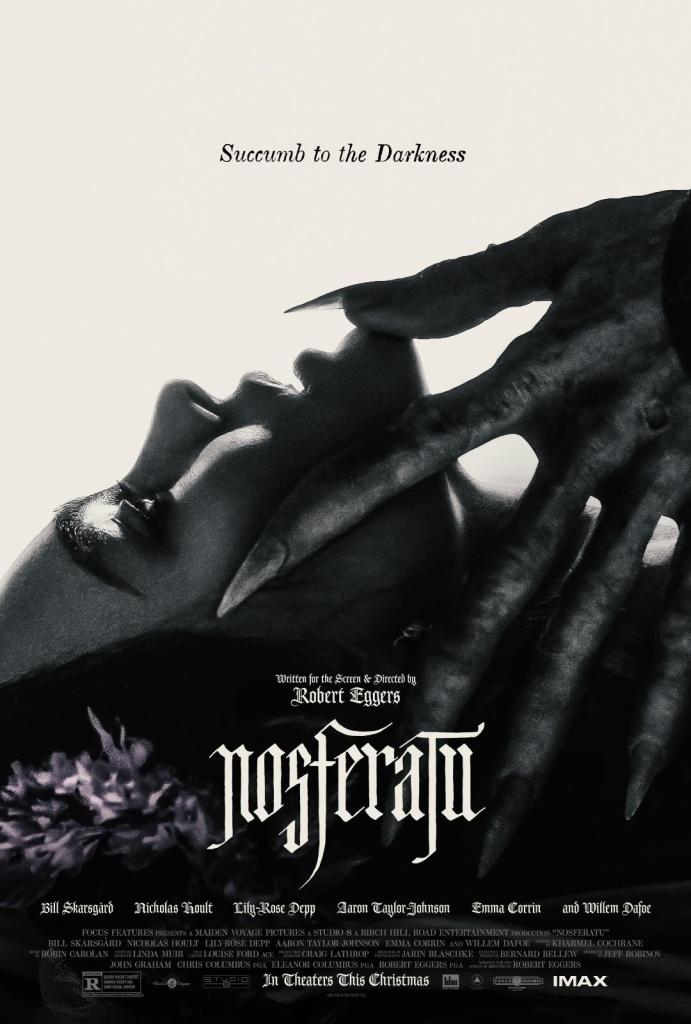
Note on Image: The image at the top of the post is the poster for the new film. I found the poster on https://www.imdb.com/title/tt5040012/.
LINK TO AVALONIAN ROSE FAERY MYSTERIES PATREON: patreon.com/AvalonianRoseFaeryMysteries
SPECIAL ANNOUNCEMENT: I am absolutely thrilled to announce that I will be doing my first-ever Herbal Tea Blending Class on December 29, 2024 (which is tomorrow)! This is a live event hosted at the shop Phoenix Lane. Here is the link to the event on Facebook if you are interested in learning from me in person: https://www.facebook.com/share/p/19hU6vdFm3/
Further Watching
- Nosferatu: A Symphony of Horror (1922)
- Nosferatu the Vampyre (1979)
- Nosferatu (2024)
One response to “‘Nosferatu’ Remakes Done Right?”
[…] https://whiteroseofavalon.life/2024/12/28/nosferatu-remakes-done-right/ […]