
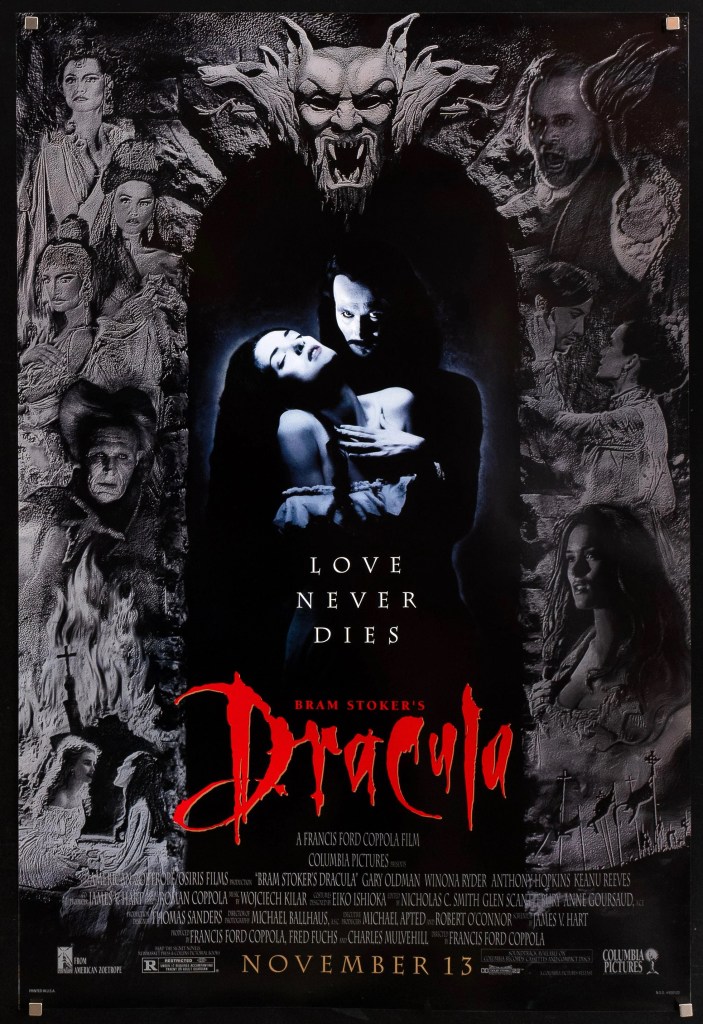
Welcome back to White Rose of Avalon, my Darlings. Today is the fourth day of Dracula Week here at White Rose of Avalon, and I am going to be doing my full spoilers review of Bram Stoker’s Dracula from 1992!
So, this was my favorite version of Dracula ever put to film for most of my life, only being surpassed by Robert Eggers’ Nosferatu last year, but this is still a close second. Francis Ford Coppola was incredibly meticulous in crafting a film which would be as book-accurate as possible (even if he did deviate in some major ways, more on that below) and using many old-school techniques to create the stunning visuals. As I said in the title, this is Dracula as the Ultimate Gothic Vampire Romance, heavy on the romance!
The film does take the plot from the book and follows it very faithfully, up to a point. The prologue showing how Dracula became a Vampire outright shows Dracula as Vlad the Impaler (which was not in the novel; Stoker only stated that Dracula was a member of the same Order of the Dragon, which Vlad the Impaler was) and added in a lost wife angle. Dracula’s original beloved wife killed herself, thinking he had died in battle, which he was told would damn her Soul, leading to him forsaking God and becoming a Vampire. Mina is the reincarnation and obvious doppelgänger of Dracula’s wife (this is a trope in Dracula retellings that has become increasingly popular). The film also added in the love story between Mina and Dracula, which I cannot deny I outright adore, so no complaints there!
Beyond making Dracula expressly Vlad the Impaler and adding a love story, the film also makes the choice of having Renfield be a former solicitor who went to Transylvania before Jonathan Harker. This is something that dates back to the 1931 film, but in the novel, Renfield is simply a patient in Dr. Seward’s asylum who is criminally insane, leading Dracula to use him because he was easy to influence after arriving in England.
Other than those things, the film does stick quite close to the novel. It follows Jonathan Harker as he arrives in Transylvania and all of his trials at the Castle, including encountering the Brides of Dracula. That scene is made much more explicitly sexual than in the novel, which makes sense for a film made in the 1990s. Coppola even included Dracula giving the Brides a baby, which the audience knows that they will feed on. This scene is in the novel, but not included in many adaptations! The film also intersperses scenes of Jonathan in Transylvania with Mina in England, rounding out the narrative nicely.
Mina is staying with her best friend, Lucy Westenra, at the beginning of the film. In the film, Lucy is portrayed as a bit more flirtatious than her sweet nature in the novel, which does play on the temptress image the character has unfairly received. However, in a voiceover, Mina does inform the audience that Lucy is virtuous and pure, but has a free way of speaking that could shock people. I quite like this update, as it assures the audience that Lucy is sweet and innocent, but makes the character a bit more in line with 1990s expectations, ultimately making her more relatable to the then-modern audience without devaluing her as a temptress looking to seduce every man around her. This is important to me, as Lucy is a character I truly adore! Just like in the novel, there is much concern after Lucy began sleepwalking. That is where more overt sexuality is added in yet again, with Lucy being ravished by Dracula in a monstrous wolf-like form, which is hinted at in the novel when Mina finds her, but is discussed in a much more veiled way.
As a bonus, this film also features all three of Lucy’s suitors, as a plot point in the novel is that Lucy is proposed to by three men in one day. Ultimately, she accepted the proposal of the man who had been actively courting her before the start of the novel, but felt so pained at rejecting his two friends, who had also proposed to her. In the film, Lucy accepted Arthur Holmwood’s proposal, as she did in the novel, and rejected Dr. John Seward and Quincey Morris. This is one of the very few films that features all three of her suitors, as most merge them into one or two characters, or leave a suitor out entirely. Dr. Seward is usually always kept, as it is he who calls in Van Helsing, but Quincey Morris is in very few adaptations. It is very sad to lose Quincey in adaptations, as he is an American, adding a layer to the context of the sorts of misunderstandings Victorian xenophobia could lead to, and mirroring the xenophobia that makes Dracula even scarier to the characters. Quincey is also the character who died fighting Dracula, ending as a hero! So, I adore that he is in this version!
Dr. Seward is shown abusing morphine after Lucy rejected his proposal. This is a very interesting inclusion, as if you read between the lines in the novel, there is a vague implication that he may have abused morphine (or other drugs) in the original text, with lines pertaining to a drug helping or not, but leaving it up to interpretation if he is referring to a drug he gave to Renfield or one he took himself to ease his own emotional pain! Little details like that are what make this adaptation so special, as they are updating the narrative to make implications explicit in a time when they need no longer be veiled.
During Lucy’s illness, which grew worse and worse as Dracula continued to feed on her, Mina had her first run-in with Dracula, who introduced himself as Prince Vlad. This is where the film added the love story and created new scenes, scenes that humanize Dracula as a tragic Gothic Romantic Anti-Hero. And, I am so delighted by this being included, as I love the dark love story elements, and how it shows Mina as being truly conflicted when Jonathan is found alive. It serves to add some complexity to Mina, and to why she would react so strongly, believing herself to be impure and tainted when Dracula had begun the process of turning her into a Vampire. She is not simply reacting to Dracula’s attack and having drunk his blood; she is reacting to having had an affair!
Mina’s wedding to Jonathan is expertly interpersed with Lucy’s struggles as she succumbs to Dracula’s thrall. It is after Lucy’s death and Mina’s wedding that the film portrays the famed scene of Lucy being killed as a Vampire. Much of the plot from then on is pulled directly from the novel, with Dracula attacking Mina (here framed as a conflicted moment of tortured romance), the men destroying the coffins of dirt Dracula must rest in, Van Helsing watching over Mina when they arrive in Transylvania and using a communion wafer on her forehead to return her reasoning and killing the Brides, and Dr. Seward, Arthur, Jonathan, and Quincey going up against Dracula (with Quincey dying in the process). There are just the final moments of a tearful goodbye between Mina and Dracula added in to round out their romantic arc!
So, yes, this film is fantastic, and I have not even mentioned the performances. Gary Oldman gives an amazing performance, which humanizes Dracula and adds emotional complexity. Winona Ryder is lovely in her turn as Mina, playing the character with a depth of nuance. Anthony Hopkins is pitch-perfect as Van Helsing, Richard E. Grant is great as Seward, Billy Campbell is lovable as Quincey, and Cary Elwes is incredibly romantic as Arthur Holmwood. I also love Sadie Frost as Lucy, balancing her fun-loving nature and the wickedness of her Vampire energy well. Tom Waits is very memorable as Renfield. I will also state that I know Keanu Reeves gets a lot of flak for his portrayal of Jonathan Harker, but while the accent is bad, I honestly still find him rather endearing in the role. In fact, I have never cared for Jonathan as a character, finding him rather boring, so Keanu Reeves being so charming in general made me like Harker as a character a bit more!
I hope you have enjoyed this rather long, deep dive into Bram Stoker’s Dracula from 1992. What is your favorite thing about this film? Let me know your thoughts in the comments below!
Note on Image: The image at the top of the post is the poster for the film. I found the poster on https://filmartgallery.com/products/bram-stokers-dracula?srsltid=AfmBOoqHcSrYmnK_FVPIiAsYeNF7rMxKyyIhZu7NJUJOt9y_F-ypWU3U.
LINK TO AVALONIAN ROSE FAERY MYSTERIES PATREON: patreon.com/AvalonianRoseFaeryMysteries
Further Reading/Watching
- Dracula by Bram Stoker
- Bram Stoker’s Dracula (1992)
2 responses to “We Need to Talk About ‘Bram Stoker’s Dracula’ (1992): The Ultimate Gothic Vampire Romance”
This is such a wonderfully passionate and insightful review! Thank you for sharing your deep love and knowledge of this film. You’ve perfectly captured why it remains such a landmark adaptation, even decades later.
Your analysis of how Coppola masterfully walks the line between book-faithfulness and creative reinterpretation is spot-on. The way you highlight the added layers—the tragic romance that gives Dracula a soul, the explicit yet thoughtful handling of sexuality, and the meticulous inclusion of characters like Quincey Morris—shows just how much care went into this production. It’s clear this isn’t just a movie to you; it’s a rich text to be unpacked and adored.
And your defense of the performances is lovely. The affection you have for this cast, from Gary Oldman’s transformative and heartbreaking Dracula to your charmingly pragmatic take on Keanu Reeves’ Harker, is genuinely heartwarming. You’ve made a brilliant case for this film as the “Ultimate Gothic Vampire Romance,” and your review is a beautiful tribute to a story that has clearly touched your soul. A truly delightful read for any gothic horror fan
Thank you so much for your kind words! Yes, this film is definitely important to me, having been my favorite adaptation of the novel until last year’s ’Nosferatu’ took that spot, but I still adore this one! As always, thanks for reading and commenting.