
Welcome back to White Rose of Avalon, my Darlings. Today is the first day of Dracula Week here at White Rose of Avalon, and I am beginning by reviewing the original book! I have never actually posted a full review of the original novel here on White Rose of Avalon, so I thought that Dracula Week was the ideal time to do so. As a preface, this is a long review, and I will be including a bit about how the novel evolved in the numerous adaptations, so there are spoilers here for those who have not read the original novel!
I want to begin by stating that Dracula by Bram Stoker is an epistolary novel, which means that the whole of the text is written in diary entries, letters, and newspaper articles. This may be a form of literature that a reader has never encountered before, but once you grow accustomed to the structure, it is a very fascinating way to delve into the world of a narrative. The epistolary form allows the author to give multiple first-person viewpoints, allowing the reader to see from the perspective and the inner mindset of multiple characters.
I have always adored all things Dracula, and first read the original novel when I was about eleven or twelve. When I first read Bram Stoker’s original novel, I found it quite dense, which it definitely can be, but I was really drawn to Mina and especially Lucy as characters. I would go on to read the novel several times after that first reading. However, it was on this last re-read that I did at the beginning of the month that I found myself immersed in the story and not even noticing how dense the prose could be! After I got past the initial descriptions of Jonathan’s travels before reaching Castle Dracula, I really was totally enamoured with how Stoker wrote the interactions between Jonathan Harker and Dracula. The descriptions of Castle Dracula were lush, and the Brides of Dracula have always fascinated me, making me wish we could see more of them. That is the beauty of the fact that Dracula is now in the public domain, and we have gotten several novels about the Brides of Dracula that really flesh out their characters and narrative, to date!
Beyond that, the plot really picks up when Mina and Lucy’s side of the story begins. Now, I do want to note that many women who enjoy Dracula discuss how Mina and Lucy are not the most three-dimensional of characters in Stoker’s original novel. While this is true to a large extent, as they are female characters written by a Victorian man (who likely did not understand the internal workings of the female mind), I still do enjoy their characters and see the use in the way they are written to drive the narrative forward. In the case of the original Stoker novel, Mina serves as a voice of reason and a steadfast and loving fiancée and later wife. She is seen as a bit of a ‘new woman’ with her learning shorthand to help Jonathan in his future work endeavors, and she is totally beloved by all of the men. However, this is an idealized view that does not show us the depth of her desires as a woman. In the case of Lucy, she is often so misunderstood and maligned, which is possibly part of why I adore her so much! In the original novel, she is a very sweet young woman from a well-off family who just so happened to be proposed to by three men in one day. She is a deeply loving and deeply feeling woman, who felt utter abject pain at having to reject the two men she did not love, which is why she stated that she wished that women could have three husbands. It was said in a feeling of pity and mercy, showing her to be a truly empathetic character. It is this empathetic and sweet nature that endears so many of the men to her, and why she got three proposals in a day in the first place! It is also this sweetness that is turned into a total distortion and perversion of her innate nature when she is turned into a Vampire by Dracula. That is when she is shown to lure in children and feed on them, and it is then that she tries to use sexuality to lure in the men who loved her in life. However, the men are disgusted by her, serving as a meditation on the Victorian male fears surrounding female sexuality! As a side note, we have also gotten novels written from Mina’s perspective that flesh out both of their characters very well (I particularly enjoy Dracula, My Love by Syrie James), and there are films that have done this as well.
Now, I have to state that it is often quite surprising to a first-time reader of Dracula that Dracula himself does not appear very much in the novel. Instead, he is a lurking evil force overlaying the novel; he is malevolence that the main characters are fighting. I also have to say that, contrary to popular belief, in Stoker’s original novel, Dracula is not outright stated to be Vlad the Impaler. He is stated to be a nobleman who was also a member of the Order of the Dragon, which both Vlad the Impaler and his father were members of, and Vlad the Impaler did take on the title Dracula (as his father was known as Dracul, with the added ‘a’ denoting ‘son of’). As time went on, the story of Dracula in the public consciousness evolved, and now we have many films stating that the character of Dracula was literally the historical Vlad the Impaler! It is actually a truly fascinating thing to look at how beloved stories evolve over time.
The final thing I want to touch on in this review is the three characters who are often morphed into one in film adaptations, or excluded entirely. These men are Lucy’s suitors. Her fiancé was named Arthur Holmwood. The other two men were good friends of Arthur’s, one being Dr. John Seward, and the other being the American Quincey Morris. John Seward is a very important character who is almost always in adaptations, as he runs the asylum where Renfield is a patient, and the one who calls in his mentor, Van Helsing, to help during Lucy’s illness. As a side note, Renfield in the original novel is just a patient who was deemed criminally insane, whom Seward had a fascination with. Dracula used Renfield, and his weak mind, to help him only once he reached England, which differs from many adaptations that have Dracula and Renfield having a deeper link. As for Arthur Holmwood and Quincey Morris, they are often merged together, or Morris is excluded entirely. This makes sense during the adaptation process, but it is sad, as Quincey Morris, being an American, is sometimes misunderstood by other characters and serves to show British Victorian xenophobia (as does Dracula himself). Beyond that, Quincey Morris is the one who dies at the end of the novel in the final fight with Dracula, so he literally died to make sure that his loved ones survived! We learn in the last paragraphs that Mina and Jonathan Harker even called their son Quincey in his honor. Obviously, I have not discussed Van Helsing very much, but that was because I wanted to highlight lesser discussed characters, but of course, Van Helsing is a completely iconic character.
So, that brings an end to this review of the Bram Stoker novel Dracula. I hope you have enjoyed reading my thoughts on this iconic piece of literature, and that you will join me tomorrow, as I continue Dracula Week. Who is your favorite character from the original novel? Let me know your thoughts in the comments below!
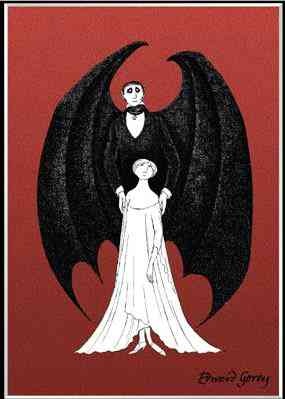
Note on Image: The image at the top of the post is an Edward Gorey illustration for Dracula. I found the artwork on https://pagefiddler.wordpress.com/2014/05/28/dracula-a-toy-theatre-edward-gorey/.
LINK TO AVALONIAN ROSE FAERY MYSTERIES PATREON: patreon.com/AvalonianRoseFaeryMysteries
Further Reading
- Dracula by Bram Stoker
- https://www.britannica.com/biography/Vlad-the-Impaler
- https://shop.minimuseum.com/blogs/specimens/the-world-of-the-real-count-dracula?srsltid=AfmBOopt1T44W-bVgsP0WPsu21nH6zQ8T0Lmp_mNyhGYMpEtXBIDPadn