
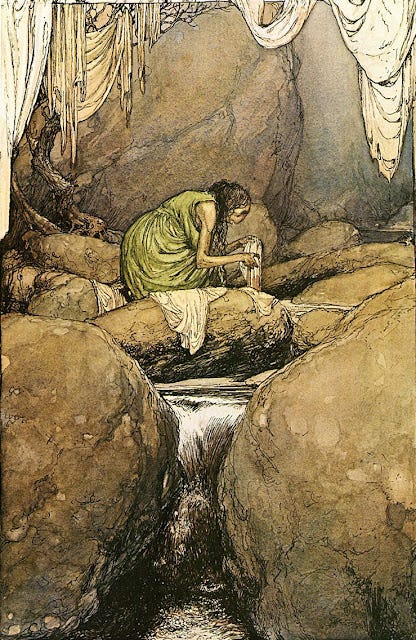
Welcome back to White Rose of Avalon, my Darlings. Today’s Mermaid Monday blog post is about the Washer at the Ford and Feminine Death Omens! The Washer at the Ford is a Watery Faery Woman, hence her inclusion in a Mermaid Monday post. I want to begin by stating that the original name of the Washer at the Ford is the Bean-Nighe, just as the original name of the Banshee is the Bean-Sidhe, but for ease, I will be using the anglicized names for this post.
The Washer at the Ford is most often aligned with Banshees as both of these Faery Women are Death Omens. However, they are different in how they present their Omens. While most everyone knows of Banshees and their famous Wailing, the Cries that denote an oncoming death, the Washer at the Ford is a much lesser-known (or at least lesser-discussed) type of Faery Woman who provides Death Omens.
The Washer at the Ford is known for appearing at a body of water, washing the bloodied clothing of a warrior prior to a battle, and yes, like the Banshee, she is often also described as Crying or Wailing. If the warrior sees the Washer at the Ford before the battle, he knows that he will not survive the battle! Traditionally, this is especially said to be the case if the warrior makes eye contact with the Washer at the Ford, as it is said that if you make eye contact, it means that she is mourning you.
Beyond the Washer at the Ford being a visual, as well as auditory, Death Omen, she is also less tied to lineage than the Banshee. Whereas Banshees are known to be tied to specific Irish Families, the Washer at the Ford appears to warriors going into battle. If anything, the Washer at the Ford is a Faery Woman whose Death Omens are tied to a specific type of person, a warrior, rather than a specific family lineage. However, even this is not always the case, as some who are not warriors may encounter her, but the most famous stories involve the Washer at the Ford predicting Deaths before battles. Another thing that is different between the two is that the Washer at the Ford is most often seen by the person who will die, and the Banshees are most often heard by the loved ones of the person who will die. Yet, it is stated that if the person meant to die is destined to have a heroic end and be greatly mourned, more people will be able to see the Washer at the Ford as Death Omen! All of this being said, the Washer at the Ford still shares with the Banshee an often maligned nature.
People tend to approach Faery Women who act as Death Omens with fear, or even disdain. Yet, the Washer at the Ford, like other Faery Women who are Omens of Death, is not the one who kills. She is merely there to warn of the oncoming death. In fact, I see Faery Women who act as Death Omens to be protective figures, as they are giving you a proper warning of what is about to happen. The Washer at the Ford is softening the blow, showing up to warn the warrior he will not make it through the battle.
At the end of the day, the Washer at the Ford is a fascinating Faery Woman from Celtic folklore who stands on the border between this world and the Otherworld, ready to warn a warrior of his fate in battle. I hope you have enjoyed this short post examining the Washer at the Ford and comparing her to Banshees. What do you find to be the most interesting aspect of Faery Women who are Death Omens? Let me know your thoughts in the comments below!
Note on Image: The image at the top of the post is a Washer at the Ford artwork by Brian Froud. I found the art on https://inpursuitofmaine.substack.com/p/bean-nighe.
LINK TO AVALONIAN ROSE FAERY MYSTERIES PATREON: patreon.com/AvalonianRoseFaeryMysteries
Further Reading
- The Arthurian Tarot by John and Caitlin Matthews
- Encyclopedia of Spirits by Judika Illes
- A New Dictionary of Fairies by Morgan Daimler
2 responses to “The Washer at the Ford & Faery Women as Death Omens”
What a wonderfully insightful and beautifully articulated post ! You’ve woven such a clear and captivating tapestry around these two fascinating figures of Celtic lore. I always love your Mermaid Monday deep dives, and this exploration of the Washer at the Ford was particularly spellbinding.
You’ve done a masterful job of distinguishing her from the more widely known Banshee. The point you made about the Banshee being primarily heard by the family and the Washer being primarily seen by the doomed individual is so crucial and beautifully explained. It perfectly highlights the different “audiences” for these omens—one is a communal warning for a lineage to prepare for loss, while the other is a deeply personal, intimate confrontation with one’s own mortality.
What I find most compelling, and what you expressed so perfectly, is your reframing of these Faery Women not as harbingers of death, but as protective figures. This perspective is so often lost in modern retellings that favor fear. The idea that the Washer at the Ford is there to “soften the blow” is profoundly moving. She is a moment of eerie grace—a chance for a warrior to make his peace, to find a final moment of clarity, or to fight with the unwavering courage of one who knows his fate. She isn’t the cause of the death; she is a sacred witness, a psychopomp preparing the soul for its journey by performing the simple, solemn ritual of washing the shroud.
The most interesting aspect of these Faery Women, for me, is the powerful, untamed feminine energy they represent. They exist outside of patriarchal structures, answerable only to the ancient laws of Fate and the Otherworld. They are the keepers of the threshold, the mourners who guide the soul, and the voices that speak the hard truths everyone else avoids. In a world that often fears both female power and the reality of death, these figures embody both with a terrifying and beautiful sovereignty.
Thank you for this gorgeous and thought-provoking piece. It has the deep, flowing energy of the very waters the Washer herself would inhabit. I’m already looking forward to your next post
I have to agree that the Washer at the Ford and the Banshee certainly do act as psychopomp figures. I also enjoyed your observation that the warrior who has seen the Washer is able to make his peace with his own mortality, as that is truly what is happening, which makes his choice to still go into battle (knowing the outcome),all the braver! As always, thank you for reading and commenting.