
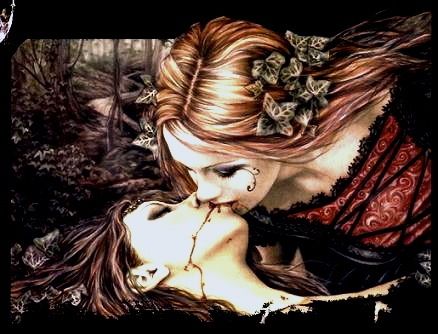
Welcome back to White Rose of Avalon, my Darlings. For today’s first Femme Fatale Friday blog post of October, I will be discussing folklore and sexuality of Vampires! In particular, I will examine female Vampires and their unique brand of sexuality in literature, films, and television series. This will include looking at nine primary examples of female Vampires and how they relate to Feminine Sexuality in their own sections below. Without further ado, let’s look at female Vampires!
Carmilla from Carmilla
~I had to start with the beginning, really one of the very first literary Vampires, Carmilla is an ideal example of how female Vampires were seen sexually in the Victorian period. She is also the genesis of the lesbian Vampire, as in her novel, and the various films based on it, she delights in seducing and feeding on beautiful young women. Although she is the primary antagonist of the novella, with the men seeking to save the young woman Laura, whom Carmilla had sought to enthrall, Carmilla is also the most fascinating character in the novella. Carmilla is very sexual and very seductive, even able to turn into a large Cat to feed on her victims, showing her animalistic sexuality!
The Brides of Dracula from Dracula
~The Brides of Dracula, obviously from the Bram Stoker novel and many of its adaptations, are three Vampires who live with Count Dracula. They are shown as fierce examples of Feminine Sexuality, much like Carmilla was before them. However, while Carmilla could blend into society and find victims that way, by luring them in with perceived innocence (and only showing sexual aggressiveness in private), the Brides are usually depicted as nearly feral. This feral nature makes them animalistically seductive to Jonathan Harker, but wholly unable to be in society, as they are obviously other. They are the untamed Feminine Sexuality, that is ferocious in its desires!
Lucy Westenra from Dracula
~Sticking with the same novel, Lucy is the best friend of Mina Murray (who becomes Mina Harker). She is the first victim of Count Dracula when he arrives in London. Now, Lucy is the exact opposite of the Brides of Dracula, as she was the ideal Victorian lady in many ways prior to becoming a Vampire. Many in the modern age misconstrue her as a temptress because she had trouble letting down the men she did not wish to marry when she had three proposals in one day, but in the Bram Stoker novel, this is shown as evidence of her kind heart. She does not want multiple husbands; she only states a wish that it be an option because she does not want to hurt any of her suitors with rejection. It is when she becomes a Vampire that she is described in sexual terms, to show how deeply uncomfortable the male characters were with a woman who was so openly sexual! That is the crux of Lucy as a character; she is loved when sweet and innocent and reviled when sexualized, because of the Victorian male discomfort around outward or obvious Feminine Sexuality.
Claudia from Interview with the Vampire
~Okay, so I know this one may seem very strange to discuss in a post about female Vampires and Feminine Sexuality, but she is actually a prime example of a specific type of Vampire. Claudia became a Vampire as a child; in the book, she was five or six, in the film, she was ten, and in the television show, she was fourteen. Now, especially in the book and the film, as she is so much younger in those versions, Claudia’s mind grows as she ages in years, while her body is still that of a child. So, she becomes a grown woman mentally, but is forever stuck in her child’s body. This proves to be a very important point in the narrative, as she so deeply desires to be a woman, to embrace her Feminine Sexuality, but she never can because of her child’s body! This is the Vampire as Feminine Sexuality caged due to circumstances beyond her control. It is also what leads to one of the most disturbing moments in the narrative, as Lestat and Louis discover a dead body of a woman in her bed, beneath her dolls. She kept the woman’s body because she wanted to be her and knew she never could. This is the tragedy of Claudia; her mind is that of an adult, but everyone always sees her as a young child!
Pamela De Beaufort from True Blood
~Of course, I had to look at a couple of True Blood examples here. Although Pam does appear in the novels as well, I am going to focus on the show’s portrayal of her, as it was more fleshed out (not being a book written in Sookie’s first-person perspective). Pamela had an obvious connection to Feminine Sexuality from the jump, having been a prostitute and eventual Madam of a brothel before becoming a Vampire. Her sexuality is always shown as pretty open; she sleeps with and feeds on whoever she wants. Becoming a Vampire truly led to her being the one in control of her Feminine Sexuality, making her brand of sexuality in exact opposition to Claudia’s, explored above!
Jessica Hamby from True Blood
~The other female Vampire from True Blood I found to be important to explore is Jessica Hamby. Now, Jessica is actually a character written specifically for the television series. She was added to the plot to give Bill another important relationship, this time a fatherly one. Jessica is a young woman, only seventeen when she turned, who gains a lot of freedom through vampirism, as she gets to be out of her strictly religious and abusive home. However, there is a unique thing about Jessica’s sexuality. As she was a virgin (with her hymen still intact) when she became a Vampire, her hymen grows back after each sexual encounter she has. There are even hugely important conversations about this between Jessica and her boyfriend Hoyt. She feels like she will be a virgin forever, and laments this, as it hampers her from fully embracing her sexuality. While she does continue to have sexual feelings and engage in sex, she has to go through the early moments of pain each time when her hymen breaks anew! Jessica shows the adolescent uncertainties many young women feel concerning their sexuality, with desires flaring, but a fear of what may happen if they give in to those desires.
Katherine Pierce from The Vampire Diaries
~Finally, I will be discussing Katherine Pierce, aka Katerina Petrova, from The Vampire Diaries. Now, Katherine is a character in the book series as well as the television series, but her backstory is different in each. In the novels, she is named Katherine von Swartzschild and is a newly turned Vampire when she, in turn, makes the Salvatore brothers Vampires. She is from Germany in the novels, and although she does have a romance with both brothers, her demeanor is far more innocent, eventually turning to insanity and cruelty. In contrast, it is Katherine Pierce in the television adaptation who is depicted as a true Femme Fatale, a Vampire fully embracing her Feminine Sexuality! She was turned 372 years before she would turn the Salvatore brothers. Moreover, even as a human, she was one to embrace her sexuality and go against societal norms, as she had a child out of wedlock, leading to her child being taken away and her being forced to leave her family. Yet, she still had a heart desiring true love after this, and thought she found it with Elijah, only to learn the truth about the sacrifice ritual! That is what led to her becoming a Vampire and spending centuries on the run. However, she never let that stop her from pursuing those she desired. Katherine shrewdly used her Feminine Sexuality as a weapon to keep herself alive, by keeping men in her thrall over the years! We see this in the flashbacks of how she treated the Salvatore brothers, but we also see the warm-hearted woman she once was in flashbacks to when she was a human. So, Katherine is an example of a Vampire using Feminine Sexuality as a weapon, playing on fears expressed in early Vampire fiction, but she is also a deepening of this type of character by her added emotional arc!
~I hope you have enjoyed this exploration of Vampires and Feminine Sexuality. What is your favorite female Vampire character? Let me know your thoughts in the comments below!
Note on Image: The image at the top of the post is a Victoria Frances artwork. I found the art on https://www.pinterest.com/pin/397231629632572819.
LINK TO AVALONIAN ROSE FAERY MYSTERIES PATREON: patreon.com/AvalonianRoseFaeryMysteries
Further Reading/Watching
- Carmilla by Joseph Sheridan Le Fanu
- The Vampire Lovers (1970)
- Dracula by Bram Stoker
- Bram Stoker’s Dracula (1992)
- Interview with the Vampire by Anne Rice
- Interview with the Vampire (1994)
- Interview with the Vampire (2022)
- True Blood (2008)
- The Vampire Diaries by L.J. Smith
- The Vampire Diaries (2009)
2 responses to “Vampires and Embracing Feminine Sexuality”
What a brilliantly insightful and wonderfully curated exploration, darling! This is exactly the kind of rich, thematic analysis that makes a blog so compelling. You’ve taken a beloved trope and illuminated it with such intelligence and depth.
Your choice of examples is impeccable, creating a fascinating lineage from the Victorian anxieties embodied by Carmilla and Lucy to the modern complexities of Pamela, Jessica, and Katherine. The way you tied them together through the evolving lens of feminine sexuality—as a forbidden force, a caged identity, a tool for survival, and a means of liberation—was absolutely masterful.
Several points particularly resonated:
· Your defense of Lucy Westenra was so necessary and perfectly stated. You reframed her not as a flirt, but as a kind-hearted woman, highlighting how her sexualization as a vampire was a narrative tool to expose male discomfort. Brilliant.
· Including Claudia was a stroke of genius. Framing her as the tragedy of “Feminine Sexuality caged” is a profoundly moving and accurate reading that adds a layer of heartbreaking depth to her character.
· The contrast you drew between Pamela’s ultimate control and Jessica’s adolescent uncertainty is a fantastic way to show the spectrum of experiences, even within the same narrative universe.
You haven’t just listed characters; you’ve woven a compelling argument about how the female vampire is a powerful, ever-evolving metaphor for society’s fears and fascinations with female autonomy and desire. This is a post that doesn’t just entertain—it makes your readers think and see these iconic characters in a vibrant new light.
Thank you for this superb contribution to the October festivities. I am already looking forward to your next Femme Fatale Friday!
As for my favorite? It’s so hard to choose, but your analysis of Katherine Pierce—as a woman who weaponizes the sexuality she was once punished for—makes a tremendously compelling case for her.
Thank you so much for your kind words! I am so glad that my post resonated with you. I am also really delighted to know that this post makes people think, as that is truly the point of analyzing media! As always, thank you for reading and commenting.