
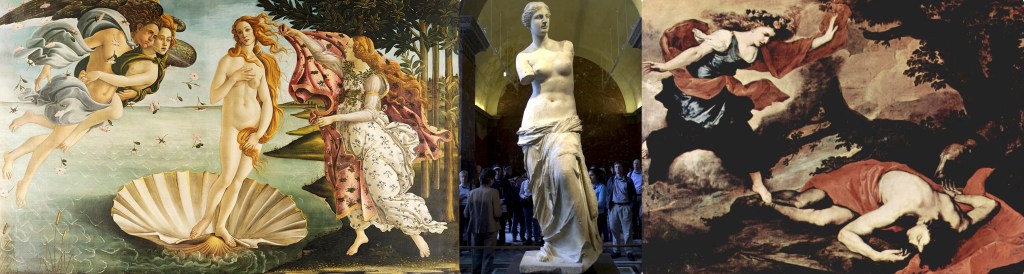
Welcome back to White Rose of Avalon, my Darlings. For today’s blog post, I will be going over some of the iconic examples of Venus in artworks! I will be looking at three examples of artwork depicting Venus. Two are paintings and one is a sculpture, but all show important aspects of Venus mythology. Without further ado, let’s look at some Venusian art!
The Birth of Venus Painting by Sandro Botticelli
~This is the first artwork in the image at the top of the post. It is likely the most well-known artwork of Venus in existence, so I am sure it is something that all of my readers are familiar with! This artwork depicts the most famous version of the Birth story of Venus (and Aphrodite). While some myths state that she was the daughter of Zeus and Dione, that is the less common version of the myth, especially as the name Aphrodite literally means ‘Foam Born,’ as a reference to this more famous Birth from the Sea! Although the artwork is stunning, with Venus shown on her large shell being revered by those who saw her rise from the waves, the story being depicted is much more unsettling in some ways. It is stated in the myth that Aphrodite (or, in this case, Venus) was born from the castrated genitals of Ouranos, who was castrated by his son Cronos at the behest of Gaia. When Cronos threw the genitals into the Ocean, over time the Ouranos was able to impregnate the Sea herself, with Aphrodite being born as a result! I know that many people find this disturbing (as even my husband cringes when I bring up this myth), but it is a very important aspect of Venusian mythology. Clearly, after this rather unsavory event, Venus rose from the Waves, and that is what is shown in this gorgeous painting!
Venus de Milo Sculpture attributed to Alexandros (but the true artist is uncertain)
~This is the second artwork in the image at the top of the post. The Venus de Milo is a marble sculpture that was created during the Hellenic period in ancient Greece, and, as I noted above, she is usually attributed to Alexandros. This famous sculpture is well-known for the fact that she does not have arms! There were originally arms on the sculpture, but at some point, they broke off. However, according to old descriptions of the sculpture, we know that when she had her arms, she held the Apple of Discord in one of her hands (as a sculpted hand holding an apple was found alongside the Venus de Milo)! This places the sculpture in the myth of the beauty contest between Aphrodite, Hera, and Athena, as Eris (Goddess of Discord) threw an Apple with the words ‘for the fairest’ on it as a punishment for not being invited to a wedding. This led to the three Goddesses all stating that they should have it, as they were most beautiful, and Zeus appointed Paris, Prince of Troy, to judge the contest. Of course, Paris chose Aphrodite as the fairest, as her bribe was what he truly desired (as all three bribed him). Aphrodite granted him the love of the most beautiful woman in the world, the wife of Menelaus, Helen. Helen went on to be remembered as ‘the Face that Launched 1000 Ships’ as this event began the Trojan War! Obviously, Aphrodite supported the Trojans, as she wanted Paris and Helen to be together, but she would leave the war (and her stake in it) to save her son Aeneas, who was nearly killed in the battle.
The Saddest Day of My Life Painting by José de Ribera
~This is the final artwork in the image at the top of the post. It is a painting that depicts the death of Adonis, one of the great lovers of Aphrodite (or Venus)! I had to include at least one artwork that depicts Adonis, as this is the most iconic love story in all of the mythology of the Goddess of Love. The birth of Adonis happened after Aphrodite (or Venus) cursed a young woman, who had been compared to her, to lust after her own father, which resulted in the conception of Adonis. This woman was transformed by the Gods into a tree, and Adonis burst forth from that tree. Aphrodite gave Adonis to Persephone to raise, and they went on to fight over him when he was an adult, leading to Adonis splitting time between the two Goddesses! Of course, he got to choose where to spend the last third of his year, which he chose to spend with Aphrodite, meaning he spent two-thirds of his time with Aphrodite. Sadly, their story ended with Adonis being gored to death by a Boar, at the fault of either Ares or Artemis. This painting shows the pain and heartbreak of Aphrodite when she lost the true love of her life!
~I hope you have enjoyed this look at three Venusian artworks. What is your favorite Venus artwork? Let me know your thoughts in the comments below!
Note on Images: The images of the artworks were originally found at these locations: https://en.wikipedia.org/wiki/The_Birth_of_Venus, https://www.theguardian.com/artanddesign/shortcuts/2015/may/11/venus-de-milo-arms-reconstruction-spinning-prostitute-sculpture, and
https://www.shmoop.com/study-guides/aphrodite-venus/photo-adonis-death.html. I created a small collage of the artworks that appear at the top of the post!
LINK TO AVALONIAN ROSE FAERY MYSTERIES PATREON: patreon.com/AvalonianRoseFaeryMysteries
Further Reading
- Blood and Roses: A Devotional for Aohrodite and Venus by Bibliotheca Alexandrina