
Welcome back to White Rose of Avalon, my Darlings. For today’s blog post, I will be discussing three examples of Celtic Goddesses who were worshipped by the Romans! As always, with this sort of post, I will discuss each Goddess in her own small section below. Without further ado, let’s look at these Celtic Goddesses also venerated by Romans!
Sulis
~Sulis, who is also referred to as Sulis Minerva, is an example of the syncretization between a Celtic Goddess (Sulis) and a Roman Goddess (Minerva). Clearly, the Romans felt a lot of love for this Goddess, since they compared her to, and syncretized her with, their Goddess of Wisdom, Minerva. Now, not all Celtic Goddesses worshiped by the Romans were syncretized (that is to say, aligned with a Roman Goddess), but syncretism was a common practice by Rome, so I wanted to begin by discussing a Goddess who was! Sulis is famously a Goddess of Liminality, with her name meaning ‘eye of the sun’ or ‘Goddess of the Gap’. The phrase Goddess of the Gap gives a hint to the Liminality of Sulis, as she minds the Gap, the in-between, in other words, the Liminal! Her Sacred Location is the Thermal Springs in Bath, England. The Celts associated her with Liminality (as already mentioned), the number three, Second Sight, and pigs. The Romans would add their own associations of Hippocampus, owls, coins, libation bowls, and jewelry. This gives us a good idea of what the ancients would leave as offerings to Sulis Minerva. When we look at what the Romans added to her associations, we see a bit of commonality with the Roman Minerva, as owls are Sacred to both, which makes sense with the syncretism!
Coventina
~Coventina is a Goddess of the Sacred Spring. Her Sacred Location includes Hadrian’s Wall, where she was commonly worshipped, and her Sacred Body of Water is Coventina’s Well in Brocolitia. She is associated with Water, Wells, fertility, and dolphins. This makes a great amount of sense, as we know that she has a Sacred Body of Water, and is often called the Goddess of the Sacred Spring, so clearly, Water and Wells would be Sacred to her. Dolphins being her Sacred Animal really illustrates her nature as a Water Goddess! She was often left offerings in hopes of bringing rain to grant a good Harvest, which shows her nature as a fertility Goddess. There is a Shrine to Coventina found in the ruins of a Roman fort near Hadrian’s Wall, which is why we know that she was worshipped heavily in that area!
Rosmerta
~Rosmerta is the only Celtic Goddess I will be looking at in this post, who we know for certain (thanks to archeological evidence) was also famously worshipped outside of Roman-occupied Britain. She was worshipped in Gaul, Germany, and Burgundy, as well as in Gloucester, England. She is a Goddess of Abundance and is deeply tied to Rivers. Her Sacred Bodies of Water include the Rhine River, the Rhone River, the Meuse River, and the Moselle River. Some depictions of her feature her with a Cauldron of Rebirth, a reminder of her healing, abundance, and fertility Goddess nature. Her name even translates as ‘the Great Provider,’ which affirms her profound connections to fertility and abundance. She is famously described as married to Woden in Germanic lore and as a consort of Mercury in continental Europe. This alignment makes great sense, as the Romans famously syncretized Woden (and Odin) with Mercury!
~I hope that you have enjoyed reading a bit about three Celtic Goddesses who were worshipped by the Romans. Which Celtic Goddess worshipped by the Romans do you find to be the most fascinating? Let me know your thoughts in the comments below!
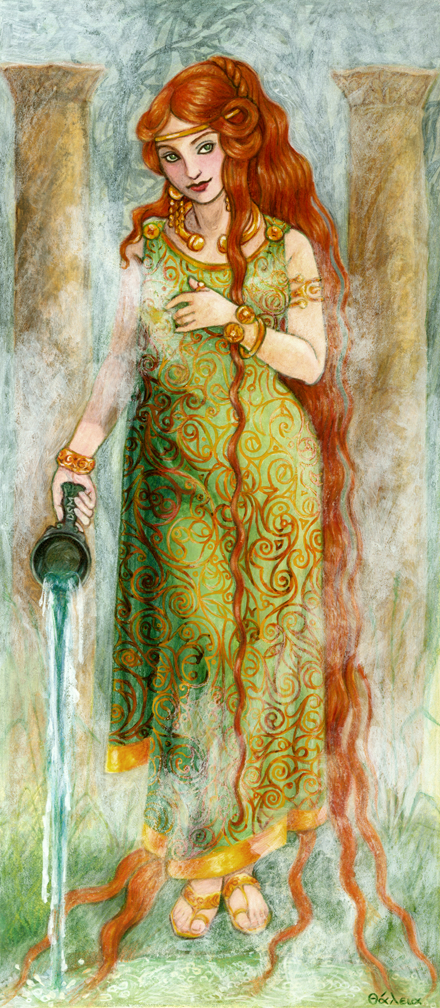
Note on Image: The image at the top of the post is a lovely artwork of Sulis by Thalia Took. I found the art on https://www.thaliatook.com/AMGG/sulis.php.
LINK TO AVALONIAN ROSE FAERY MYSTERIES PATREON: patreon.com/AvalonianRoseFaeryMysteries
Further Reading
- Celtic Goddess Grimoire: Invoke the Enduring Power of the Celtic Divine Feminine by Annwyn Avalon
- Encyclopedia of Spirits by Judika Illes
2 responses to “3 Celtic Goddesses Worshipped by the Romans”
Your exploration of these syncretized Celtic goddesses is fascinating! What stands out most is **Rosmerta’s fluidity across cultures**—a Celtic “Great Provider” woven into Germanic *and* Roman myth, her cauldron brimming with rebirth even as rivers carried her reverence from Gaul to Gloucester. She feels like a living bridge between worlds.wonderful read Maranda 👍🏻🤝🌷
I am so glad that you enjoyed reading it! I find studying how Celtic Goddesses (and those from other cultures) were worshipped cross-culturally to be not only fascinating, but so informative of how their stories were passed between cultures! As always, thanks for reading and commenting!