
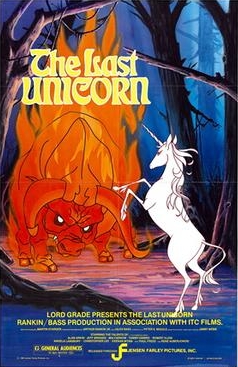
Welcome back to White Rose of Avalon, my Darlings. Today’s blog post is about the film and novel, The Last Unicorn, and how the story can be viewed as potent healing for the Inner Child and Maiden. I will also be focusing on the connection between this story and other Faery stories! Now, analyzing the story of The Last Unicorn is nothing new, given that several film analysis YouTube channels have done just that over the years (I will even link my favorite video about the movie below). What will make my analysis a bit more unique is that I will be looking at the film through a Divine Feminine and Faerylore lens!
So I want to begin this post by stating what inspired me to write it. I just recently rewatched the film for the first time in many years, as I do not think that I had watched it since high school! While I was watching the film, I was overcome by not only the nostalgia of watching a film I had loved in childhood, but also the realization of how the film was aligned with other Faerlore, which is why I decided I had to write this post. I did not reread the book, although I definitely would like to, as I have also not read this book in many years. That being said, this is a film that is known to be quite faithful to the novel, with the screenplay even written by the author, Peter S. Beagle.
Now, just watching this film again felt like a great way to do some Inner Child and Inner Maiden work, as watching things you loved as a child is often a great way to heal any woundings we may have around our childhoods. More specifically, this film acknowledges the connection between Unicorns and virginal Maidens, with Molly famously being very angry when first seeing Amalthea, as she was meeting a Unicorn as a grown woman long after being the traditional virginal Maiden that Unicorns are supposed to appear to. However, I actually view this as something more profound; it is not that you need to be in the first blooms of youth, just having become a woman of marriageable age, to be attached to your Maiden energy. This is an energy that we can access all throughout our lifetimes, and that is what Molly is there to show us, as she gets to experience childlike wonder by caring for Amalthea and aiding her in freeing the other Unicorns!
One of the most memorable aspects of the story of The Last Unicorn is that Amalthea is transformed from her Unicorn form into a human form by Schmendrick in order to protect her from being captured by the Red Bull. Amalthea is horrified by this because she is meant to be a Unicorn, not a human, and she can immediately feel the human body dying around her. This is because humans are mortal and will eventually die, and being an immortal Unicorn, she is traumatized by this new body! It is a heartbreaking scene, and Molly chastises Schmendrick for his actions, but the three know they must carry on their Quest to find the other Unicorns. They finally arrive at the Castle of King Haggard, whom they have reason to believe will lead them to finding out if the other Unicorns still live or if Amalthea truly is the last of her kind.
Amalthea is assumed to be a Noblewoman, even though Schmendrick had claimed she was his niece, especially given the way Molly cared for her (like a handmaiden). The Prince Lir becomes very infatuated with Amalthea, and eventually wins her love. This is during a turning point, where Amalthea is having a deeper crisis of self and uncertainty about her identity, wanting to remain human to be with Lir. However, she ultimately cannot do so, as King Haggard confronts her with his knowledge of her true nature and the confession that Unicorns are the only thing that brings him happiness, which is why he has had the Red Bull trap them all in the Sea where he can view them in the waves!
It takes the help of Lir, Schmendrick, and Molly for Amalthea to defeat the Red Bull and free her fellow Unicorns. It also takes the painful willingness for Lir to give up Amalthea’s love (and for her to return to her true form), which is acknowledged with Schmendrick telling him she is the only Unicorn to have known love with a human and to have regrets. Amalthea echoes the sentiment later when saying her goodbyes to Schmendrick, that she does regret not being able to be with Lir (as she had wanted to, even considering remaining human before realizing that she could not allow the other Unicorns to remain in Haggard’s control). However, it is bittersweet, as while Amalthea has regained her immortality and original form she had missed for a long time, she will forever hold the memories of her love for Lir, granting him a sort of immortality as well!
Now that I have gone over the parts of the story that I think best align with other Faerylore, let’s get into how I think that Amalthea’s story has echoes of the stories of Swan Maidens and Selkies. Firstly, there is the obvious transformation aspect, Amalthea transforms from her Unicorn form to that of a human, just as Swan Maidens and Selkies transform from animal to human forms. But there is more to this connection than just that. Selkies and Swan Maidens are horrified to be separated from their Seal Skins and Swan Feather Cloaks, respectively, just as Amalthea is horrified to be transformed into a human. Usually, the Selkie and the Swan Maiden have their skin/cloak stolen by their future husband to force them into marriage. Clearly, this is not the case for Amalthea, but she does fall in love when in human form and almost gives up on her original form because of this love. Beyond these facts, Amalthea’s story of coming to terms with her transformation and her eventual destiny of freeing the Unicorns, but giving up the man she loves, is sad much in the way the tales of Selkies and Swan Maidens can be! Swan Maidens often have to have their husbands win back their love by proving themselves after the Swan Maiden has fled, having found her Swan Feather Cloak. Selkies, on the other hand, usually flee their husbands and happily return to their home in the sea, without looking back, but with the traumas of being forced into a life they did not want remaining in their memories!
It is clear to me that Lir’s willingness to give up Amalthea so she can return to her true form can be aligned with both of these cases; she will leave him just as the Selkie does, but he has acted with true love just as the Swan Maiden’s husband does. Amalthea has many struggles and eventually discovers how to live in her authenticity and truth, which is ultimately at the heart of Swan Maiden and Selkie lore!
I hope you have enjoyed this analysis of The Last Unicorn. Have you ever noticed the parallels to Selkies or Swan Maidens? Do you see them now? Let me know your thoughts in the comments below!
Note on Image: The image at the top of the post is a theatrical release poster for the film. I found the poster on https://en.wikipedia.org/wiki/The_Last_Unicorn_(film).
LINK TO AVALONIAN ROSE FAERY MYSTERIES PATREON: patreon.com/AvalonianRoseFaeryMysteries
Further Reading/Watching
- The Last Unicorn by Peter S. Beagle
- The Last Unicorn (1982)
- The Fairy Bible by Teresa Moorey
- Beauty and the Beast: Classic Tales About Animal Brides and Grooms from Around the World, edited by Maria Tatar
- https://youtu.be/5HELDcv5ZcA?si=FBLFFXFir5AJnYxt