
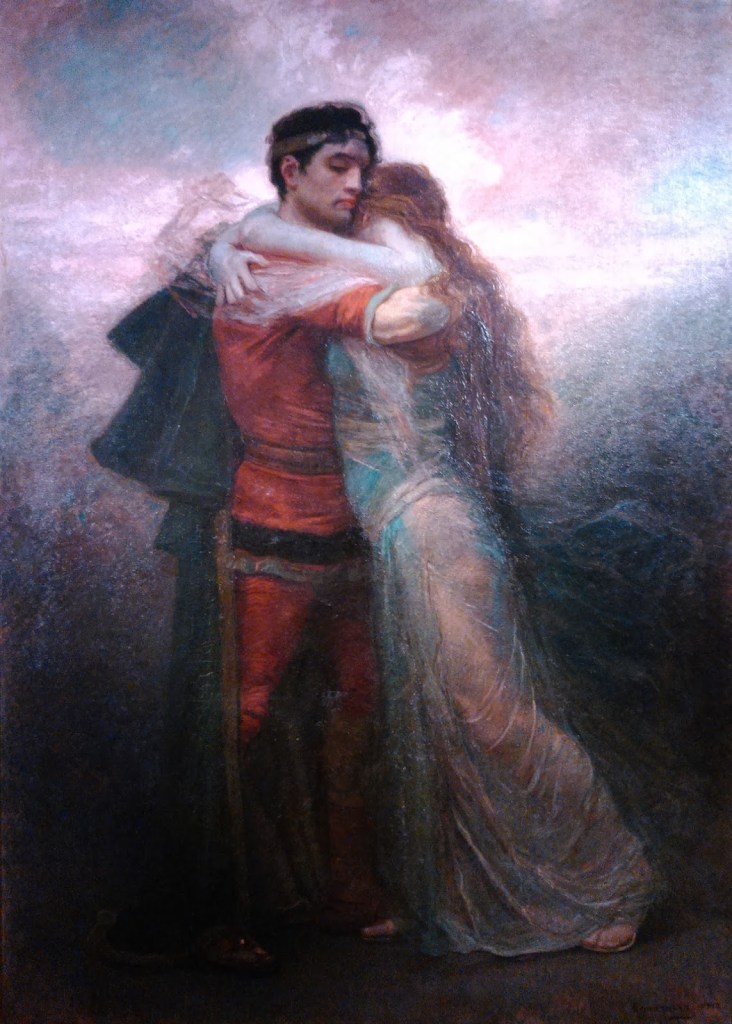
Welcome to the final day of Legendary Love Week at White Rose of Avalon, my Darlings. Today’s post is about the love of Tristan and Iseult! So, for those who do not know, the tale of Tristan and Iseult is my second favorite love story of Arthurian legend (only beat out by Lancelot and Guinevere, who I did not feature this week, as I have written about them several times in the past). I have been utterly fascinated, and even a little bit obsessed with the story of Tristan and Iseult since I was in junior high school, due in part to the release of the film Tristan + Isolde starring James Franco and Sophia Miles. I watched that film, a lot, and still do love to revisit it, and it stoked the desire to deep-dive into the many variants of this legend.
Of course, I had grown up with the Malory take, as Le Morte d’Arthur is the most complete medieval collection of the Arthurian legends. However, there are so many tellings of this story (with so very many variations on the name spellings, also including Tristram, Tristam, Isolde, Isolt, Isoud, etc) that there are whole websites devoted to the different versions. An old website from the early 2000s was a favorite of mine when I first began to obsess over this story (which I sadly could not find to link here when writing this, so it may not exist anymore). The website had all the different aspects of different tellings and where they overlapped and where they diverted, which to a folklore nerd like myself was utterly enthralling!
Now that I have gone over some of my history with the story of Tristan and Iseult, let’s get onto looking at the story itself. The story begins with Tristan going to Ireland from Cornwall. Some versions state that he was in Ireland for the first time for a battle, which is the version famously used by the film. In this version, Tristan meets Iseult when she aids him by healing his wounds. This healer energy is something that is always acknowledged in the story of Iseult, as she is known equally for her romantic nature and sexual affair with Tristan as she is for her ability as a healer. When Tristan and Iseult had met before, they fell in love naturally before Tristan returned to take Iseult back to Cornwall to be the wife of King Marc. There are other versions that have Tristan first arriving in Ireland to bring Iseult to Cornwall, without ever having met her before. This is often the most common version of the story, as this is the one that includes the Love Potion!
As noted above, some versions have Tristan and Iseult fall in love naturally, but others have them falling in love due to drinking a Love Potion accidentally when on the ship traveling from Ireland to Cornwall. The Love Potion was in a bottle of wine that was given to Iseult (usually by her mother) and intended for her to drink it on the Wedding Night with her husband, in the hopes of aiding Iseult in truly loving her husband and having a happy marriage! Of course, given that Iseult did not know about the potion, she shared it with Tristan on the ship and they ended up falling in love and sleeping together before they arrived in Cornwall. It is traditional to have Tristan and Iseult consummate their relationship before arriving in Cornwall, which is why there is a famous part of the story where Iseult had her Lady’s Maid switch places with her on the Wedding Night (once the lights were out) so Marc would not realize she was not a virgin! On a side note, it was common in the medieval era (and into the early modern era) to have the bedsheet shown after the Wedding Night to prove consummation of the marriage, as a virginal bride was very likely to bleed. It was very important for a Royal Bride to be pure before marriage to ensure any heirs were legitimate, so that is part of why seeing blood on the bedsheets was important, beyond confirming that the marriage was consummated, as an unconsummated Royal Marriage could be annulled. The medieval audience would have had this knowledge and understood the gravity of why Iseult would make this trade with her Lady’s Maid, which is why I wanted to go over it briefly!
So, Iseult’s trading places meant that Iseult even spent her Wedding Night in bliss with Tristan, carefully switching back with her Lady’s Maid before Marc awoke to carry off this ruse. I want to note here that some versions have the Love Potion being a permanent state, and others have it wear off, but either way, they do continue to care for each other. No matter what, Tristan and Iseult continue to be lovers in secret during her marriage and are increasingly less subtle over time. So, of course, they do get found out eventually!
In the end, there are two main ways the story goes. Either they are both put to death for their adultery, or Tristan saves Iseult and himself, but they are separated. Iseult sometimes also gets to remain with Marc and Tristan is banished (after attempting to kill him). When they both end up dead, they are buried together with a tree planted over each grave, and over time the trees grow together in a beautiful sign of their undying love! In the versions when Tristan has to leave, he goes on to marry a woman also named Iseult (Iseult of the White Hands, to differentiate her from Iseult of Ireland). This is where we get one of the most famous endings, where Tristan is dying of battle wounds and Iseult is called for to heal him. There is a code with the colors of the sails of the ship to signal if she was on board (having agreed to come to heal him), but Iseult of the White Hands lied to Tristan about the color of the sails. This meant that Tristan gave up and died before Iseult could arrive to heal him!
Personally, while I adore both versions of the ending for their beautiful tragedy, I prefer the version where they are buried together, being a hopeless romantic. No matter what, this is an Arthurian love story that has never ceased to pull on my heartstrings. I hope you have enjoyed this look at the story of Tristan and Iseult. What is your favorite part of their love story? Let me know your thoughts in the comments below!
Note on Image: The image at the top of the post is the painting titled Tristan and Isolde (Life) by Rogelio de Egusquiza. I found the artwork on https://en.wikipedia.org/wiki/Tristan_and_Isolde_(Egusquiza).
LINK TO AVALONIAN ROSE FAERY MYSTERIES PATREON: patreon.com/AvalonianRoseFaeryMysteries
Further Reading
- Le Morte d’Arthur by Sir Thomas Malory
- https://www.gutenberg.org/files/14244/14244-h/14244-h.htm (This is a version of the tale you can read for free online, Retold by J. Bédier Rendered into English by H. Belloc.)
- Tristan + Isolde (2006)