
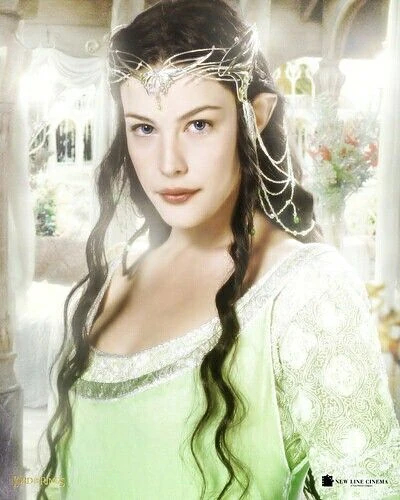
Welcome back to White Rose of Avalon, my Darlings. This week’s Femme Fatale Friday is about Arwen, the Elven Queen from The Lord of the Rings. Arwen embodies much of the classic Faery Queen energy, being a well-respected and beloved fixture at her father Elrond’s Court at Rivendell.
She is referred to as Arwen Undómiel, the Evenstar of Her People. The Evenstar is known as the light that does not wax and wane (differing from the Moon, for instance), which shows that Arwen’s place amongst her people has always been revered. Arwen is also famously compared to Lúthien, known to have been the fairest of all the Elves, and was called Nightengale. This comparison to Lúthien, who is spoken of with such deep reverence as a beloved ancestor and figure given folkloric status, is a very profound way to exemplify how subtly powerful and respected Arwen was!
All of this goes to show the great level of reverence and adoration that Arwen received while living at the Court of her father. Arwen’s lineage is quite interesting, as Elrond was a half-elf, and Arwen’s mother was the Elf Celebrian. Celebrian was the daughter of Elf-Queen Galadriel, ruler of Lothlórien. That cements just how powerful Arwen is from birth, the granddaughter of one of the most powerful Elven Queens!
Arwen has a unique story within The Lord of the Rings trilogy, as she is not simply an Elf, or more accurately, half-Elven, Princess or Queen. Arwen famously fell in love with the human Aragorn. Now, this should not be something surprising in the world of Middle-Earth, as humans and Elves had married before. What makes this unique is that the race of Elves was readying to leave Middle Earth, and if Arwen remained behind with the man she loved, she would likely eventually outlive him and have to live in Middle Earth for a time without her people. Yet Arwen made the choice to stay behind, even as the darkness of Sauron was threatening to snuff out the light of the Evenstar. Arwen was close to death when Aragorn was given the reforged sword of his ancestors to become King of Gondor, as he was always meant to be. Sauron’s defeat is what saved Arwen’s life.
Arwen then is able to marry Aragorn and rule as his Queen, even knowing she would eventually outlive him! As a side note, we learn she only lived a year after Aragorn’s death, after a long and happy marriage together. Arwen is commonly remembered for having chosen the fate of men, acting as a protector of humans after marrying Aragorn. I find the romance between Arwen and Aragorn all the more beautiful when you know that Tolkien based Arwen on his own wife, Edith! This tells me that we can view Arwen as not only a great example of Tolkien’s profound study of Faery and Elven Queens of folklore but also as a love letter to his wife.
It must be noted that Arwen is given a more active role in Peter Jackson’s films than in Tolkien’s novels, with her rescuing Frodo in the first film. In the novel, Arwen’s first appearance is at a dinner scene, where Frodo is rather enchanted by her beauty, admiring her from afar. The films also take scenes from the Unfinished Tales, in particular, a story titled Here Follows a Part of the Tale of Aragorn and Arwen, which is a more fleshed-out short story about Arwen and Aragorn’s romance. As a side note, this tale can also be found within an appendix to some editions of The Lord of the Rings: The Return of the King, as my edition contains it! I really love that the films chose to incorporate these scenes, as it gives a more fleshed-out perspective of how Arwen and Aragorn ended up marrying for love when he took the crown as King of Arnor and Gondor.
Arwen’s role of marrying Aragorn and ruling as his Queen is deeply reminiscent of the role of many a Faery Queen in Faerylore, Celtic folklore, and Arthurian legends. Holding similarities to Guinevere and Rhiannon marrying their respective Kings to cement their rulership of the land. However, luckily, she married for love and was happy in her union, which differs from many folkloric examples. Arwen’s nature as a half-Elven Princess made her the perfect Queen to cement Aragorn’s rulership, bringing the blessings of the Elves and the magic of the land itself! I do want to give context to that statement from a historical and folkloric perspective. While Aragorn had the right to rule from both birth and having won it in battle (much like many tales of King Arthur), without a Queen to birth an heir, his rule would not be seen as fully cemented. Furthermore, as the Elves share much in common with their folkloric and Faerylore counterparts, they can provide many magickal blessings to the rule of a King. All of that goes to show that the way Arwen is viewed can be related to the concept of the Celtic Venus! The Celtic Venus is something I am so deeply attuned to in my spiritual practice, and likely why I resonate with Arwen as a character.
I hope that you have enjoyed this exploration of Arwen, who is my very favorite character in Lord of the Rings (just narrowly beating out Galadriel, of course). What is your favorite aspect of Arwen’s energy? Let me know your thoughts in the comments below!
Note on Full Moon: As a reminder, I give Full Moon Tarot Readings every month on Patreon for my Owl and Raven Tier members, a single card reading for Owl Tier, and a three-card reading for Raven Tier. I do these readings over the three days of the Full Moon Cycle. That means that if you sign up for either my Owl or Raven Tiers today or tomorrow, you can get in on this month’s Full Moon Tarot Readings!
Note on Image: The image at the top of the post is a beautiful picture of Liv Tyler as Arwen in the films! I found the image on https://middleearth-films.fandom.com/wiki/Arwen.
LINK TO AVALONIAN ROSE FAERY MYSTERIES PATREON: patreon.com/AvalonianRoseFaeryMysteries
Facebook Note: The White Rose of Avalon Online Shop now has a Facebook page! I would be very grateful if you followed and shared this page. https://www.facebook.com/profile.php?id=61568898686130
Further Reading/Watching
- The Lord of the Rings by J.R.R. Tolkien
- Red Tree White Tree by Wendy Berg
- The Lord of the Rings: The Fellowship of the Rings (2001)
- The Lord of the Rings: The Two Towers (2002)
- The Lord of the Rings: The Return of the King (2003)