
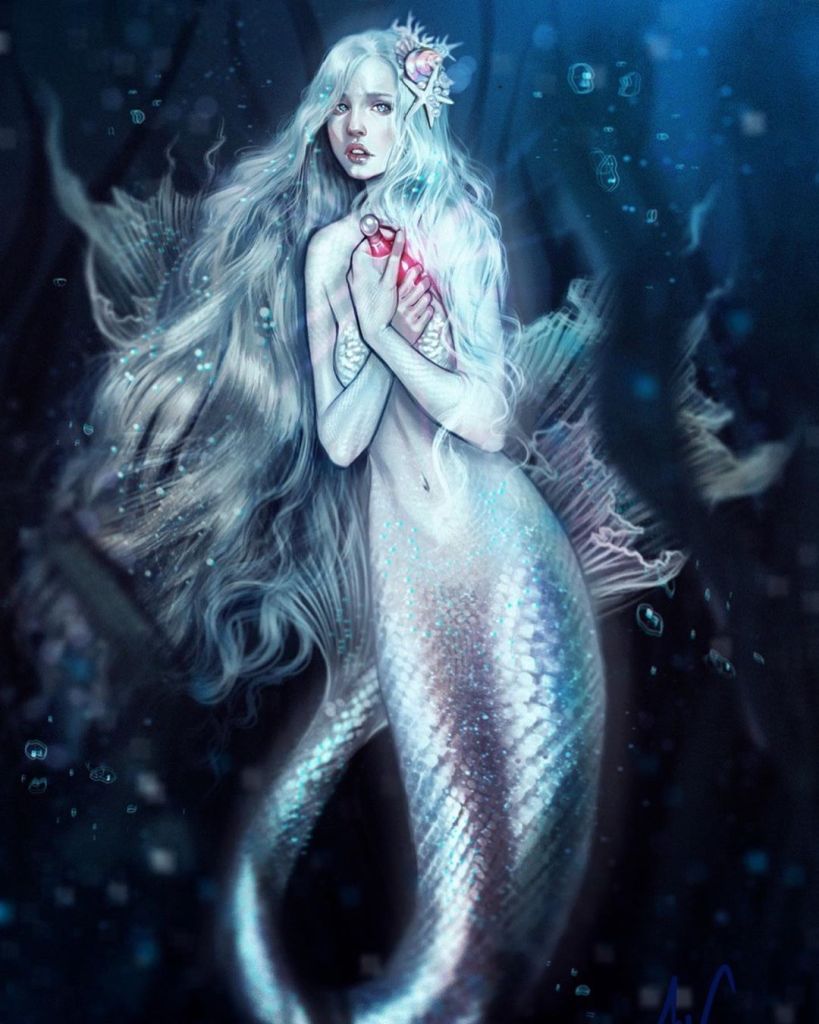
Welcome to day two of The Horror of Fairytales Week here at White Rose of Avalon, my Darlings. Today’s post is also a Siren Saturday post, so what better way to celebrate that than to examine more body horror, this time from Andersen’s original The Little Mermaid? This body horror is very different from the body horror found in Cinderella. The Mermaid does not harm herself so much as endure the body horror in the hopes of gaining an immortal soul!
For those unfamiliar with Andersen’s original tale, it is one of the most different fairytales compared to its Disney adaptation. In part, Hans Christian Andersen wrote the story to deal with the pain of his unhappy love life. There is also the traditional examination of the world through the lens of Christianity, common for tales written in the nineteenth century. In this case, Andersen wrote of Mermaids being creatures who lived for three hundred years, but when they died, they would turn to sea foam and cease to exist. This is how they differ from humans because humans live much shorter lives but have immortal souls!
The fact that humans have immortal souls fascinated the Little Mermaid (called so because she is the youngest of her sisters) when she heard the tale from her grandmother. The Mermaid felt so much sorrow at the fact that she would one day cease to exist that she wanted an immortal soul for herself. This led to her searching for an answer to how a Mermaid like herself could gain an immortal soul. She came to learn that if a Mermaid married a human, she could gain an immortal soul, as she would live out the rest of her days as a human herself.
It is this knowledge that led the Little Mermaid to seek out the Sea Witch. It is of note that the Sea Witch in the original is not a villain, only a magickal practitioner who warns the Little Mermaid of just how dire this magick is. The true villain of the story is the Mermaid’s own ambition to gain an immortal soul, but even that is not a totally bad thing, as we will soon see.
When the Sea Witch casts her spell, the Little Mermaid has her tongue cut out of her mouth rather than having her voice simply stolen. She also had the horror of the pain that came with human legs, as each step she took felt like knives cutting into her feet! The Little Mermaid endured all of these horrors in the hopes of marrying the human Prince that she set her sights on. The sad fact is that although the Prince found her of interest, it was more a fascination you might have with a new pet, as he had no attraction to her and no respect for her! That is why he so easily fell in love with another woman and married her so swiftly. In the original tale, there is no Sea Witch trickery, the Prince simply falls in love and marries another. The Little Mermaid had endured utter torture but had lost her bet because she had not won the love of the man she sought to marry.
The Little Mermaid’s sisters actually famously gave up their hair to the Sea Witch to obtain a special blade that they gave to the Little Mermaid on the day of the wedding. If the Little Mermaid killed the Prince on the night of the wedding, before sunrise, she could regain her mermaid tail and live in the sea again. However, the Little Mermaid could not bring herself to kill the Prince. This meant that her body turned to sea foam as the new day dawned, but she did not cease to exist.
Instead, she found her soul rising up into the sky, where she met a group of sky spirits. These sky spirits told the Little Mermaid that because she was so kind-hearted in not killing the Prince, she had gained the opportunity to earn an immortal soul. If she spent the next three hundred years acting as a sort of guardian spirit helping humans, she would gain an immortal soul of her own! This is the bittersweet, yet strangely hopeful, end of the original tale. However, it is of note that the sky spirit part is said to have been tacked on after an editor or publisher told Andersen that the Little Mermaid simply becoming sea foam and ceasing to exist was too tragic an end. No matter which way you look at it, the Little Mermaid endured the torture of having her tongue cut out and having each footstep on land that feels like being cut with knives, only to not survive. At least, with the ending as it is, there is hope for the possibility of having an immortal soul. And, maybe, just maybe, that ending is actually better for the Little Mermaid, as her Prince was never the prize she sought, and he honestly sucked!
I hope you have enjoyed this examination of the Horrors of The Little Mermaid. What is your favorite horror element from the original tale? Let me know your thoughts in the comments below!
Note on Image: The image at the top of the post is a beautiful, yet haunting, illustration of The Little Mermaid. I found the artwork on https://www.tumblr.com/lukaswerneck/186484833751/there-it-is-the-witch-said-and-cut-the-little.
LINK TO AVALONIAN ROSE FAERY MYSTERIES PATREON: https://patreon.com/AvalonianRoseFaeryMysteries?utm_medium=unknown&utm_source=join_link&utm_campaign=creatorshare_creator&utm_content=copyLink
Further Reading
- The Little Mermaid by Hans Christian Andersen
2 responses to “‘The Little Mermaid’ & the Horror of Ambition”
I see the Little Mermaid as a character who has a deep desire for transcendence.
I think that is certainly true, after all she does everything she does not for love so much as for an immortal soul she wishes to gain. It ends up being her compassion and inability to kill the man that broke her heart which leads to her death and also to her opportunity to gain a soul though doing good deeds as a Spirit of the Air.