
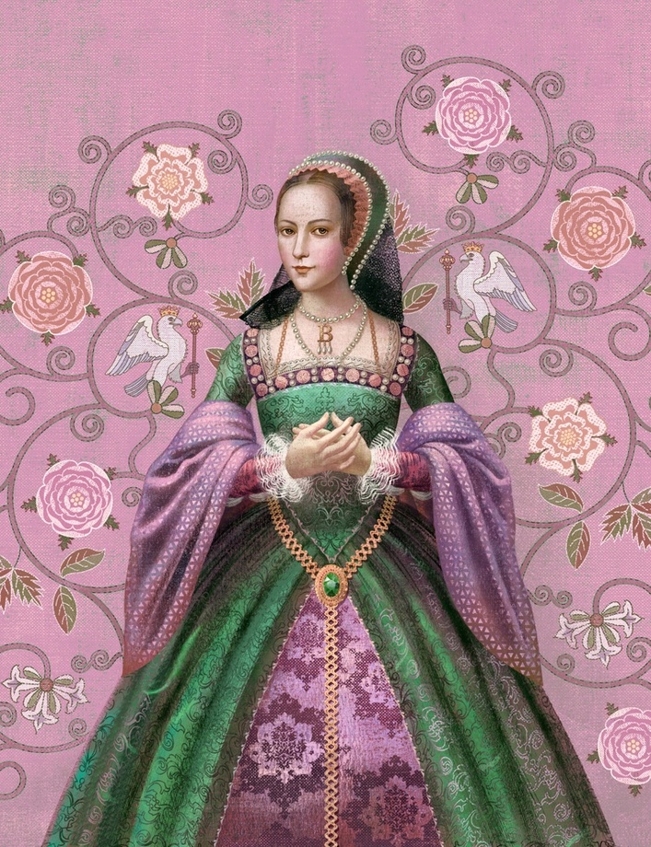
Welcome back to White Rose of Avalon my Darlings. Today’s post will explore the possible connection between Anne Boleyn and Shakespeare’s play A Winter’s Tale. Many people who are fans of Shakespeare and lovers of Tudor history will know that the plot of A Winter’s Tale is a complex romance set at a Royal Court.
Much like Anne Boleyn herself, Queen Hermione, wife of King Leontes of Sicilia is thought by her husband to have had an affair during their marriage. At this time in the plot of the play Queen Hermione is heavily pregnant, and King Leontes plots the death of her accused lover Polixenes, by asking a trusted courtier to poison him. Now, this does sound a lot like Anne Boleyn’s trial, does it not? However, I must note that the plot of the play has a happy ending with Queen Hermione reuniting with her husband. This makes me wonder if the play is in some ways a response to the tragic end of Anne Boleyn, desiring her to have a happier ending. Sort of how Tarantino changed the fate of Sharon Tate in Once Upon a Time in Hollywood.
Anne Boleyn’s downfall began in the early Spring of 1536 when an investigation was underway to prove that she was having affairs betraying her marriage and even committing treason by imagining the King’s death. It was on May 2, 1536, that Anne was arrested and taken to the Tower of London to await her trial. There were five men arrested with her, believed to be her lovers, including her own brother George Boleyn! It was one of the accused men that would eventually confess to having an affair with the Queen, under the pressure of torture. One thing to note is that Mark Smeaton, the man who confessed, was the only one who was not a noble, only a Court Musician. This meant that there was more leeway in how they could treat Smeaton, and his torture was likely worse than anything a Noble or Royal would ever have been put through. None of the other four men, who were Nobles, ever confessed to anything untoward with the Queen.
In the modern age, we know that Anne Boleyn was executed on May 19, 1536, on false and trumped-up charges. She was innocent of the charges of incest and having affairs with courtiers obviously. The only thing that could be proven was that she once talked with a courtier whom she accused of imagining the King’s death so that he would be free to have a relationship with her. This was a very unwise thing to say and was likely meant to be a flirtation of Courtly Love traditions, but it went far beyond what was acceptable at the time. In the case of A Winter’s Tale, the Queen does not get executed for her accused crime of adultery which she did not commit. Instead, she ends up being shown to be innocent and regains the love of her husband the King! In some ways, the end of the play seems to be a fairytale fantasy fan fiction re-write of the story of Henry VIII and Anne Boleyn, with a happy ending this time!
I hope you have enjoyed this short analysis of the connection between Anne Boleyn and A Winter’s Tale. What other connections between Anne Boleyn and Shakespeare’s work do you see? Let me know your thoughts in the comments below!
Note on Image: The image at the top of the post is an Anne Boleyn illustration from Alison Weir’s Six Tudor Queens Series. I found the image on http://alisonweir.org.uk/books/bookpages/more-anne-boleyn-a-kings-obsession.php.
Tarot Note: I have a page offering tarot and oracle readings for those interested in these services! I am very happy to be offering these readings to my treasured readers at White Rose of Avalon! Link to page: https://whiteroseofavalon.life/tarot-and-oracle-readings/
Further Reading
- The Life and Death of Anne Boleyn by Eric Ives
- A Winter’s Tale by William Shakespeare