
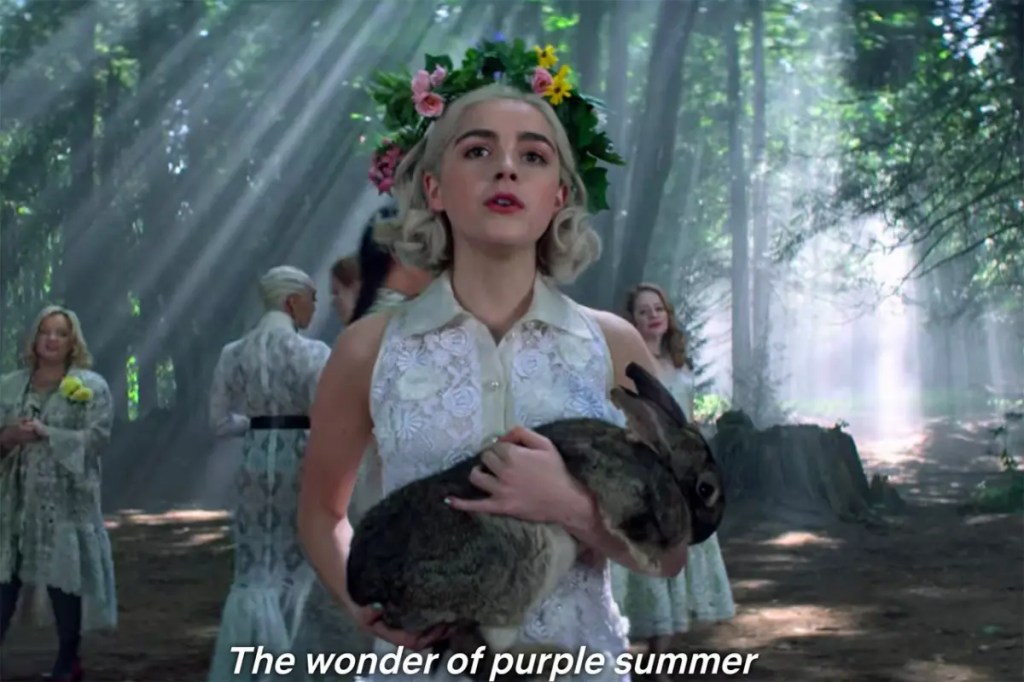
Welcome to another Magical Media Analysis! Today’s topic is Chilling Adventures of Sabrina, in particular, I will be looking at the Pagans as portrayed in the series. Instead of doing a regular overview, as I have when analyzing a whole plot and where magick is used in it, I am going to do a small section for each of the Pagan characters. I liked that there was a dispute between the Satanic witches and Pagans, as it seems to mirror the anxiety and dislike between Pagans and Christians back at the beginning of the Christian period. While I do not like Pagans being portrayed as the villains, I did like that there was nuance, in that the Pagans were not all evil and the Satanic witches become Pagans themselves by the end of the third part of the series, as they become worshippers of Hekate!
Medusa: The snake dancer character is actually Medusa, which is not a surprising profession for the snake-haired Goddess to take on. This version of Medusa is a seductress who can utilize her massive sexuality to make men fall at her feet. Her ability to turn people to stone is something that she can choose to do or not, instead of having to turn anyone she gazed upon to stone. I also liked the inclusion of her turning Roz to stone and the reference to the Pygmalion mythic tale.
Circe: The fortune teller character is actually the great witch Circe, which again felt like a great idea for Circe to use within this traveling carnival. She even gets to use her natural ability to transfigure people into animals, her signature ability from myth and ancient literature. She turned Aunt Hilda into a Spiderwoman monster. Circe is also able to transform several characters into pigs, in a great reference to her transformation of sailors and warriors into pigs in The Odyssey. I really enjoyed this inclusion in the series.
The Great God Pan: The Ring Leader of the circus is actually the Great God Pan. He is a very powerful deity that can cause madness due to his association with being a God of the Wild, which in the extreme can be madness. Bringing about madness is an ability of Pan in actual myth, as he is a complex deity of nature. I loved how he used this ability to make Agatha go insane, which is something that impacts the plot of the rest of the series greatly!
Robin Goodfellow: Robin is based on the character Puck from Shakespeare’s A Midsummer Night’s Dream. Puck himself is rooted in older Faerylore that Shakespeare utilized. I loved that they used a character that is rooted in Faery lore to add to the Pagan characters in the third part of the series. I also adored him as a character because he was the Pagan that helped the witches protect themselves! I was a fan of the series referring to Robin as a Hobgoblin, as that is an actual species of Faery. It seemed to be rooted in the Shakespearean version and the older Faerylore in equal measure.
The Green Man or Green God: I loved that their whole mission was to resurrect their own Greatest God, who is essentially the Green Man! It is very similar to the energy of the Maenad plot in the True Blood television show, except at that time the God they were trying to resurrect was Dionysus.
The Order of Hekate: By the end of this part of the series, the Satanic witches fully turned away from the Devil and had become devoted to the Great Goddess Hekate! Hekate is referred to as “the three in one” very often, which is a way that she is often referred to by devotees in real life. I actually liked that moving forward we never see Hekate, instead, she is a presence that is always there, but never physically present. This is very rooted in actual magickal practices and devotional work.
~I hope you have enjoyed this Magical Media Analysis overview of how Pagans are utilized in part three of Chilling Adventures of Sabrina. I figured breaking it down to explain the mythic references and folklore was a good way to explain the usage of Pagan deities within the series. I enjoyed the reference to celebrating Ostara, as it is one of the names of the Spring Equinox, further rooting this in the modern magickal practices of many people. I do truly adore the way this show formats the magick and incorporates folklore and fantasy pop-culture references. While most witches are not Satanists in the modern day, many being some form of Pagan or secular, I do like the way the plot informs a connection to old folk beliefs of witches being Satanic. It also makes for a very satisfying plot point when they turn to a Pagan Goddess and away from the Dark Lord! In actual Folk Magick of centuries ago, the practitioners were believed to worship the Devil, but were actually Christian, leading to this bringing full circle that the series does by rooting the magick in old folk beliefs oftentimes! What is your favorite aspect of magick and folklore used within the Pagan plot on Chilling Adventures of Sabrina? Let me know your thoughts in the comments below!
Note on Image: The image at the top of the post is of Sabrina during the Hare Moon episode. I found the image on https://decider.com/2020/01/24/chilling-adventures-of-sabrina-season-3-episode-4-the-hare-moon/.
Note: I have a Donations Page here for any of my readers who would like to support this blog. If you enjoy what I do here on White Rose of Avalon (and what I do on my YouTube channel Enchantress of Avalon), I would appreciate you considering giving a small one-time donation to support my ability to continue to create content. Link to my Donations Page: https://whiteroseofavalon.life/donations-page/
Tarot Note: I have launched a page where I offer tarot and oracle readings for those of you interested in these services! I am very happy to be offering these readings to my treasured readers at White Rose of Avalon! Link to page: https://whiteroseofavalon.life/tarot-and-oracle-readings/
Further Watching
- Chilling Adventures of Sabrina (2018)