
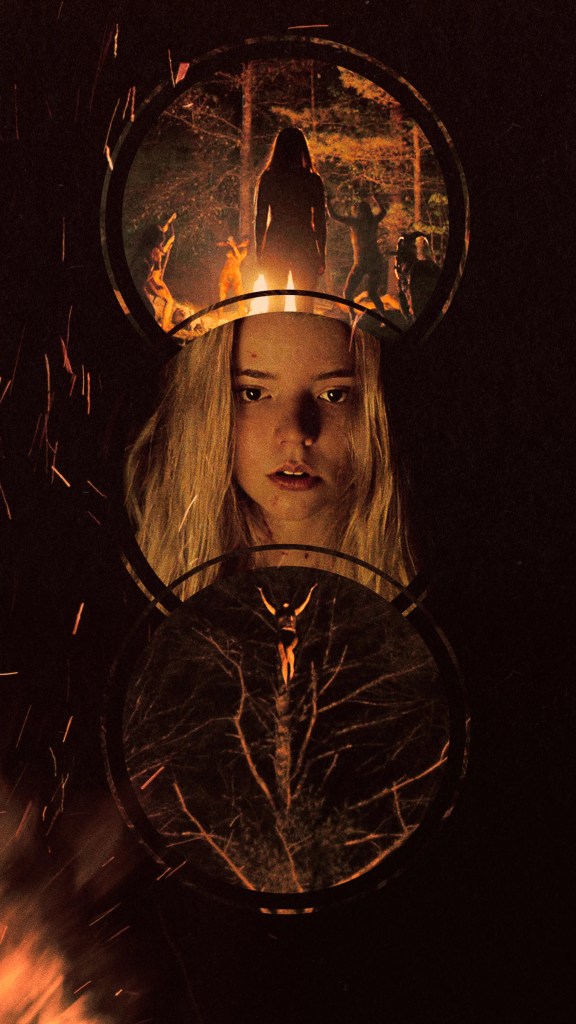
Welcome back to White Rose of Avalon, my Darlings. For this week’s Femme Fatale Friday, I will be discussing the classic archetype of the Witch in the Woods!
We see this archetype appearing constantly, most often in fairytales, but also in more modern interpretations. Possibly the most famous case of a modern interpretation of the Witch in the Woods is in Robert Eggers’ film The Witch! The film has likely been the reference point for horror fans when they think of a Witch in the Woods for the last decade, because who could forget Anya Taylor-Joy as Thomasin asserting, “I be the Witch in the Woods?” As with all of Eggers’ works, his first film was heavily inspired by history and folklore with absolutely impeccable attention to detail. So, the actual Witch in the Woods at the beginning of the film does what folklore and belief in the 1630s said she would do. She killed a baby to make flying ointment and seduced a young boy into her thrall, all the while serving the Devil, in the case of the film, disguised as Black Phillip! However, I would argue that she also hinted at older fairytales of Witches in the Woods.
After all, Baba Yaga and the Witch from Hansel and Gretel are both known for eating children who wander in the woods alone. So, I ask, how much difference is there between killing a child to make flying ointment and eating children lost in the woods? I would argue, not much at all!
Clearly, if we peel back the layers of this idea of a fearsome Witch in the Woods who will harm you if you get lost, we see a quite obvious reason for these stories to have been spread. Parents looking to instill fear in their children, to keep them from wandering off the beaten path, to keep their children safe! In this context, the Witch in the Woods serves the same reasoning for being discussed as the Werewolf and the Wolf of Little Red Riding Hood, a cautionary tale to fear. Yet, there is that other context, the fact that in the case of Baba Yaga, she was a Goddess being demonized (who in fairytales helped as much as she harmed), and in the case of the Witch in the Woods of Eggers’ film, we see the demonization of actual people who did not fit society’s norms! After all, Eggers was drawing on the actual beliefs of the time period, the beliefs that inspired Witch Trails and deaths across centuries, so his Witch in the Woods is a real Witch, fashioned out of old folkloric beliefs, but she hints at the demonization felt by many of the innocent accused.
Those are two of the factors at the heart of the Witch Hysteria, both in Europe and later in America: the demonization of Goddesses (which left women still working with them prey to accusations), and the demonization of those who do not fit the norm (be they poor, herbalists, midwives, or widows with land who refused to remarry). This adds a special layer to the Witch of the Woods Archetype, for she is not just a Witch gladly killing children and eating them, she is not only a cautionary tale told to keep children safe, and she is not only the villain. She is also the Goddess and Her Devotees, acting to help those who knock on the door of the Woodland Cottage. Other examples we see of this Witch in the Woods serving the people in the town while also being hated by them are in the characters of Joan Clayton (known as the Cut-Wife) in the television series Penny Dreadful and Hannah Owens (adoptive mother of Maria Owens) in the book Magic Lessons by Alice Hoffman!
So, yes, we see this archetype appear again and again. Each time, there is more to the archetype than a simple villain meant to frighten. Baba Yaga, even in her most villainous portrayals in fairytales, still acts as a tester, there to initiate the worthy, and acts justly to those who have been fair in return! Even the Witch from Hansel and Gretel gets additional layers, while remaining a villain, in Oz Perkins’ film Gretel & Hansel, where she seeks to teach Gretel in the arcane arts of the Witch. The Witch in the Woods Archetype has fascinated us for centuries, with no sign of slowing down. But now, we can examine this archetype with more nuance and even embrace parts of this archetype to reclaim them in a positive light. After all, there are good things in the Witch of the Woods Archetype, for she is not all wickedness, as I have shown in this post. Here are some ways to embrace the positive side of this archetype. We can enjoy living a life of solitude and service, allowing only those who need aid to come our way, if we so choose. We can be the teachers, taking on apprentices to mentor in the knowledge we have. We can even choose to live in the Woods, or at the edge of a town, and practice the traditional arts of the Witch, like herbalism and midwifery!
I hope that you have enjoyed this discussion of the Witch in the Woods Archetype, and that it has given you food for thought about how much more complex than face value the archetype is. What is your favorite example of a Witch in the Woods? Let me know your thoughts in the comments below!
Note on Image: The image at the top of the post is a lovely artwork from The Witch. I found the art on https://a24films.com/notes/2020/10/watching-the-witch-with-two-actual-witches.
LINK TO AVALONIAN ROSE FAERY MYSTERIES PATREON: patreon.com/AvalonianRoseFaeryMysteries
Further Reading/Watching
- Hansel and Gretel by the Brothers Grimm
- Encyclopedia of Spirits by Judika Illes
- Encountering the Dark Goddess by Frances Billinghurst
- Magic Lessons by Alice Hoffman
- The Witch (2015)
- Penny Dreadful (2014)
- Gretel & Hansel (2020)