
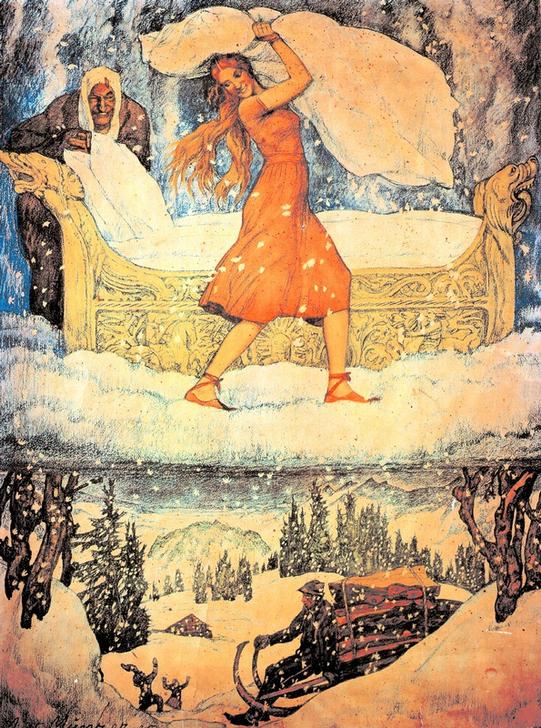
Märchen / Frau Holle.
“Frau Holle”.
Farblithographie nach Zeichnung, 1925,
von Adolf Münzer (1870–1953).
Schulwandbild, o. O. u. J.
Dortmund, Westfälisches Schulmuseum.
Welcome back to White Rose of Avalon, my Darlings. For today’s Femme Fatale Friday blog post, I will be discussing Frau Holle! Frau Holle is also known as Mother Holle, Hulde, Hulda, Mother Hulda, and even has connections to Frau Perchta, with some stating that the two are one and the same (I have written about Frau Perchta in a post back in 2023, which I will link below). Throughout this post, I will be referring to her as Hulda and Frau Holle interchangeably.
Frau Holle, or Hulda, or whatever other name you may prefer to call her by, has her origins in Teutonic folklore and Germanic myth. She is a very powerful Goddess, often described as an ancient Goddess of Birth and Death, whose feast day is on the Winter Solstice! She is alternately described as either a young and beautiful blonde Goddess or as an Old Crone, depending on the story. According to Judika Illes, Hulda receives the souls of the newly dead into her realm and also releases newborns to live new lives on Earth. That is such a beautiful image of a Goddess who governs over the womb and tomb of the world! Judika Illes also stated in the Encyclopedia of Spirits that Holland is her namesake, and that her name may be related to the word “holy”, showing just how important Hulda was across ancient Europe.
Beyond her role as a Goddess of Birth and Death, Hulda also governs a realm that can be accessed via Wells, Elder Trees, and Mountain Caves. It is said that she lives in Mountain Caves and among Elder Trees, for this reason. Hulda is known to be seen walking on mountain paths and along rivers, where she is often accompanied by Rabbits and Faeries. This is why she is sometimes seen as a Queen of the Elves! In fact, there is a type of German Hill Faery known as the Hulden, who are led by Hulda and serve her. I find the association with Rabbits fascinating, as this fits in perfectly with not only the Fae connection, as Fae are deeply connected to Rabbits and Hares in various folklore, but also with Hulda’s association with Birth.
Hulda guards and nurtures all things that grow in the forest, is credited with introducing flax to Europe, and even taught the art of linen making. These things, along with the demonization of worshipping Hulda after the conversion to Christianity (as many of her worshippers were branded as witches, if discovered), are where the connections to Frau Pertcha really come in. You see, it was at this time that Hulda was rebranded as a demon-witch Goddess, and accused of harming children, which we can see with Frau Perchta’s punishment of those who do not finish their chores (especially spinning of flax)! All of this makes it unsurprising that Frau Holle is known to have a guise as Queen of the Witches. It is truly saddening to see a benevolent and loving Goddess of Birth and Death go on to be transformed into little more than a monster who was used to scare children into behaving. However, this is often the case for powerful Goddesses after Christianity became the dominant religion, so Frau Holle is far from alone in being seen this way.
One of the more famous fairytales featuring Frau Holle is Mother Holle by the Brothers Grimm. The story shows both her benevolence and malevolence, with one girl being rewarded for being respectful and another being punished for being lazy! Of course, beyond that, Jacob Grimm wrote about her in his book Teutonic Mythology, and it seems that he was one of the first to argue that Frau Holle and Frau Perchta may be one and the same.
Frau Holle is also seen as a Weather Spirit, and that is important when we look at her involvement in the Wild Hunt. It is said that when Hulda shakes out her featherbed, it snows. When she rinses her laundry, rain falls, and that fog forms from the smoke of her fire. This paints a vivid picture of just how much Frau Holle is deeply entwined with the weather, in general. It also makes it very unsurprising that she would be associated with leading the Wild Hunt, alongside Odin! There is some belief that there could be a connection between Frau Holle and Frigg, Odin’s wife, given her associations and power, and the fact that Frau Holle also rides in the Wild Hunt. This possible connection stems from the fact that Frau Holle may be one and the same with the wife of Woden in Germanic myth, with Woden being Odin’s Germanic counterpart! While this may be conjecture, it is surely quite fascinating.
Now, I want to finish off with just what Frau Holle does during the Wild Hunt. She is known to visit homes during the Twelve Nights of Yule, providing punishments or rewards, with a particular focus on spinning and other domestic tasks (which is again something she shares with the more horrific tales of Frau Perchta). Now, sometimes these visits to people’s homes are part of the Wild Hunt, and other times it seems like she is doing this without the larger entourage. However, no matter what, she is deeply tied to the domestic sphere, as well as to the cycles of life, death, and rebirth! This makes it unsurprising to me that she is entwined with so many other Goddesses, and that there is conjecture of her being one and the same as them.
I hope you have enjoyed this look at Frau Holle. What do you find to be most fascinating about her story? Let me know your thoughts in the comments below!
Note on Image: The image at the top of the post is the painting Frau Holle by Adolf Muenzer, which I love, as it shows her connection to snow. I found the art on https://www.art-prints-on-demand.com/a/adolf_muenzer/frau-holle.html.
LINK TO AVALONIAN ROSE FAERY MYSTERIES PATREON: patreon.com/AvalonianRoseFaeryMysteries
Further Reading
- Encyclopedia of Spirits by Judika Illes
- Mother Holle by The Brothers Grimm
- Teutonic Mythology by Jacob Grimm
- https://www.fabledcollective.com/frau-holle/#google_vignette
- https://www.germanicmythology.com/original/FRAUHOLLE_TIMM.html
- https://whiteroseofavalon.life/2023/12/22/frau-perchta-another-christmas-witch/ (My post about Frau Perchta from 2023.)