
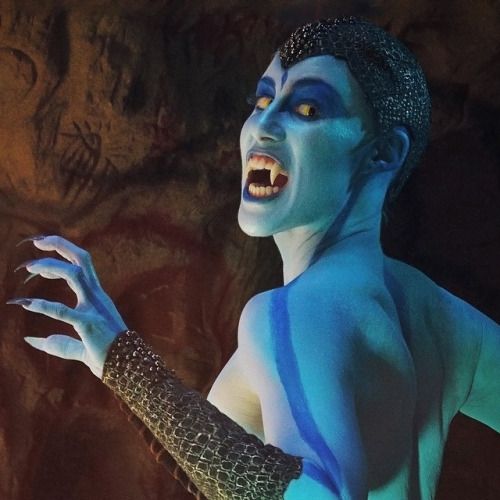
Welcome back to White Rose of Avalon, my Darlings. For today’s blog post, I will be sharing my spoiler review and analysis of the 1988 film The Lair of the White Worm, based on a story by Bram Stoker. In particular, I want to dig into the Snake folklore and the Serpentine Vampires that we get within this film. So, you can say that this is also going to be a bit of a Magical Media Analysis, as I want to dig into why I think some of this Snake energy was drawn from the Minoan Snake Goddess, even though in the film, the God worshipped by the Priestess Lady Sylvia (who is also our Serpentine Vampire) is named Dionin, a God who may be fictional (simply made up for the story). However, Dionin could also very well be a misspelling of Dionysus, making this connection even more interesting, but more on that after the plot breakdown.
Now, I have wanted to watch this film for a long time, but had not gotten around to it until very recently (although to be honest, I had tried to watch it last year and was not in the right headspace to appreciate it, so I turned it off after only a few minutes). I am so glad that I finally decided to watch this very trippy and surreal film when I was in the right headspace because it is utterly incredible! It is a Folk Horror film and also classed as a horror comedy. The basic plot of the film is that it is set in a British town where there is a centuries-old legend of the White Worm of D’Ampton, which was famously slain by the Lord John D’Ampton.
In the present day, the current Lord James D’Ampton (played very well by Hugh Grant in an early role) has recently taken over his title. At the beginning of the film, he hosted a party to celebrate the White Worm legend, which is held annually. This party is attended by an archaeologist who is digging on one of the properties owned by Lord James. The archaeologist, named Angus Flint, had just dug up a large Serpent Skull before attending the party with Mary and Eve Trent, two young women who rent the property from Lord James. This leads to an interesting dialogue, where Angus tells Lord James that he believed that he had found the legendary White Worm!
The film gets all the more fascinating when the female lead is introduced: Lady Sylvia Marsh. It is not long before we are shown that she is not just your average titled Noblewoman, as we see her suck Snake Venom out of a police officer’s leg and swallow it! Lady Sylvia had just returned to her home in the town, earlier than expected, as she normally comes in the Spring, and the weather had not quite broken yet. We are led to the conclusion that she was drawn to the area early because of the Snake Skull that Angus had unearthed, and that is confirmed when she steals the Skull for her Ritual!
We get to see Lady Sylvia hunt for her prey by picking up a young man in the woods to feed on, and likely later sacrifice to her God, as we learn she does this regularly. It is also revealed towards the end of the film that she had done this to Mary and Eve’s parents the year before, as we see that their mother had been turned into a Serpentine Vampire after the attack! Now, Lord James meets Lady Sylvia after some of the crazy events begin taking place with Eve (including a hallucination where she saw Snakes after touching a crucifix that Lady Sylvia had spit venom on).
Lady Sylvia quickly charmed Lord James, claiming a deep fear of Snakes, which she stated that she is trying to overcome. This leads to a kiss between the two, even though it was made quite clear that Eve had some sort of relationship with Lord James. It is also this scene that I think induces Lord James to have surreal dreams about Lady Sylvia, Eve, Mary, and their parents! After these dreams, Lord James helps Angus, Eve, and Mary search a cave that he believes could be where the legend of the White Worm’s slaying may have taken place.
All the while, we begin to see Lady Sylvia’s plot unfold, with her luring Eve away when she left the group. Lady Sylvia stated that Eve was a perfect sacrifice, as she was a virgin. It is also during this scene that Lady Sylvia expresses her deep disgust with Christianity, as she is much older than that religion, and her God is more powerful in her eyes. This is where a lot of the Pagan elements are on full display, as Lady Sylvia is preparing a Ritual to sacrifice Eve to her God, really making the most of this Folk Horror motif. Clearly, Eve’s name and the choice to make Lady Sylvia a Serpentine type of Vampire have heavily Christian overtones, harkening to the Garden of Eden. This makes Lady Sylvia’s clear disdain for the Christian religion and iconography make a lot of sense, as she is in the role of the Snake tempting a young woman named Eve! However, we should not forget that she is also a Priestess to a Pagan Snake God, making this narrative even more layered.
Over the rest of the film, we see others who have been transformed into Serpentine Vampires by Lady Sylvia’s bite (like Mary and Eve’s mother, as I touched on above). There is an epic climax where the heroes defeat Lady Sylvia, having her fall into her own Ritual death trap. So, the irony is that Lady Sylvia went on to be the sacrifice to her Snake God Dionin herself! However, the film does end with us discovering that Angus has been infected and will now become a Serpentine Vampire, showing that this cycle has not ended, after all.
Now that I have gone over the plot, let’s see how Lady Sylvia may have some echoes of the Minoan Snake Goddess. The original figures of the Minoan Snake Goddess were said to have been found on Knossos, Crete, by Sir Arthur Evans. Two Snake Goddess figurines were discovered at the same time, both broken, so they had to be reassembled. When reassembled, they depicted a bare-breasted woman holding snakes, an obvious symbol of fertility and sexuality! The Snakes are even circling her breasts, amplifying the connection with female sexuality. While there is debate over whether we can consider these to be true representations of a Goddess, it is clear that at the very least they show how Snake Deities were worshipped in Ancient Greece! Some scholars hypothesize that these Snake Goddess figurines are actually depicting Priestesses worshipping an Ancient Diety. So, I think that may even amplify the connection between these Snake Goddess figurines and Lady Sylvia, when we look to the idea that Dionin may be a misspelling of Dionysus, which I mentioned at the beginning of this post. This is especially true when we make the connection that Dionysus was worshipped on Crete, which is where the Minoan Snake Goddess figurines were found! Dionysus is the Greek God of Wine, Revelry, and Madness, with his famed ancient worshippers, the Maenads, being known for their ecstatic orgies of devotion. So, yes, this seems to fit in well with how Lady Sylvia is depicted!
Finally, I want to look at Snakes, Snake Goddesses, and Snake Priestesses’ energy to analyze Lady Sylvia a bit more. I think that it is really easy to draw a parallel between how Lady Sylvia acts, literally embodying a Snake, luring men into her clutches with sexual allure, and acting as a Priestess to a Snake God, with the Minoan Snake Goddess. She is worshipping an Ancient God and is deeply tied to the Serpents herself. Lady Sylvia takes on the role of a Sacred Sexual Priestess, which is exactly what the Minoan Snake Goddess seems to represent, and is working to serve her God! Beyond that, Maenads who worshipped Dionysus definitely partook in Sacred Sexual Rites in honor of him, which I briefly mentioned above. It is clear to see that Lady Sylvia may well be meant to represent a Snake Vampire version of a Maenad! Now, obviously, Lady Sylvia is performing seriously dark and wicked acts to have sacrifices to her God, but it can be said that she is inspired by what Christians fear when they think of Priestesses to the Old Gods. To conclude this post, I want to say that this very dark version of Pagan worship, beyond showing Christian fears, is something that many Victorian people feared in general, and this film is based on a story written by a Victorian man.
I hope you have enjoyed this review and analysis of The Lair of the White Worm. What is your favorite thing about this film? Let me know your thoughts in the comments below!
Note on Image: The image at the top of the post is a picture of Lady Sylvia in her Serpentine Vampire form. I found the picture on https://www.pinterest.com/pin/lair-of-the-white-worm–426153183487103686/.
LINK TO AVALONIAN ROSE FAERY MYSTERIES PATREON: patreon.com/AvalonianRoseFaeryMysteries
Further Watching/Reading
- The Lair of the White Worm (1988)
- The Lair of the White Worm by Bram Stoker
- https://smarthistory.org/snake-goddess/
- https://www.theoi.com/Olympios/Dionysos.html