
Your cart is currently empty!
Iseult: Faery Queen of Cornwall & Healer Princess of Ireland
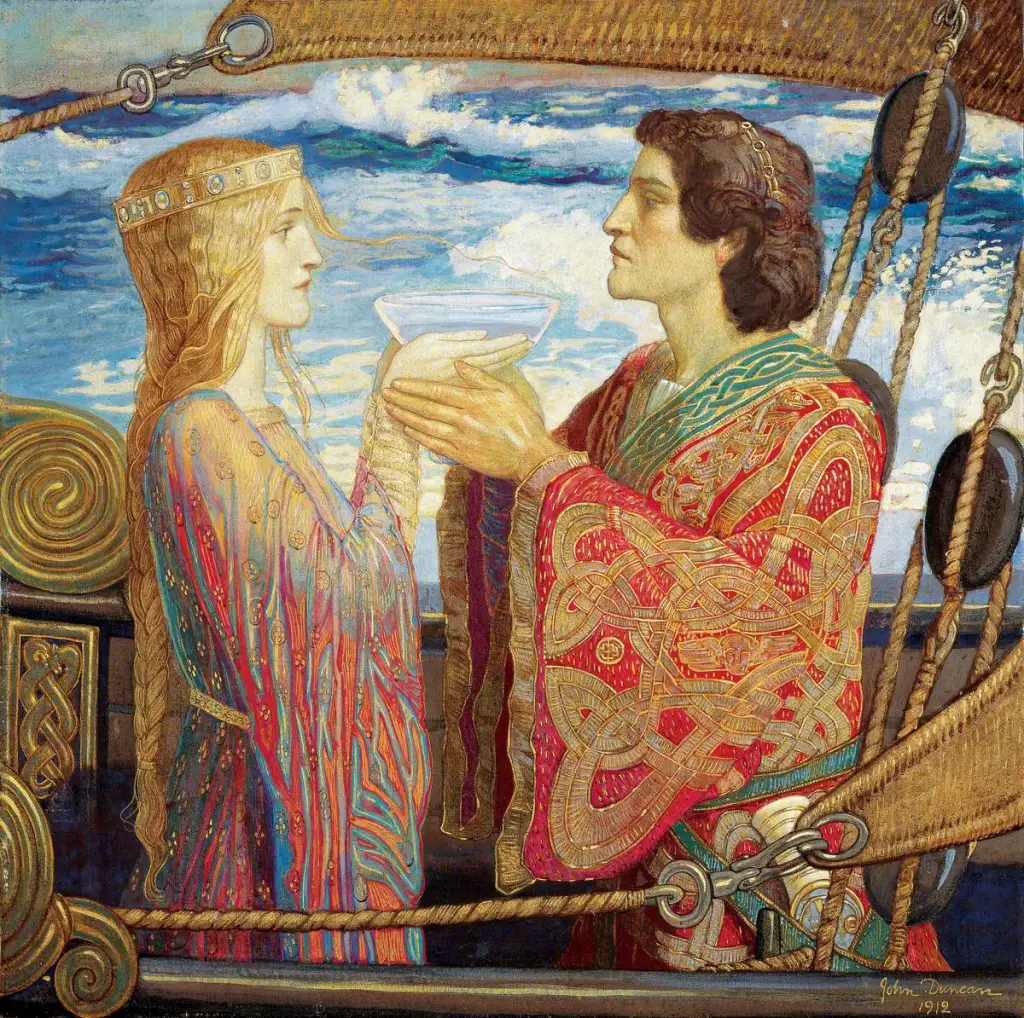
Welcome back to White Rose of Avalon, my Darlings. For this week’s Femme Fatale Friday blog post, I will be discussing Iseult and her nature as a Faery Queen and Healer! I have long been utterly fascinated, and honestly totally obsessed, with the legend of Tristan and Iseult. My obsession began in middle school and has never really abated.
The legend of Iseult and her Knightly lover, Tristan, piqued my hopelessly romantic interest because of just how many similarities and parallels there were to that of Guinvere and Lancelot. This makes perfect sense, as many believe that the two tales may have roots in the same ancient origin story that had been passed orally for generations (but we have no way to know this for certain, as that origin story has likely been lost to time). It is really a surprise to me that I did not become obsessed with this story earlier than the age of twelve or so, as I had been completely enchanted and obsessed with Arthurian legends, and especially stories of Guinevere, Lancelot, and Morgan le Fay, since I was a very young child.
This is the perfect lead-in to one interesting aspect of Iseult’s story. Firstly, Iseult was born as a Princess of Ireland, which gives her origins that connect her with the wider corpus of Celtic lore. Secondly, the story of Tristan and Iseult is one that is part of the Arthurian legends, while also existing as a folktale and legend on its own. In this way, Iseult stands as a legendary figure who spans multiple Celtic cultures. We see this with other Faery Queens as well, but Iseult’s story weaves in and out of various Celtic cultures quite seamlessly.
Iseult’s greatest claim to fame, outside of her famous and infamous love affair, is that she is an insanely gifted healer. I find it fascinating, as this is a trait that she shares with Morgan le Fay, rather than with Guinevere, helping to set the two Queens, famed for love affairs with Knights, apart (if only in this one way)! As I already mentioned, Iseult was a Princess of Ireland by birth, and Guinevere is often said to have been a Princess of Scotland by birth. This links them as both being outsiders coming to a new Court to be married off to a King; they are there to bless his reign, in hopes of providing an heir. However, in both cases, we can read between the lines and see that their origins in other Celtic lands can actually be referring to origins as Faery Queens of the Otherworld. Their respective marriages to the Kings to whom they are betrothed act as a way of not just blessing his reign with children, but acting as a blessing of the Otherworld and of the Land made Manifest!
Iseult’s nature of being a healer is also another sign of her Otherworldly origins, as the Fae and Faery Queens are often known to be gifted healers. She has an innate connection with the land and the seas, being able to use plants, herbs, flowers, and Sacred Waters to create healing balms and save lives! In some versions of her legend, that is how she first encountered Tristan, when she felt sympathy towards him and healed him of wounds inflicted during a battle between Ireland and his land of Cornwall. This shows her truly kind heart, as she was actively working to save a man who had fought against her country! It is also often stated that Iseult’s gift for healing was meant to save Tristan again at the end of their story, but he died before she could reach him to give him aid. Iseult’s connection with the magickal arts is also shown in versions of the legend when a love potion, given to her by her own mother, was the cause of her and Tristan’s romance. While I do not prefer this version, and it does not even appear in the earliest versions of the legend, it is a famous version and does show that Iseult had likely inherited her magickal abilities from her own mother!
The romance between Tristan and Iseult is one of the most beautiful in all of the Arthuriad. Unlike most versions of the Lancelot and Guinevere tale, Tristan and Iseult’s love affair always begins before the marriage between Iseult and King Marc takes place. Versions that blame a love potion for the affair were a way to make the adultery more palatable to later Christian audiences, as we are still meant to root for Tristan and Iseult as people, and those who wrote the story did not want to condone adultery. The love potion takes away the guilt or blame for the adultery, but it also takes away their Sovereignty and the Authenticity of their choice. With Tristan and Iseult, you have a love affair that begins prior to the marriage, and usually continues on until they are caught. This differs from Lancelot and Guinevere, who are often depicted as attempting not to give in to their feelings for one another, but eventually cannot resist their desires, leading to a long-lasting affair. Both stories have similar energy, with the Queen and her Knight continuing their affair for a long time, and the betrayal of the King’s favorite Knight. In fact, the betrayal in Tristan’s case is often worse, as he is usually said to be King Marc’s nephew and heir, as well as best Knight, making the betrayal sting worse!
I want to finish off this post by pointing out one last point of connection between Iseult and Guinevere. That is the story of Morgana’s Cursed Cup. There is a legend where Morgan le Fay cursed a Cup to make it spill whenever an unfaithful wife tried to sip from it. Of course, the Cup was supposed to be sent to the Court of Camelot to expose Lancelot and Guinevere. However, the cup was accidentally sent to the Court of Cornwall instead, where it was shown that all the Nobles and Royal women were unfaithful wives! I love the symmetry of this story, as an item meant to expose one Queen actually exposed the other. It is also very interesting that Morgan le Fay had accidentally exposed the adultery of a woman who shared her gifts of healing, and likely other magickal arts (although we have to read between the lines to see that). This story truly links Iseult, Guinevere, and Morgan le Fay, all together. It really shows just how important they are, as key feminine figures in the Arthurian legends!
I hope you have enjoyed this exploration of Iseult’s story. What is your favorite thing about Iseult? Let me know your thoughts in the comments below!
Note on Image: The image at the top of the post is John Duncan’s painting of Tristan and Isolde. I found the art on https://eclecticlight.co/2023/10/02/arthur-5-tristram-isode-and-the-potion/.
LINK TO AVALONIAN ROSE FAERY MYSTERIES PATREON: patreon.com/AvalonianRoseFaeryMysteries
Further Reading/Watching
- Le Morte d’Arthur by Sir Thomas Malory
- The Romance of Tristan and Iseult retold by J. Bedier, translated by Hilaire Belloc
- Tristan + Isolde (2006)
- https://youtu.be/dt_7KHCkifk?si=rSnCCT-Is8aBDM3B