
For today’s post I would like to look at the influence of the Romantic poet Samuel Taylor Coleridge on other writers! Christabel is a poem by Samuel Taylor Coleridge. This poem was in fact never fully finished, but was nevertheless is one of Coleridge’s masterpieces.
This poem was influential to later authors, such as Edgar Allan Poe and Joseph Sheridan Le Fanu. Poe’s poem The Sleeper and Le Fanu’s novella Carmilla both play on similar themes as Christabel. Themes of a woman being taken into the home of a father of another young woman her age when she is beset by tragedy. There are attacks, or fear of being attacked on the road in these works.
Coleridge chose a dark gothic romance theme for this poem. He was, of course, a Romantic poet. Samuel Taylor Coleridge was one of the older generation of Romantic poets, along with William Blake and William Wordsworth. Wordsworth and Coleridge worked together on their poetry, and published together! The first generation of Romantics were followed by the second generation of Romantics. This second generation included George Gordon (Lord Byron), Percy Bysshe Shelley, and John Keats.
Coleridge’s most popular poem is likely The Rime of the Ancient Mariner. This was his longest major poem, and showed many of the dark themes that would be used in Christabel. The Nightingale was another famous poem by Coleridge that would inspire other Romantics, especially Shelley and Keats. Shelley’s To a Skylark is seen as very similar as The Nightingale. Keats would write a poem Ode to a Nightingale, obviously taking cues from Coleridge. These “bird centric” poems show the Romantics preoccupation with the natural world.
The Romantics obviously inspired later Victorian writers, especially those working in the Gothic Romance genre. Poe was heavily influenced by the English Romantic poets, and this inspiration is seen very obviously seen in his story The Oval Portrait and his poem The Sleeper, which both take themes from Coleridge’s Christabel. Le Fanu took inspiration from Coleridge’s unfinished masterpiece, as well, when writing his vampire novella Carmilla. Carmilla is a beautiful and dark work about a young woman being enthralled by a seductive female vampire. This can be seen as one of the earliest lesbian tales, and an early example of vampire lesbians. The Romantic poets, just like Gothic Romance writers of the Victorian period, were obviously interested in female sexuality. This can be seen in their poems, and it is no surprise these poems would go on to inspire other writers to write about sexuality. Gothic Romance was the perfect genre to explore sexuality, since it utilized the supernatural, and therefore was not feared of these tales being taken as “real.” The earlier Romantics were perfect people to explore sexuality in their time since they were seen as rebelling against societal norms!
There is a reason these works are still widely read, and are still inspiring modern authors! These works were ahead of their times, and are strong indicators of the hidden lives and desires of their authors and readers.
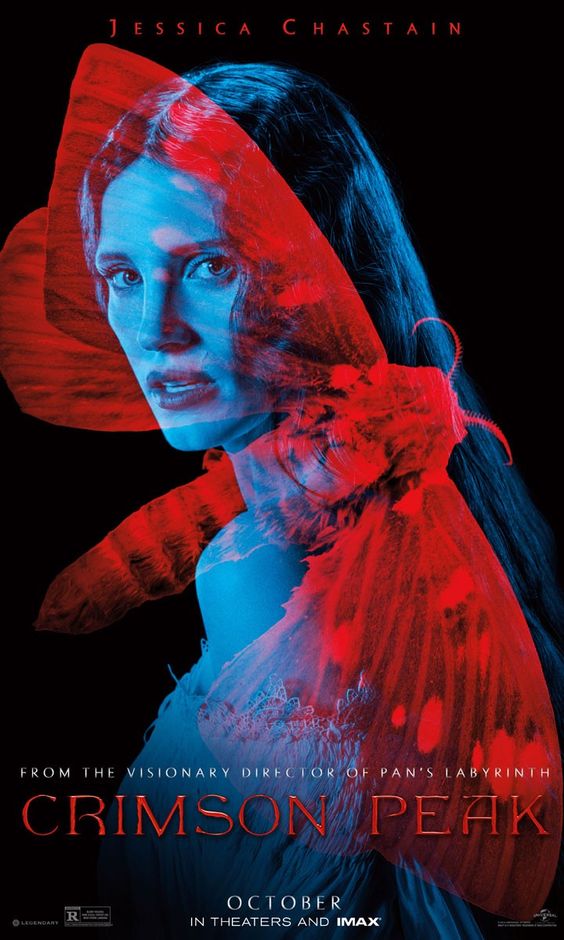
Modern writers and filmmakers are still utilizing the elements of the Romantics, and the Gothic Romances. A prime example is the film Crimson Peak (2015) by Guillermo del Toro. This film looks like a classic Gothic Romance novel brought to life, but it was not an adaption of any one novel. The inspiration was obvious, and some of the favorite tropes of the Romantics, and the Gothic Romance writers, were utilized. There is a young wife moving into her husband’s family home, there is the deep dark family secret that will be uncovered, and there is the feeling of otherness and ostracism. I will not ruin the plot for anyone interested in viewing this film, but needless to say it is a beautiful modern taken on the gothic!
I hope you have enjoyed my look at the ways in which the Romantics inspired on another, and the Victorians. Let me know your thoughts in the comments below!
Note on Image: The image at the top of the post is a poster for the film Crimson Peak. I found the image on pinterest.com via crimsonpeakmovie.tumblr.com
Further Reading/Watching
- Christabel by Samuel Taylor Coleridge
- The Oval Portrait by Edgar Allan Poe
- Carmilla by Joseph Sheridan Le Fanu
- The Rime of the Ancient Mariner by Samuel Taylor Coleridge
- The Nightingale by Samuel Taylor Coleridge
- To a Skylark by Percy Bysshe Shelley
- Ode to a Nightingale by John Keats
- Crimson Peak (2015)
2 responses to “Coleridge’s Gothic Influence”
Thanks for making the connection, which I was too blind to notice, between Rime, Christabel (which I really like) and Carmilla (which I adore) and the bird poems.
I’ve always enjoyed a bit of horror on the side and over the past couple of years have been plumbing the seductive dark heart of the Gothic, largely through a reawakened obsession with Goth and darkwave music. That in turn led me to ‘Dracula’ (thank you Bauhaus!) and thence to ‘Melmoth the Wanderer’, Florence Marryat’s ‘The Blood of the Vampire’, Polidori’s ‘The Vampyre’, Theophile Gautier’s ‘Clarimonde’ and Charles Baudelaire’s ‘Les Fleurs du Mal’, among others. As with the music, there’s this connection between English and Irish literature (Le Fanu and Stoker representing the latter, of course) and their counterparts in France, Germany and Italy.
Many people characterise the Gothic as dark = gloomy = negative. But I believe you’re absolutely right to emphasise that it’s a subset of Romanticism. Just as painters such as Caspar David Friedrich emphasised the ‘awful’ (ie ‘awe-inspiring’) grandeur of mountain scenery (used to effect in Shelley’s ‘Frankenstein’), the Gothic writers turned to the beauties and dangers of the natural world. Surely, one of the oldest horror themes is that of arrogant or foolish people interfering with some aspect of the natural or supernatural world – killing an albatross or disturbing a grave – and unleashing forces they can’t control.
I do wonder whether ‘The Rime of the Ancient Mariner’ influenced Bram Stoker’s portrayal of the voyage of the ‘Demeter’, which is such a striking feature of ‘Dracula’ – a voyage doomed from the start by its deadly supercargo rather than through any fault of the captain or crew. [Good grief: as I was writing this the postman knocked on my door and delivered a copy of ‘The Perilous Deep: A Supernatural History of the Atlantic’ complete with three pages on ‘Rime’ in a chapter titled ‘The Nautical Gothic’. A supernatural coincidence! And not the first…]
It fascinates me especially as I’ve belatedly been moved to attempt a first novel drawing on many of these elements and combining elements of them. It’s ostensibly an ‘inversion’ of ‘Dracula’, in which a fourth female vampire, who’d escaped Van Helsing’s staking party, comes to England – by stowing away on a container ship, naturally – to take her revenge on the descendants of the original protagonists. Music is integrated into the story. One of the characters is a bass guitarist in a goth band, Alraune (named after Hanns-Heinz Ewers’ story).
‘Daciana’s Revenge’ also incorporates many localities in my home county of Surrey and aspects of Surrey history and legends. Daciana herself sets up home in a house featured in a Conan Doyle tale, Wisteria Lodge, where she lives with a panther (long dismissed as a myth, we now know there really was one living wild in the county 30 years ago) called Carmilla. Stoker and Doyle were both briefly members of an occult group called the Hermetic Order of the Golden Dawn (as was Aleister Crowley); it was run by a relative of Lewis Carroll’s real-life Alice (Liddell). Bats, a banshee, two witches and that staple of English folklore, the Black Dog (which I’ve encountered myself), all make an appearance. They are all seen as playing a part in a balanced supernatural ecosystem. The only exception is the dragon, the embodiment of evil, whose natural enemy is the panther (Hana Videen’s ‘The Deorhord’ is the go-to reference on this).
Whereas Stoker portrayed Count Dracula as wholly evil, my Daciana represents the natural world fighting back against greed, arrogance and technocracy.* As a vampire academic wrote (I’m paraphrasing), each age gets the vampire it desires or needs! (* Of course, vampires being the liminal creatures they are, there’s a fair amount of ambiguity – you can’t take everything Daciana says at face value, especially as her face is hidden by a veil most of the time!)
So thanks for sparking off yet more ideas with your piece, which I greatly enjoyed.
Wow! I am so glad that my post made such an impact. The Gothic and the Romantics have long been fascinating to me, hence the post (and many others on this blog) focusing on the subject. Good luck with your book, it’s sounds fascinating, and I’m always up for more Dracula retellings and Dracula-inspired works! Thanks so much for reading and commenting!